Crayonbird
Menu

Maths · Ages 5–6 · 45 minutes

Number bonds to 10

Children find and recall the pairs of whole numbers that make 10 and use a ten frame to explain how they know.

Success criteria

  • I can make 10 on a ten frame
  • I can find the missing part
  • I can say a bond to 10 quickly

Key vocabulary

  • number bond
  • part
  • whole
  • make
  • ten frame
  • missing

You will need

  • ten frames
  • two-colour counters
  • part-whole mats
  • mini whiteboards
  • a bag of 10 cubes
  • Year 1· England
  • Kindergarten· United States
  • Primary 1· Nigeria
  • Class 1· India

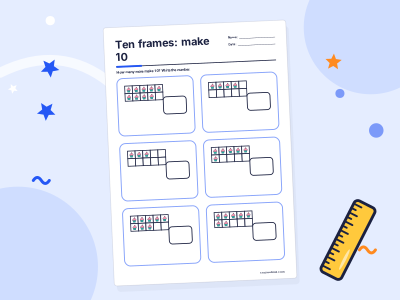
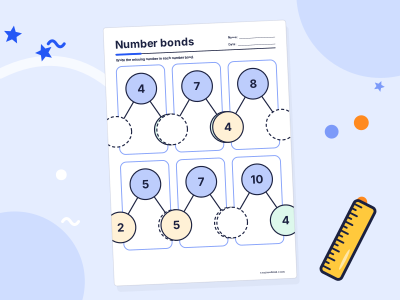
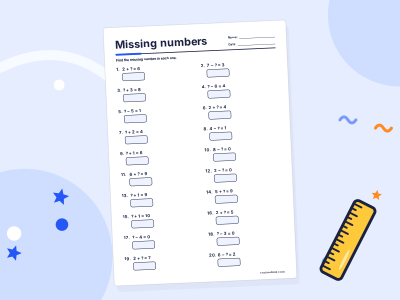
Practice sheets

Generated fresh each time you press a button, and marked instantly on screen.

The lesson at a glance

45 minutes in all. Timings are a guide: follow your class.

  1. Step 1: Starter

    Hold up ten fingers. Fold down three.
    7 minutes
  2. Step 2: Teach

    Show a ten frame with 6 red counters.
    12 minutes
  3. Step 3: Guided practice

    In pairs, children have a ten frame and two-colour counters.
    10 minutes
  4. Step 4: Independent practice

    Use the practice buttons above.
    12 minutes
  5. Step 5: Plenary

    Quick-fire: say a number, children show its partner to 10 on fingers.
    4 minutes
  6. Step 6: Assessment for learning

    Look for children who: recall a bond without counting (instant answers to "8 and..." are a good sign); count the empty spaces one by one (secure, but not yet fluent); use the full row of five ("five a
  7. Step 7: Differentiation

    Keep a ten frame on the table for any child who needs it during the sheet.
  8. Step 8: Common misconceptions

    Counting all ten spaces to find the gap.
  9. Step 9: Home link

    At home, put 10 small toys under a tea towel, take some out, and ask your child how many are still hiding.

1.Starter

7 minutes

Hold up ten fingers. Fold down three. "How many are still up? How many are down? So 7 and 3 make..." Children chant "10". Repeat with other numbers of fingers down, getting quicker.

Then play "Hide the cubes": put 10 cubes in a bag, pull out 6. "I had 10. Six are out. How many are hiding?" Children show the answer with fingers, then you tip out the bag to check.

2.Teach

12 minutes

Show a ten frame with 6 red counters.

"A ten frame has ten spaces, five on top and five underneath. I've got 6 red counters. How many empty spaces? I don't need to count all of them. The top row is full, so that's 5, and one more is 6. Four spaces left on the bottom row."

Fill the gaps with 4 yellow counters. "Six red and four yellow. 6 and 4 make 10. That's a number bond to 10."

Draw a part-whole model next to it: the whole (10) in the top circle, the parts (6 and 4) underneath.

Step by step

  1. Look at the frameHow many counters are already there?
  2. Look at the gapsThe empty spaces are the missing part.
  3. Say the bond"6 and 4 make 10" and "4 and 6 make 10" are the same bond turned round.

Now build the list together, moving one counter at a time: 10 and 0, 9 and 1, 8 and 2... down to 0 and 10. "What do you notice? When one part goes down by one, the other goes up by one."


The rest of the plan

Guided and independent practice, the plenary, assessment for learning, differentiation, common misconceptions and the home link are free with a Crayonbird account.

  1. Guided practice10 minutes
  2. Independent practice12 minutes
  3. Plenary4 minutes
  4. Assessment for learning
  5. Differentiation
  6. Common misconceptions
  7. Home link

Learning Wiki

Number bonds

Number bonds are pairs of numbers that add up to a given total, like 3 and 7 making 10. Knowing them by heart makes adding and subtracting much faster.

Addition

Addition is putting amounts together to find a total. The sign is +, and the answer is called the sum or total, so 4 + 3 = 7.

Counting

Counting means saying one number for each thing in a group, in order, to find out how many there are. The last number you say is the total.

  • Maths · Ages 6–7 · 50 min

    Adding within 20 on a number line

    Children add two numbers within 20 by counting on along a number line, starting from the larger number.

  • Maths · Ages 5–6 · 45 min

    2D shapes and their properties

    Children name common 2D shapes and describe them by counting their sides and corners, whatever their size, colour or which way round they are.