Maths
What are number bonds?
Quick answer
Number bonds are pairs of numbers that add up to a given total, like 3 and 7 making 10. Knowing them by heart makes adding and subtracting much faster.
In one sentence
Number bonds are pairs of numbers that join together to make a total, such as 6 and 4 making 10.
Explained
A number can be split into two parts in different ways. Ten can be 9 and 1, 8 and 2, 7 and 3, 6 and 4, or 5 and 5 (plus 10 and 0). Those pairs are the number bonds to 10. Children often learn them with a "part-whole" picture: a big circle for the whole, joined to two smaller circles for the parts.
 star
star- star
- star
- star
- star
 ball
ball- ball
- ball
Why bother learning them by heart? Because so much maths leans on them. To work out 8 + 5, you can borrow 2 from the 5 to make 10, then add the 3 left over: 13. To work out 100 − 37, you think "37 and what makes 100?" Bonds to 10 also give bonds to 100 for multiples of ten: 3 + 7 = 10, so 30 + 70 = 100.
Each bond is really a small family of four facts. From 6 and 4 you get 6 + 4 = 10, 4 + 6 = 10, 10 − 6 = 4 and 10 − 4 = 6. That makes bonds just as useful for subtraction as for addition.
Examples
| Total | Some bonds |
|---|---|
| 5 | 0 + 5, 1 + 4, 2 + 3 |
| 10 | 1 + 9, 2 + 8, 3 + 7, 4 + 6, 5 + 5 |
| 20 | 12 + 8, 15 + 5, 17 + 3 |
| 100 | 60 + 40, 25 + 75, 35 + 65 |
Worked example: 9 + 6. Take 1 from the 6 to turn 9 into 10. Now it is 10 + 5 = 15.
Common mistakes
- Forgetting zero. 10 and 0 is a bond to 10 as well. It matters later in subtraction.
- Making 110 instead of 100. Asked for the partner of 45, many children say 65, because 4 + 6 = 10 and 5 + 5 = 10. But 45 + 65 = 110. Fix: the ones already make 10, so the tens only need to make 90. The answer is 55.
- Counting on fingers every time. That is fine at first, but aim for quick recall through short, regular games.
Quick quiz
Number bonds
Check what you know with 4 quick questions.
Question 1 of 4
Which pair is a number bond to 10?
Practise it
Try it
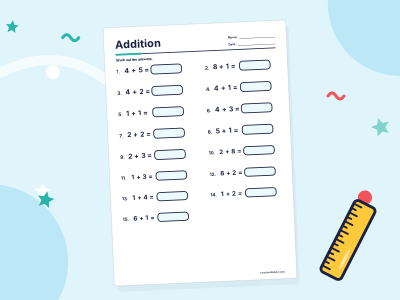
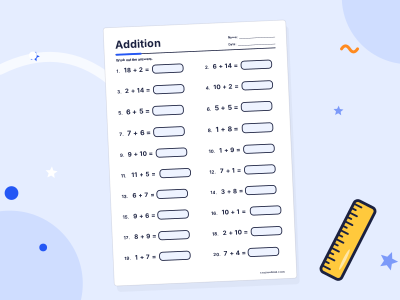
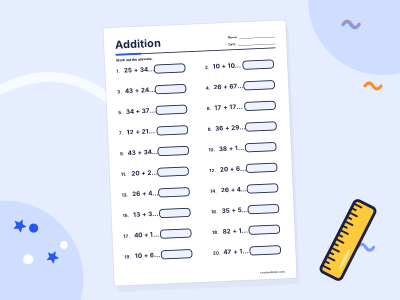
Number bond and addition practice
For grown-ups
Related topics
Addition
Addition is putting amounts together to find a total. The sign is +, and the answer is called the sum or total, so 4 + 3 = 7.
Subtraction
Subtraction is taking one amount away from another, or finding the difference between two numbers. The sign is −, so 9 − 4 = 5.
Counting
Counting means saying one number for each thing in a group, in order, to find out how many there are. The last number you say is the total.
Place value
Place value means a digit's value depends on its position in a number. In 352, the 3 is worth 300, the 5 is worth 50 and the 2 is worth 2.
2D shapes
2D shapes are flat shapes with length and width but no thickness, like circles, triangles, squares and hexagons. You can draw them on paper.
3D shapes
3D shapes are solid shapes with length, width and height, like cubes, spheres, cylinders and pyramids. They have faces, edges and vertices.