Maths
What is subtraction?
Quick answer
Subtraction is taking one amount away from another, or finding the difference between two numbers. The sign is −, so 9 − 4 = 5.
In one sentence
Subtraction means taking some away to see how many are left, or comparing two numbers to see how far apart they are.
Explained
There are two ways to picture subtraction, and both give the same answer.
Taking away. You have 9 balloons and 4 float off. How many are left? 9 − 4 = 5. We say "nine minus four" or "nine take away four".
 balloon
- balloon
- balloon
- balloon
- balloon
Finding the difference. Ana is 12 and her brother is 7. How much older is she? You are comparing, not taking anything away. Count up from 7 to 12: that is 5. On a number line, the difference is the gap between the two numbers.
Subtraction is the opposite (the inverse) of addition. If 5 + 4 = 9, then 9 − 4 = 5 and 9 − 5 = 4. That means you can always check a subtraction by adding.
Unlike addition, order matters. 9 − 4 is 5, but 4 − 9 is a different answer altogether: −5, a negative number.
For larger numbers, use columns. Start with the ones. If the top digit is too small, exchange one ten for ten ones (also called borrowing or, in the US, regrouping).
Examples
- 10 − 3 = 7 (a number bond fact)
- 43 − 20 = 23 (just take 2 tens)
- 61 − 58: the numbers are close, so count up: 58 to 60 is 2, 60 to 61 is 1. Answer 3.
- 52 − 27 in columns: exchange a ten, so the ones become 12 − 7 = 5 and the tens 4 − 2 = 2. Answer 25.
- 400 − 136: exchange across two zeros, or count up from 136: 4 to 140, 60 to 200, 200 to 400. 4 + 60 + 200 = 264.
Common mistakes
- Taking the smaller digit from the bigger one in each column, so 52 − 27 becomes 35. Fix: always subtract the bottom digit from the top digit, exchanging when needed.
- Starting the count at the wrong number. For 12 − 7 by counting back, say "eleven" for the first step, not "twelve".
- Getting stuck with zeros, as in 300 − 128. Fix: count up instead, or exchange in two stages.
Quick quiz
Subtraction
Check what you know with 4 quick questions.
Question 1 of 4
What is 15 − 8?
Practise it
Try it
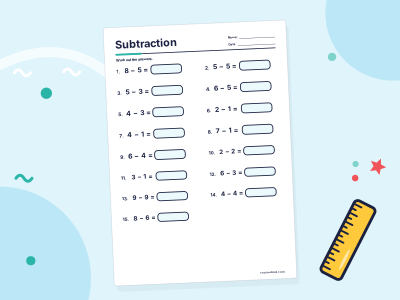
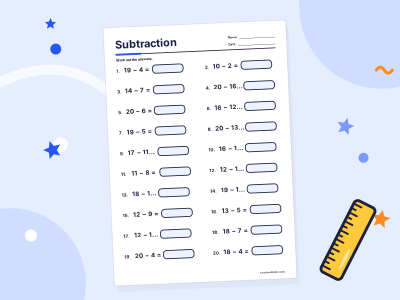
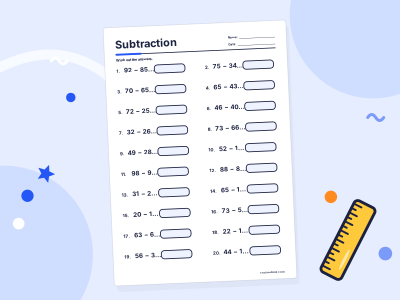
Subtraction worksheets
For grown-ups
Related topics
Addition
Addition is putting amounts together to find a total. The sign is +, and the answer is called the sum or total, so 4 + 3 = 7.
Number bonds
Number bonds are pairs of numbers that add up to a given total, like 3 and 7 making 10. Knowing them by heart makes adding and subtracting much faster.
Negative numbers
Negative numbers are numbers less than zero, written with a minus sign, like −3. You meet them in cold temperatures, bank overdrafts and floors below ground.
Number line
A number line is a straight line with numbers marked at equal steps, smallest on the left and biggest on the right. It helps you count, compare, add and subtract.
Money
Money maths means counting coins and notes, adding up prices and working out change. Most currencies split one unit into 100 smaller ones, like 100 pence in a pound.
Equations
An equation says two things are equal, using an = sign, like 2x + 1 = 9. Solving it means finding the value of the letter that makes it true, here x = 4.