Maths
How does money maths work?
Quick answer
Money maths means counting coins and notes, adding up prices and working out change. Most currencies split one unit into 100 smaller ones, like 100 pence in a pound.
In one sentence
Money maths is using numbers to count, spend, save and give change.
Explained
Most currencies work the same way. One big unit is split into 100 smaller units:
| Currency | Big unit | Small unit |
|---|---|---|
| UK | pound (£) | penny (p) |
| US, Canada, Australia | dollar ($) | cent (¢) |
| Eurozone | euro (€) | cent |
| Nigeria | naira (₦) | kobo |
| India | rupee (₹) | paisa |
So £1 = 100p and $1 = 100¢. That's why prices are written with two decimal places: £4.75 means 4 pounds and 75 pence. Money is the most common place children meet decimals.
 shop
shop basket
 bag
bag
Counting coins. Start with the biggest coin and count on. For a 50p, a 20p, two 10p coins and a 2p: "50, 70, 80, 90, 92." That's 92p.
Adding prices. Line up the decimal points, or add pounds and pence separately. £2.45 + £1.30: pounds 2 + 1 = 3, pence 45 + 30 = 75, so £3.75. If the pence go over 100, swap 100p for £1.
Giving change. Shopkeepers count up from the price to the amount paid, which is easier than subtracting. A drink costs £1.35 and you pay £2. Count up: £1.35 → £1.40 (5p) → £1.50 (10p) → £2 (50p). Change: 65p.
Don't mix units. Never write £1.50p. Use either £1.50 or 150p, not both signs.
Older children use money for percentages too: a 20% discount, interest on savings, or comparing which pack is better value by finding the price of one item.
Examples
- 3 × 20p + 2 × 5p = 60p + 10p = 70p
- 125p = £1.25
- $10 − $6.49 = $3.51
- Best buy: 4 apples for £1.20 (30p each) beats 6 for £2.10 (35p each).
- ₦500 shared equally by 4 friends is ₦125 each.
Common mistakes
- Writing £3.5 for three pounds fifty. It is £3.50, with two digits for the pence.
- Thinking more coins means more money. Five 1p coins are worth less than one 10p coin.
- Mixing up £0.05 and £0.50. 5p and 50p are very different amounts.
Quick quiz
Money
Check what you know with 5 quick questions.
Question 1 of 5
How many pence are in £1?
Practise it
Try it
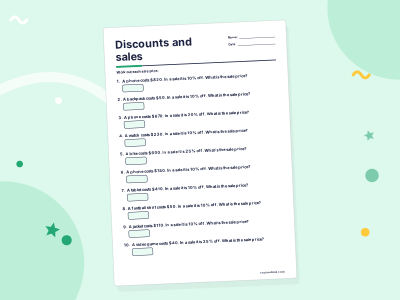
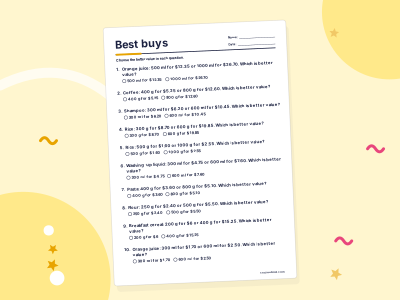
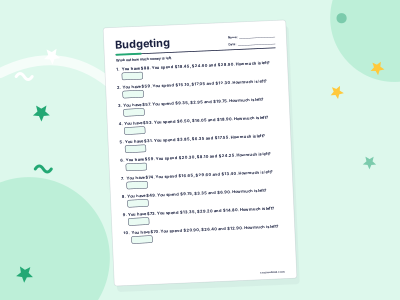
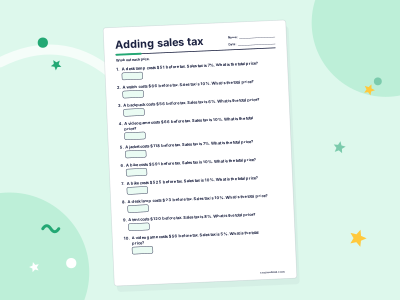
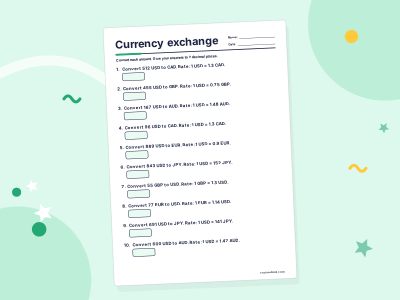
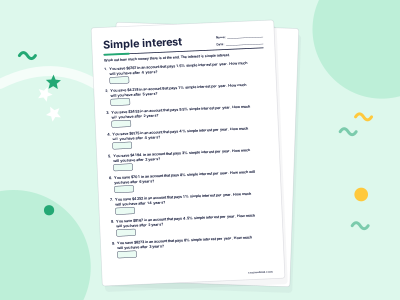
Money maths worksheets
For grown-ups
Related topics
Decimals
Decimals are numbers with a decimal point. Digits after the point show tenths, hundredths and so on, so 2.5 means two and five tenths.
Addition
Addition is putting amounts together to find a total. The sign is +, and the answer is called the sum or total, so 4 + 3 = 7.
Subtraction
Subtraction is taking one amount away from another, or finding the difference between two numbers. The sign is −, so 9 − 4 = 5.
Percentages
A percentage is a number out of 100, written with the sign %. So 25% means 25 out of every 100, which is the same as one quarter.
2D shapes
2D shapes are flat shapes with length and width but no thickness, like circles, triangles, squares and hexagons. You can draw them on paper.
3D shapes
3D shapes are solid shapes with length, width and height, like cubes, spheres, cylinders and pyramids. They have faces, edges and vertices.