Maths
What is a percentage?
Quick answer
A percentage is a number out of 100, written with the sign %. So 25% means 25 out of every 100, which is the same as one quarter.
In one sentence
A percentage tells you how many out of 100, so 40% means 40 out of every 100.
Explained
Per cent comes from Latin and means "for each hundred". The sign % stands for "out of 100". If 100 children take a spelling test and 62 get full marks, 62% got full marks.
 shop
shop bag
bag
Percentages are useful because they let you compare things fairly. Scoring 18 out of 20 and 42 out of 50 is hard to compare. As percentages, they are 90% and 84%, so the first score is better.
A few percentages are worth knowing by heart, because they match simple fractions and decimals:
| Percentage | Fraction | Decimal |
|---|---|---|
| 100% | 1 whole | 1 |
| 50% | ½ | 0.5 |
| 25% | ¼ | 0.25 |
| 10% | 1/10 | 0.1 |
| 1% | 1/100 | 0.01 |
To find a percentage of an amount in your head, start from 10% (divide by 10) and build up. For 35% of 80: 10% is 8, so 30% is 24, and 5% is half of 8, which is 4. Total: 28.
With a calculator, change the percentage to a decimal and multiply: 35% of 80 = 0.35 × 80 = 28.
To turn a score into a percentage, divide and multiply by 100. 17 out of 25 is 17 ÷ 25 = 0.68, which is 68%.
Examples
- 25% of 36 = ¼ of 36 = 9
- 1% of 300 = 3, so 7% of 300 = 21
- 20% off a $45 game: 10% is $4.50, 20% is $9, so it costs $36
- 12 out of 40 = 12 ÷ 40 = 0.3 = 30%
- 150% of 20 = 30 (percentages can go over 100)
Common mistakes
- Thinking 5% is a fifth. A fifth is 20%. 5% is one twentieth.
- Taking a percentage of the wrong amount after a change. A 10% rise followed by a 10% fall does not get you back to where you started.
- Moving the decimal point the wrong way: 8% is 0.08, not 0.8.
Quick quiz
Percentages
Check what you know with 5 quick questions.
Question 1 of 5
What is 50% of 60?
Practise it
Try it
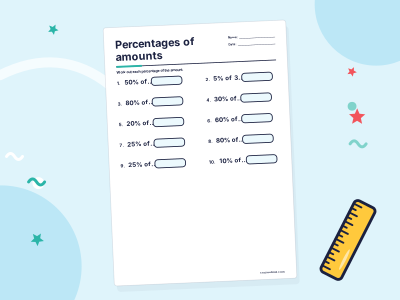
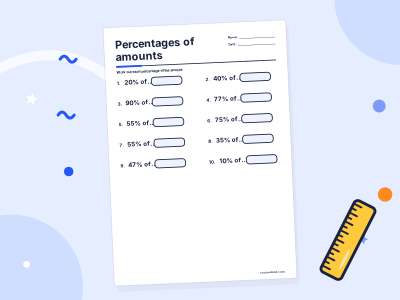
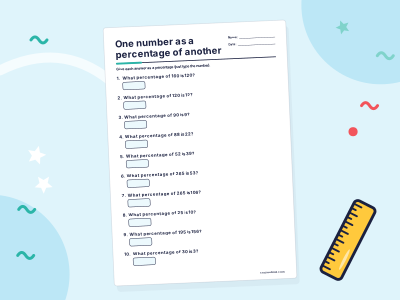
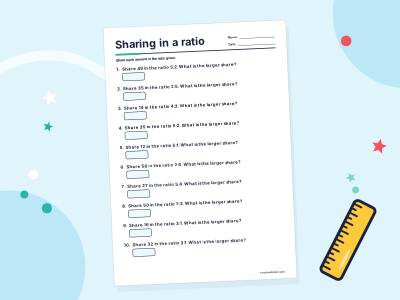
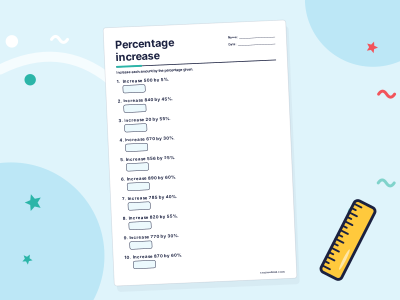
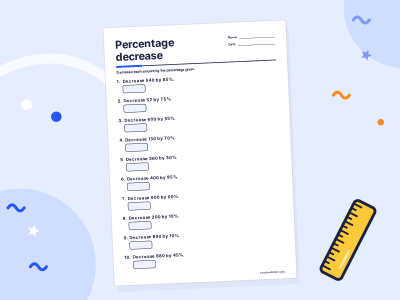
Percentage practice
For grown-ups
Related topics
Fractions
A fraction is part of a whole that has been split into equal parts. In ¾, the bottom number says how many equal parts and the top says how many you have.
Decimals
Decimals are numbers with a decimal point. Digits after the point show tenths, hundredths and so on, so 2.5 means two and five tenths.
Ratio
A ratio compares two or more amounts, written with a colon. A ratio of 2:3 means for every 2 of one thing there are 3 of the other.
Equivalent fractions
Equivalent fractions look different but are the same size, like 1/2, 2/4 and 4/8. You make them by multiplying or dividing the top and bottom by the same number.
Money
Money maths means counting coins and notes, adding up prices and working out change. Most currencies split one unit into 100 smaller ones, like 100 pence in a pound.
Probability
Probability measures how likely something is to happen, on a scale from 0 (impossible) to 1 (certain). A fair coin landing heads has a probability of 1/2.