Maths
What are equivalent fractions?
Quick answer
Equivalent fractions look different but are the same size, like 1/2, 2/4 and 4/8. You make them by multiplying or dividing the top and bottom by the same number.
In one sentence
Equivalent fractions are different ways of writing the same amount, such as one half and two quarters.
Explained
Cut a watermelon in half and eat one piece: you have eaten ½. Now imagine it had been cut into 4 equal slices and you ate 2. You have eaten exactly the same amount of melon, so ½ = 2/4. Cut it into 8 and eat 4: still the same, so 4/8 is equal too.
 watermelon
- watermelon
 pizza
pizza
The rule is short: whatever you do to the bottom, do to the top. Multiply (or divide) the numerator and denominator by the same number and the fraction keeps its size.
- ½ → multiply both by 3 → 3/6
- ⅖ → multiply both by 4 → 8/20
Why does it work? Multiplying top and bottom by 3 means you cut every piece into 3 smaller pieces. You have 3 times as many pieces, but each one is a third of the size, so the amount stays the same.
Going the other way is called simplifying (or cancelling, or in the US reducing). Divide top and bottom by a number that goes into both. For 15/20, both divide by 5, giving ¾. A fraction is in its simplest form when nothing except 1 divides into both numbers. Dividing by the highest common factor gets you there in one step (see factors and multiples).
Equivalent fractions are the key to comparing and adding fractions. To compare ⅔ and ¾, rewrite them with the same bottom: 8/12 and 9/12. Now it is clear that ¾ is bigger.
Examples
| Start | Change | Equivalent |
|---|---|---|
| ¼ | × 2 | 2/8 |
| ⅗ | × 5 | 15/25 |
| 6/8 | ÷ 2 | ¾ |
| 10/15 | ÷ 5 | ⅔ |
| 1/5 | × 20 | 20/100 (= 0.2 = 20%) |
Worked example: ⅓ + ¼. Both 3 and 4 go into 12, so ⅓ = 4/12 and ¼ = 3/12. Then 4/12 + 3/12 = 7/12.
Common mistakes
- Changing only the bottom number, so ½ becomes 1/4. Fix: say the rule aloud: "same to top and bottom".
- Adding instead of multiplying, so ⅔ turns into 3/4 by adding 1 to each. That changes the size. Fix: only multiply or divide.
- Stopping too early when simplifying, leaving 6/9. Fix: check again. Both divide by 3, so ⅔.
Quick quiz
Equivalent fractions
Check what you know with 4 quick questions.
Question 1 of 4
Which fraction is equivalent to 1/3?
Practise it
Try it
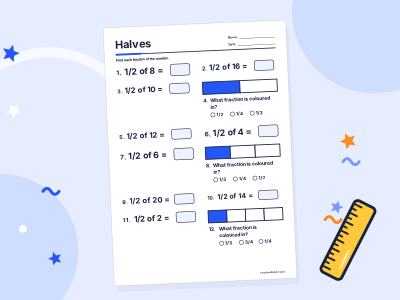
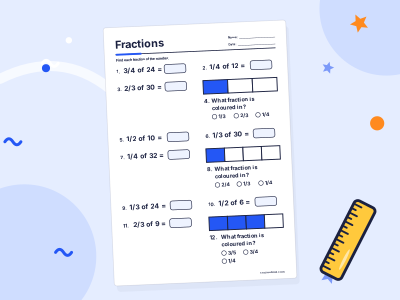
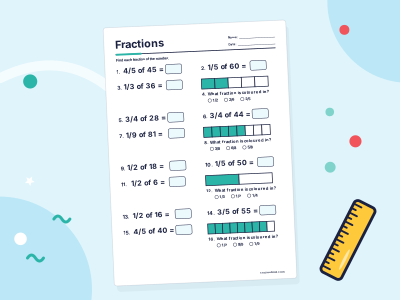
Equivalent fraction practice
For grown-ups
Related topics
Fractions
A fraction is part of a whole that has been split into equal parts. In ¾, the bottom number says how many equal parts and the top says how many you have.
Decimals
Decimals are numbers with a decimal point. Digits after the point show tenths, hundredths and so on, so 2.5 means two and five tenths.
Percentages
A percentage is a number out of 100, written with the sign %. So 25% means 25 out of every 100, which is the same as one quarter.
Factors and multiples
Factors are numbers that divide exactly into a number (the factors of 12 are 1, 2, 3, 4, 6 and 12). Multiples are the numbers in its times table (12, 24, 36…).
2D shapes
2D shapes are flat shapes with length and width but no thickness, like circles, triangles, squares and hexagons. You can draw them on paper.
3D shapes
3D shapes are solid shapes with length, width and height, like cubes, spheres, cylinders and pyramids. They have faces, edges and vertices.