Maths
What are factors and multiples?
Quick answer
Factors are numbers that divide exactly into a number (the factors of 12 are 1, 2, 3, 4, 6 and 12). Multiples are the numbers in its times table (12, 24, 36…).
In one sentence
A factor goes into a number exactly; a multiple is what you get when you multiply a number by 1, 2, 3 and so on.
Explained
Factors and multiples are two sides of the same fact. Since 3 × 4 = 12:
- 3 and 4 are factors of 12 (they divide into 12 with no remainder).
- 12 is a multiple of 3, and a multiple of 4.
A memory trick: factors are few, multiples are many. 12 has only six factors (1, 2, 3, 4, 6, 12), but its multiples go on forever (12, 24, 36, 48…).
 cupcake
- cupcake
- cupcake
- cupcake
- cupcake
- cupcake
To find all the factors of a number, work in factor pairs, starting from 1. For 36: 1 × 36, 2 × 18, 3 × 12, 4 × 9, 6 × 6. Once the pairs meet in the middle, you have them all: 1, 2, 3, 4, 6, 9, 12, 18 and 36. A number with exactly two factors is a prime number.
Common factors and multiples answer real puzzles.
- You have 18 apples and 24 pears and want identical fruit bags with nothing left over. The most bags you can make is the highest common factor, 6. Each bag gets 3 apples and 4 pears.
- A bus comes every 4 minutes and a tram every 6. If they both leave now, they leave together again after the lowest common multiple, 12 minutes.
Examples
| Number | Factors | First multiples |
|---|---|---|
| 10 | 1, 2, 5, 10 | 10, 20, 30, 40 |
| 15 | 1, 3, 5, 15 | 15, 30, 45, 60 |
| 16 | 1, 2, 4, 8, 16 | 16, 32, 48, 64 |
| 20 | 1, 2, 4, 5, 10, 20 | 20, 40, 60, 80 |
HCF of 15 and 20 is 5. LCM of 15 and 20 is 60.
Common mistakes
- Swapping the words. "Is 30 a factor of 5?" is backwards. 5 is a factor of 30; 30 is a multiple of 5.
- Forgetting 1 and the number itself in the factor list.
- Multiplying to find the LCM. 4 × 6 = 24 is a common multiple, but the lowest is 12. Fix: list multiples until they meet.
Quick quiz
Factors and multiples
Check what you know with 4 quick questions.
Question 1 of 4
Which number is a factor of 24?
Practise it
Try it
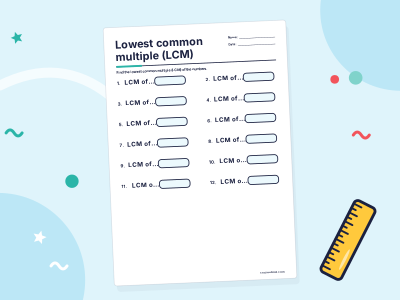
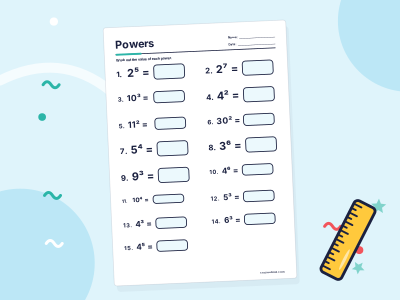
Factors, primes and powers practice

For grown-ups
Related topics
Prime numbers
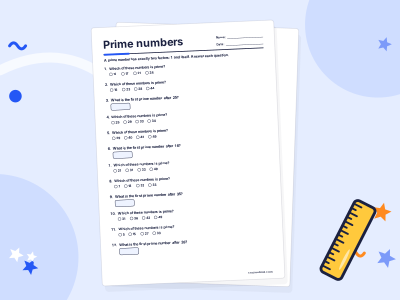
A prime number is a whole number greater than 1 that has exactly two factors, 1 and itself. The first primes are 2, 3, 5, 7, 11 and 13.
Times tables
Times tables are lists of the multiplication facts for a number, such as 3 × 1 = 3 up to 3 × 12 = 36. Knowing them by heart speeds up almost all later maths.
Multiplication
Multiplication is adding equal groups quickly. 4 × 3 means 4 groups of 3 (or 3 groups of 4), which makes 12. The answer is called the product.
Division
Division is sharing into equal groups, or finding how many groups fit. The sign is ÷, so 12 ÷ 3 = 4. The answer is called the quotient.
Equivalent fractions
Equivalent fractions look different but are the same size, like 1/2, 2/4 and 4/8. You make them by multiplying or dividing the top and bottom by the same number.
Square numbers
A square number is what you get when you multiply a whole number by itself, like 4 × 4 = 16. The first square numbers are 1, 4, 9, 16, 25 and 36.