Maths
What are times tables?
Quick answer
Times tables are lists of the multiplication facts for a number, such as 3 × 1 = 3 up to 3 × 12 = 36. Knowing them by heart speeds up almost all later maths.
In one sentence
A times table is the list of answers you get when you multiply one number by 1, 2, 3 and so on, usually up to 12.
Explained
The 5 times table goes 5, 10, 15, 20, 25… because each step adds another 5. Written out in full it is 1 × 5 = 5, 2 × 5 = 10, all the way to 12 × 5 = 60. In the US the same facts are often called multiplication facts.
Learning every table from 1 to 12 sounds like 144 facts, but it is far fewer than that. Because 3 × 7 is the same as 7 × 3 (multiplication works in either order), each fact counts twice. Take away the easy 1, 2, 5 and 10 tables and only a few dozen tricky facts are left.
 clock
clock- clock
- clock
Patterns help a lot:
- 2s are the even numbers. 10s end in 0. 5s end in 0 or 5.
- 4s are double the 2s, and 8s are double the 4s.
- 9s: the tens digit goes up by 1 while the ones digit goes down by 1 (09, 18, 27, 36…), and the digits add up to 9.
- 11s up to 9 × 11 are just repeated digits: 33, 44, 55.
- 6s are double the 3s.
Times tables make division quick too: if 7 × 6 = 42, then 42 ÷ 6 = 7.
Examples
| Fact | A way to work it out |
|---|---|
| 6 × 7 = 42 | 5 × 7 = 35, plus one more 7 |
| 8 × 4 = 32 | double, double, double: 4, 8, 16, 32 |
| 9 × 6 = 54 | 10 × 6 = 60, take away 6 |
| 12 × 7 = 84 | 10 × 7 = 70, plus 2 × 7 = 14 |
| 11 × 12 = 132 | 10 × 12 = 120, plus 12 |
Common mistakes
- Chanting from the start every time to reach 7 × 8. Fix: practise facts out of order, so each one can be recalled alone.
- Muddling neighbouring facts like 6 × 8 = 48 and 7 × 8 = 56. Fix: link tricky facts to a known one ("7 × 8 is one more 8 than 6 × 8").
- Learning the words without the meaning. Use arrays or groups now and then so 4 × 6 still means "four sixes".
Quick quiz
Times tables
Check what you know with 4 quick questions.
Question 1 of 4
What is 7 × 8?
Practise it
Try it
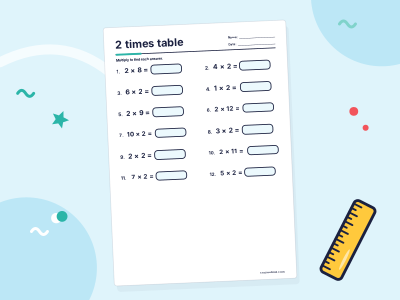
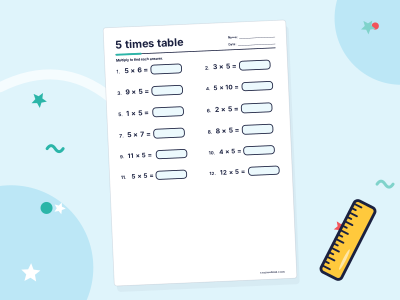
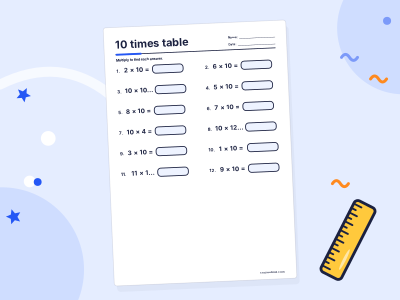
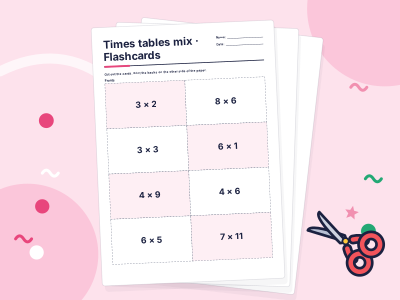
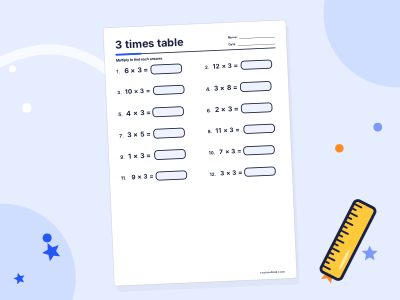
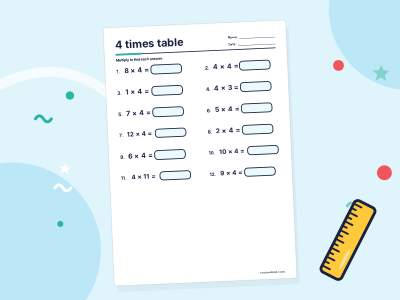
Times tables practice sheets
For grown-ups
Related topics
Multiplication
Multiplication is adding equal groups quickly. 4 × 3 means 4 groups of 3 (or 3 groups of 4), which makes 12. The answer is called the product.
Division
Division is sharing into equal groups, or finding how many groups fit. The sign is ÷, so 12 ÷ 3 = 4. The answer is called the quotient.
Factors and multiples
Factors are numbers that divide exactly into a number (the factors of 12 are 1, 2, 3, 4, 6 and 12). Multiples are the numbers in its times table (12, 24, 36…).
Square numbers
A square number is what you get when you multiply a whole number by itself, like 4 × 4 = 16. The first square numbers are 1, 4, 9, 16, 25 and 36.
Odd and even numbers
Even numbers can be split into two equal groups or pairs with none left over (2, 4, 6…). Odd numbers always leave one left over (1, 3, 5…).
Sequences
A sequence is a list of numbers or shapes that follows a rule, like 3, 7, 11, 15 (add 4 each time). Each item is called a term.