Maths
What is multiplication?
Quick answer
Multiplication is adding equal groups quickly. 4 × 3 means 4 groups of 3 (or 3 groups of 4), which makes 12. The answer is called the product.
In one sentence
Multiplication is a quick way of adding the same number again and again.
Explained
Imagine 4 egg boxes with 3 eggs in each. You could add 3 + 3 + 3 + 3, or you could say "4 lots of 3" and write 4 × 3 = 12. The × sign is read as "times" or "multiplied by". The answer is called the product.
 egg
egg- egg
- egg
- egg
- egg
- egg
Arranging things in rows and columns, called an array, shows something useful: 2 rows of 3 is the same as 3 columns of 2. So 2 × 3 = 3 × 2. You can multiply in either order, which halves the number of facts to learn in your times tables.
Multiplying by 10 is special. Each digit moves one place to the left: 7 × 10 = 70 and 45 × 10 = 450. Multiplying by 1 changes nothing, and anything multiplied by 0 is 0 (no groups means nothing).
To multiply bigger numbers, split them up. For 23 × 4, do 20 × 4 = 80 and 3 × 4 = 12, then add: 92. This grid method (or area model in the US) leads on to the column method, called short and long multiplication in the UK.
Multiplication and division undo each other: if 6 × 4 = 24, then 24 ÷ 4 = 6.
Examples
- 3 × 5 = 15 (three groups of five)
- 9 × 0 = 0
- 12 × 10 = 120
- 16 × 5: 10 × 5 = 50, 6 × 5 = 30, so 80
- 34 × 12: 34 × 10 = 340 and 34 × 2 = 68, so 340 + 68 = 408
| × | 30 | 4 |
|---|---|---|
| 10 | 300 | 40 |
| 2 | 60 | 8 |
The grid for 34 × 12: 300 + 40 + 60 + 8 = 408.
Common mistakes
- Mixing up × and +, so 3 × 4 becomes 7. Fix: say "three groups of four" out loud and picture them.
- Multiplying only the ones and tens straight down, so 23 × 14 becomes 2 × 1 and 3 × 4, giving 212. Fix: use a grid so every part meets every other part.
- Thinking multiplying always makes a number bigger. Not with 0, 1 or fractions: ½ × 8 = 4.
Quick quiz
Multiplication
Check what you know with 4 quick questions.
Question 1 of 4
Which addition is the same as 5 × 3?
Practise it
Try it
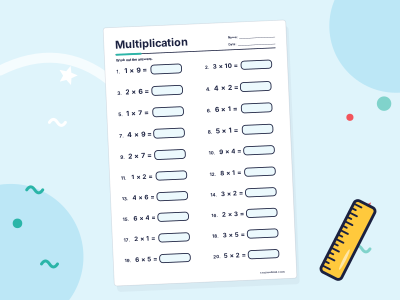
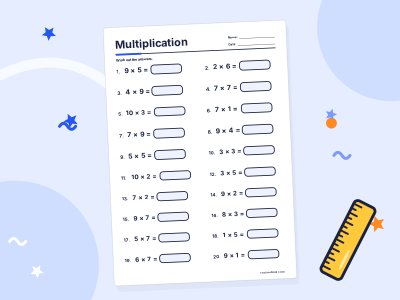
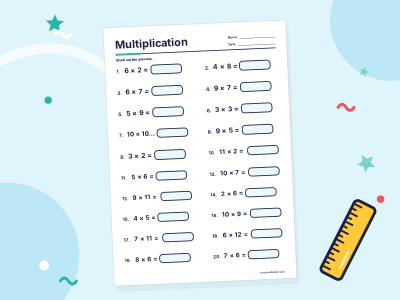
Multiplication practice
For grown-ups
Related topics
Times tables
Times tables are lists of the multiplication facts for a number, such as 3 × 1 = 3 up to 3 × 12 = 36. Knowing them by heart speeds up almost all later maths.
Division
Division is sharing into equal groups, or finding how many groups fit. The sign is ÷, so 12 ÷ 3 = 4. The answer is called the quotient.
Addition
Addition is putting amounts together to find a total. The sign is +, and the answer is called the sum or total, so 4 + 3 = 7.
Factors and multiples
Factors are numbers that divide exactly into a number (the factors of 12 are 1, 2, 3, 4, 6 and 12). Multiples are the numbers in its times table (12, 24, 36…).
Area
Area is the amount of flat space inside a shape, measured in square units like cm² or m². A rectangle 4 cm by 3 cm has an area of 4 × 3 = 12 cm².
Estimation
Estimating means making a sensible guess at an answer, usually by rounding the numbers first. It tells you roughly what to expect and helps you spot mistakes.