Maths
How do you do long multiplication?
Quick answer
Long multiplication multiplies a big number by splitting the second number into ones, tens and hundreds, finding each part, then adding the results together.



In one sentence
Long multiplication breaks one number into ones, tens and hundreds, multiplies each part, and adds the answers.
Explained
Take 34 × 27. Twenty-seven is 20 + 7, so you can multiply 34 by 7 and 34 by 20 separately and add them together.
Step by step
- Multiply by the ones.34 × 7 = 238. Write 238.
- Put a zero in the ones place.You are about to multiply by 20, which is 2 tens, so the answer is ten times bigger. The zero holds that place.
- Multiply by the tens.34 × 2 = 68, and with the zero this becomes 680.
- Add.238 + 680 = 918.
You can see the same thing in a grid. Draw a box split into 30 + 4 across the top and 20 + 7 down the side. Multiply each pair: 30 × 20 = 600, 4 × 20 = 80, 30 × 7 = 210, 4 × 7 = 28. Add them: 600 + 80 + 210 + 28 = 918. The grid method shows why the column method works. Both rely on place value.
 pencil
 notebook
 ruler
When you multiply by a single digit, you may need to carry. For 23 × 4: 3 × 4 = 12, write 2 and carry the 1; then 2 × 4 = 8, plus the carried 1 is 9. The answer is 92.
Before you start, estimate. Round 34 × 27 to 30 × 30 = 900. The exact answer, 918, is close, so it is believable. Your times tables are the tools that make each step quick.
Examples
| Sum | Working | Answer |
|---|---|---|
| 23 × 4 | 20 × 4 + 3 × 4 = 80 + 12 | 92 |
| 34 × 27 | 238 + 680 | 918 |
| 48 × 21 | 48 × 1 = 48, 48 × 20 = 960 | 1,008 |
| 125 × 12 | 125 × 2 = 250, 125 × 10 = 1,250 | 1,500 |
Common mistakes
- Forgetting the placeholder zero. Without it, the tens row is ten times too small.
- Forgetting to add the carried digit. Write the little carried number above the next column.
- Misaligned columns. Squared paper helps a lot.
Quick quiz
Long multiplication
Check what you know with 4 quick questions.
Question 1 of 4
What is 34 × 27 using long multiplication?
Practise it
Try it
Multiplication practice
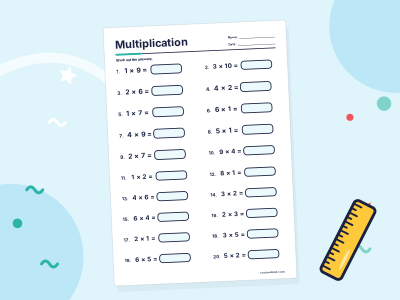
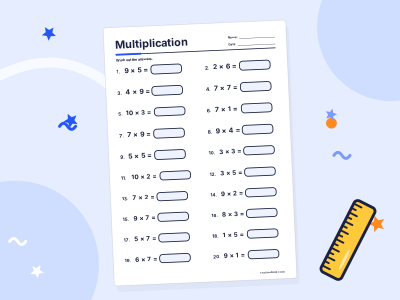
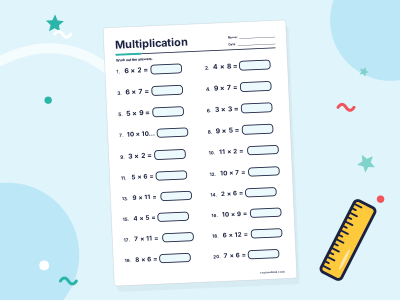
Practise it step by step in a full course: Grade 5 Maths
For grown-ups
Related topics

Multiplication
Multiplication is adding equal groups quickly. 4 × 3 means 4 groups of 3 (or 3 groups of 4), which makes 12. The answer is called the product.

Place value
Place value means a digit's value depends on its position in a number. In 352, the 3 is worth 300, the 5 is worth 50 and the 2 is worth 2.

Times tables
Times tables are lists of the multiplication facts for a number, such as 3 × 1 = 3 up to 3 × 12 = 36. Knowing them by heart speeds up almost all later maths.
Arrays
An array is a set of objects arranged in equal rows and columns. 3 rows of 4 dots is an array that shows 3 × 4 = 12, so arrays help children see multiplication.
The 24-hour clock
The 24-hour clock counts the hours from 00:00 at midnight to 23:59, so there is no am or pm. For afternoon times, add 12: 3 pm is 15:00.

2D shapes
2D shapes are flat shapes with length and width but no thickness, like circles, triangles, squares and hexagons. You can draw them on paper.