Maths
What are 2D shapes?
Quick answer
2D shapes are flat shapes with length and width but no thickness, like circles, triangles, squares and hexagons. You can draw them on paper.
In one sentence
A 2D shape is a flat shape, like one drawn on paper, with length and width but no depth.
Explained
"2D" stands for two-dimensional: you can measure across it and up it, but it has no thickness. Shapes made of straight sides are called polygons. Each straight edge is a side, and each corner where two sides meet is a vertex (plural vertices).
 window
 clock
clock kite
kite
Polygons are named by how many sides they have:
| Sides | Name | Everyday example |
|---|---|---|
| 3 | triangle | a slice of pizza |
| 4 | quadrilateral | a book cover |
| 5 | pentagon | the outline of a simple house drawing |
| 6 | hexagon | a honeycomb cell |
| 7 | heptagon | a UK 50p coin (with slightly curved sides) |
| 8 | octagon | a stop sign in many countries |
A regular polygon has all sides the same length and all angles the same size. A regular quadrilateral is a square. An irregular hexagon still has 6 sides; they are just not all equal.
Circles are 2D but not polygons, because they have one curved edge and no corners.
Quadrilaterals (four sides) come in a family:
- Square: 4 equal sides, 4 right angles.
- Rectangle: 4 right angles, opposite sides equal.
- Rhombus: 4 equal sides, angles not necessarily right angles.
- Parallelogram: opposite sides parallel and equal.
- Trapezium (UK) or trapezoid (US): exactly one pair of parallel sides (some definitions say at least one).
- Kite: two pairs of equal sides next to each other.
A square fits several of these at once: it is also a rectangle, a rhombus and a parallelogram.
Triangles have their own names too: equilateral (3 equal sides), isosceles (2 equal sides) and scalene (no equal sides). See angles for right-angled triangles.
Examples
- A regular hexagon has 6 equal sides and 6 vertices.
- A rectangle 5 cm by 3 cm has two sides of 5 cm and two of 3 cm.
- A semicircle is half a circle: one curved edge and one straight edge.
- An equilateral triangle has three 60° angles.
Common mistakes
- Thinking a turned square is a "diamond" and a different shape. It is still a square. Fix: turn the page round.
- Saying a square isn't a rectangle. It is a special kind.
- Calling 3D objects by 2D names, like a ball a "circle". A ball is a sphere; see 3D shapes.
Quick quiz
2D shapes
Check what you know with 5 quick questions.
Question 1 of 5
How many sides does a hexagon have?
Practise it
Try it
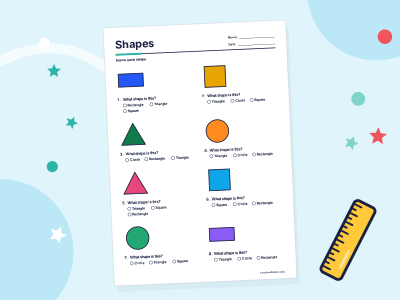
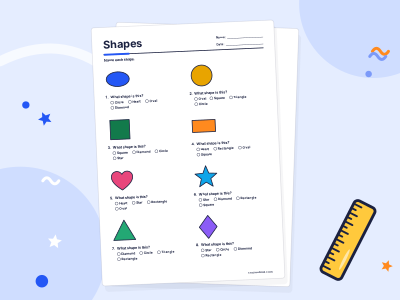
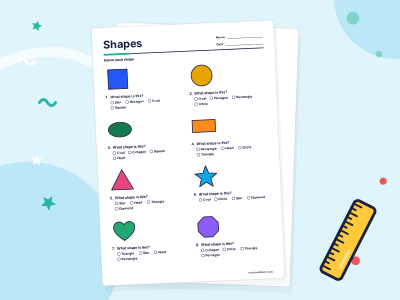
2D shape worksheets
For grown-ups
Related topics
3D shapes
3D shapes are solid shapes with length, width and height, like cubes, spheres, cylinders and pyramids. They have faces, edges and vertices.
Angles
An angle measures the amount of turn between two lines that meet at a point. Angles are measured in degrees (°); a right angle is 90° and a full turn is 360°.
Symmetry
A shape has symmetry when one half is a mirror image of the other (line symmetry), or when it looks the same after being turned (rotational symmetry).
Perimeter
Perimeter is the total distance all the way around the outside of a flat shape. For a rectangle 5 cm long and 3 cm wide, it is 5 + 3 + 5 + 3 = 16 cm.
Addition
Addition is putting amounts together to find a total. The sign is +, and the answer is called the sum or total, so 4 + 3 = 7.
Area
Area is the amount of flat space inside a shape, measured in square units like cm² or m². A rectangle 4 cm by 3 cm has an area of 4 × 3 = 12 cm².