Maths
What is symmetry?
Quick answer
A shape has symmetry when one half is a mirror image of the other (line symmetry), or when it looks the same after being turned (rotational symmetry).
In one sentence
Something is symmetrical when it matches itself after being folded, reflected in a mirror or turned.
Explained
Look at a butterfly. Its left wing is a mirror image of its right wing. If you could fold it down the middle of its body, the two halves would match exactly. That fold line is a line of symmetry (also called a mirror line or axis of symmetry).
 butterfly
 mirror
 flower
You can test for line symmetry in three ways:
- Fold it. Cut the shape out and fold it. Do the halves sit exactly on top of each other?
- Use a mirror. Stand a small mirror on the line. Does the reflection complete the shape?
- Measure. Every point on one side should be the same distance from the line as its partner on the other side.
Shapes can have no lines of symmetry, one, or many. A regular polygon has as many lines of symmetry as it has sides: a regular pentagon has 5, a regular hexagon has 6. A circle has infinitely many, since any line through the centre works.
Rotational symmetry is about turning. Spin a shape around its centre. If it looks exactly the same before you have turned it all the way round, it has rotational symmetry. The order is how many times it fits onto itself in one full turn. A square has order 4 (every 90°). The letter S has order 2 (every 180°), even though it has no line of symmetry. A shape that only fits once, after a full turn, has order 1, which means no rotational symmetry.
You will meet reflection again on coordinate grids, where you reflect shapes in the x-axis or y-axis.
Examples
| Shape | Lines of symmetry | Rotational order |
|---|---|---|
| Square | 4 | 4 |
| Rectangle | 2 | 2 |
| Equilateral triangle | 3 | 3 |
| Isosceles triangle | 1 | 1 |
| Parallelogram | 0 | 2 |
| Regular hexagon | 6 | 6 |
| Letter H | 2 | 2 |
| Letter Z | 0 | 2 |
Common mistakes
- Drawing the diagonals of a rectangle as lines of symmetry. Fold a sheet of A4 paper corner to corner to see that the halves don't match.
- Thinking every symmetrical shape is "upright". A tilted shape can still have a slanting line of symmetry.
- Calling "order 1" symmetrical. Every shape fits onto itself after a full turn, so order 1 means no rotational symmetry.
Quick quiz
Symmetry
Check what you know with 4 quick questions.
Question 1 of 4
How many lines of symmetry does a square have?
Practise it
Try it
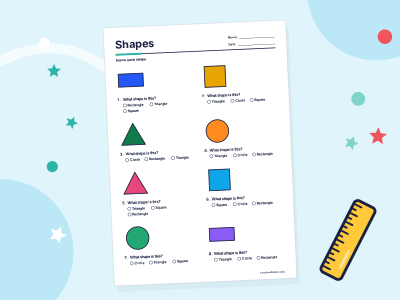
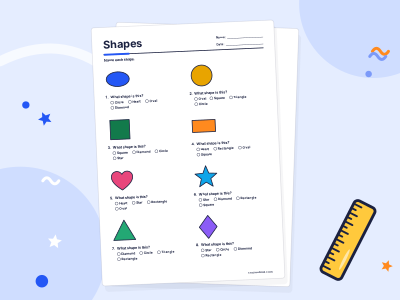
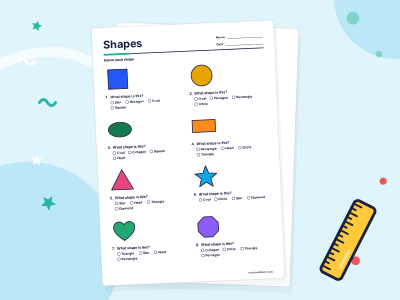
Shape and symmetry worksheets
For grown-ups
Related topics
2D shapes
2D shapes are flat shapes with length and width but no thickness, like circles, triangles, squares and hexagons. You can draw them on paper.
Angles
An angle measures the amount of turn between two lines that meet at a point. Angles are measured in degrees (°); a right angle is 90° and a full turn is 360°.
Coordinates
Coordinates are a pair of numbers that give an exact position on a grid, like (3, 5). The first number is how far across (x) and the second is how far up (y).
3D shapes
3D shapes are solid shapes with length, width and height, like cubes, spheres, cylinders and pyramids. They have faces, edges and vertices.
Addition
Addition is putting amounts together to find a total. The sign is +, and the answer is called the sum or total, so 4 + 3 = 7.
Area
Area is the amount of flat space inside a shape, measured in square units like cm² or m². A rectangle 4 cm by 3 cm has an area of 4 × 3 = 12 cm².