Maths
What are coordinates?
Quick answer
Coordinates are a pair of numbers that give an exact position on a grid, like (3, 5). The first number is how far across (x) and the second is how far up (y).
In one sentence
Coordinates are two numbers in brackets that pinpoint a spot on a grid: across first, then up.
Explained
Imagine a treasure map drawn on squared paper. To tell a friend where the treasure is buried, you could say "go 4 squares across and 3 squares up". In maths, that becomes the coordinates (4, 3).
 map
map ship
ship
A coordinate grid has two number lines, called axes:
- the x-axis goes across (horizontally),
- the y-axis goes up (vertically).
They cross at the origin, the point (0, 0). Every point on the grid has an x-coordinate and a y-coordinate, always written in that order, with a comma between: (x, y).
A popular memory trick: "along the corridor, then up the stairs". You walk along before you can climb. Another: x comes before y in the alphabet.
Each axis is a number line, so it can carry on past zero. To the left of the origin, x is negative; below it, y is negative. That splits the grid into four sections called quadrants. The point (−2, −5) is 2 left and 5 down.
Coordinates let you describe shapes exactly. A square might have corners at (1, 1), (4, 1), (4, 4) and (1, 4). Move every point 2 to the right and it becomes (3, 1), (6, 1), (6, 4), (3, 4). That's a translation. Flip it in an axis and that's a reflection (see symmetry). Later, in algebra, you plot lines such as y = 2x + 1 from their coordinates.
Examples
| Point | Meaning |
|---|---|
| (2, 6) | 2 across, 6 up |
| (6, 2) | 6 across, 2 up (a different point) |
| (0, 4) | on the y-axis, 4 up |
| (−3, 1) | 3 left, 1 up |
| (5, −2) | 5 right, 2 down |
Worked example: three corners of a rectangle are (1, 2), (5, 2) and (5, 6). The fourth must line up with (1, 2) across and with (5, 6) up, so it is (1, 6).
Common mistakes
- Swapping the order, plotting (3, 5) at 5 across and 3 up. Fix: "along the corridor, then up the stairs".
- Plotting in the squares instead of on the lines. Coordinates mark where grid lines cross.
- Counting the origin as 1. Start counting from 0.
- Getting the sign wrong for points left of or below the origin.
Quick quiz
Coordinates
Check what you know with 4 quick questions.
Question 1 of 4
In the coordinates (4, 7), which number tells you how far across to go?
Practise it
Try it
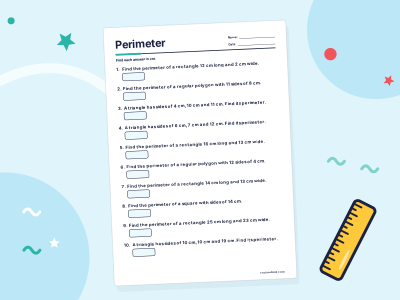
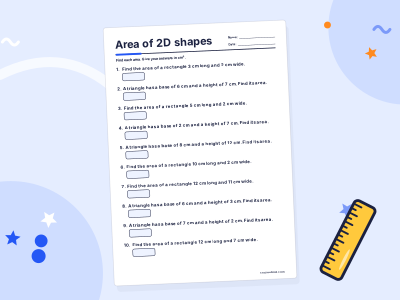
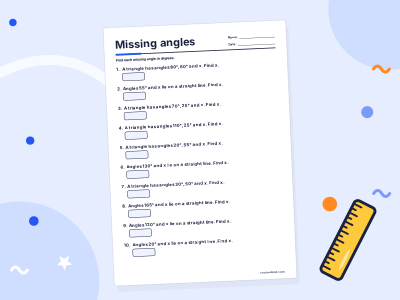
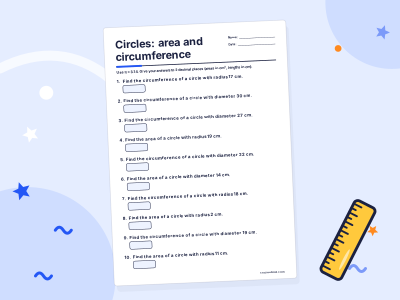
Coordinates and geometry practice
For grown-ups
Related topics
Negative numbers
Negative numbers are numbers less than zero, written with a minus sign, like −3. You meet them in cold temperatures, bank overdrafts and floors below ground.
Number line
A number line is a straight line with numbers marked at equal steps, smallest on the left and biggest on the right. It helps you count, compare, add and subtract.
Symmetry
A shape has symmetry when one half is a mirror image of the other (line symmetry), or when it looks the same after being turned (rotational symmetry).
Algebra
Algebra is maths that uses letters, like x or n, to stand for numbers we don't know yet or numbers that can change. For example, if n + 3 = 10, then n = 7.
Angles
An angle measures the amount of turn between two lines that meet at a point. Angles are measured in degrees (°); a right angle is 90° and a full turn is 360°.
Area
Area is the amount of flat space inside a shape, measured in square units like cm² or m². A rectangle 4 cm by 3 cm has an area of 4 × 3 = 12 cm².