Maths
What is a number line?
Quick answer
A number line is a straight line with numbers marked at equal steps, smallest on the left and biggest on the right. It helps you count, compare, add and subtract.
In one sentence
A number line is a line with numbers written along it in order and evenly spaced, like the marks on a ruler.
Explained
Draw a straight line and mark 0 at the left end. Then mark 1, 2, 3, 4… with the same space between each one. That is a number line. The numbers get bigger as you go right and smaller as you go left.
 frog
frog ruler
ruler
Number lines turn sums into hops you can see. For 5 + 4, start at 5 and make 4 hops to the right: you land on 9. For 9 − 4, start at 9 and hop 4 to the left: back to 5. You can also make bigger jumps. To add 38 to 26, jump 30 to reach 56, then 8 more to reach 64.
An empty number line has no marks printed on it. You draw just the jumps you need, which makes it great for mental maths. To find 82 − 47, start at 47, jump 3 to reach 50, jump 30 to reach 80, then 2 more to 82. The jumps total 3 + 30 + 2 = 35, so the difference is 35.
The line doesn't stop at 0. Keep going left and you meet −1, −2, −3, the negative numbers. And between the whole numbers there are halves, quarters and tenths: 2½ sits exactly halfway between 2 and 3. That is a good way to picture fractions and decimals.
Examples
- 7 + 5: start at 7, hop 3 to reach 10, then 2 more to 12.
- 15 − 6: start at 15, hop back 5 to reach 10, then 1 more to 9.
- Which is bigger, 0.7 or 0.65? Mark both between 0 and 1: 0.7 is further right, so it is bigger.
- Rounding 47 to the nearest 10: it sits between 40 and 50 but closer to 50.
- Temperature: from −3 °C to 4 °C is a rise of 7 degrees.
Common mistakes
- Counting the starting point as a hop. For 4 + 3, children say "4, 5, 6" and land on 6. Fix: count the jumps, not the numbers you touch.
- Uneven spacing when drawing a line, which makes halfway look wrong. Fix: use squared paper or a ruler.
- Thinking −5 is bigger than −2 because 5 is bigger than 2. Fix: −5 is further left, so it is smaller.
Quick quiz
Number line
Check what you know with 4 quick questions.
Question 1 of 4
On a number line, which way do the numbers get bigger?
Practise it
Try it
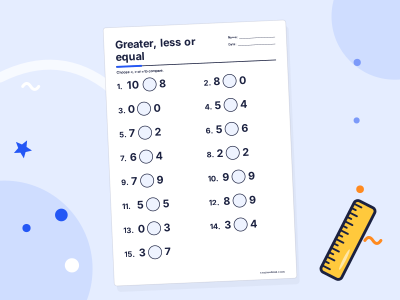
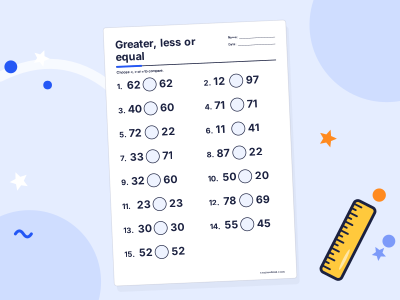
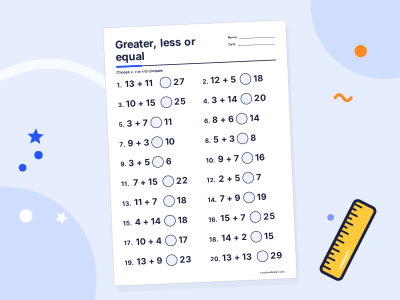
Number line and comparing practice
For grown-ups
Related topics
Counting
Counting means saying one number for each thing in a group, in order, to find out how many there are. The last number you say is the total.
Negative numbers
Negative numbers are numbers less than zero, written with a minus sign, like −3. You meet them in cold temperatures, bank overdrafts and floors below ground.
Fractions
A fraction is part of a whole that has been split into equal parts. In ¾, the bottom number says how many equal parts and the top says how many you have.
Addition
Addition is putting amounts together to find a total. The sign is +, and the answer is called the sum or total, so 4 + 3 = 7.
Coordinates
Coordinates are a pair of numbers that give an exact position on a grid, like (3, 5). The first number is how far across (x) and the second is how far up (y).
Rounding
Rounding means replacing a number with a simpler one that is close to it, such as 47 rounded to the nearest ten being 50. It makes numbers easier to work with.