Maths
What is counting?
Quick answer
Counting means saying one number for each thing in a group, in order, to find out how many there are. The last number you say is the total.
In one sentence
Counting is saying one number for each thing, in the right order, so that the last number tells you how many there are.
Explained
Counting looks easy to adults, but it is really several skills working together. First you need the number words in the right order: one, two, three, four. Then you need to match exactly one number to each object, so nothing is skipped and nothing is counted twice. Pointing or touching helps a lot.
The big idea comes next. When you finish, the last number you said is the answer to "how many?" If you count four apples, there are four apples, not "one, two, three, four apples". Teachers call this the cardinal principle.
Two more surprises for young children: it does not matter which apple you start with, and moving the apples around does not change how many there are. Five is five, in a line or in a heap.
 apple
apple- apple
- apple
- apple
- apple
Once counting by ones is secure, children learn to count on from a number ("seven, eight, nine"), count back ("ten, nine, eight") and count in steps of 2, 5 and 10. These lead straight into addition and times tables.
Examples
| What you do | What it sounds like |
|---|---|
| Count objects | "One, two, three. Three buttons." |
| Count on from 6 | "Six… seven, eight, nine." |
| Count back from 10 | "Ten, nine, eight, seven…" |
| Count in 2s | 2, 4, 6, 8, 10 |
| Count in 5s | 5, 10, 15, 20, 25 |
| Count in 10s | 10, 20, 30, 40, 50 |
Crossing a "tens boundary" is a good test: 28, 29, 30, 31. And 99, 100, 101.
Common mistakes
- Counting one object twice or skipping one. Fix: move each object to a new pile as you count it.
- Saying the numbers faster than pointing. Fix: slow down and touch each thing as you say its number.
- Not knowing the total after counting. Ask "So how many are there?" straight after, and praise "five" rather than recounting.
- Mixing up the teens, such as saying "twenty-ten" after 29 or swapping 13 and 30. Fix: count past 10s on a number line or a 100 square.
Quick quiz
Counting
Check what you know with 4 quick questions.
Question 1 of 4
You count five ducks and touch each one once. What is the last number you say?
Practise it
Try it
Counting practice pages
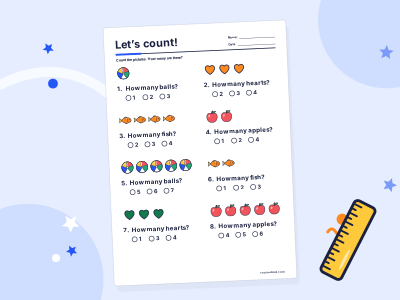
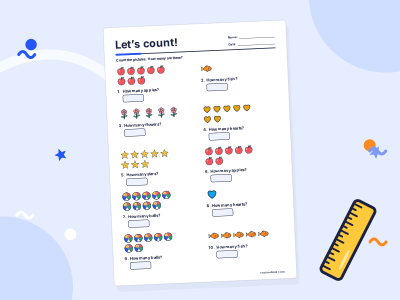
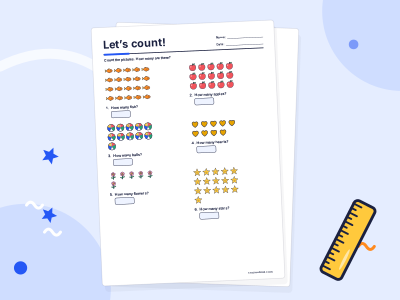
For grown-ups
Related topics
Number bonds
Number bonds are pairs of numbers that add up to a given total, like 3 and 7 making 10. Knowing them by heart makes adding and subtracting much faster.
Place value
Place value means a digit's value depends on its position in a number. In 352, the 3 is worth 300, the 5 is worth 50 and the 2 is worth 2.
Number line
A number line is a straight line with numbers marked at equal steps, smallest on the left and biggest on the right. It helps you count, compare, add and subtract.
Addition
Addition is putting amounts together to find a total. The sign is +, and the answer is called the sum or total, so 4 + 3 = 7.
Bar charts
A bar chart shows data using bars of different lengths. The longer the bar, the bigger the number. In the US it is usually called a bar graph.
Estimation
Estimating means making a sensible guess at an answer, usually by rounding the numbers first. It tells you roughly what to expect and helps you spot mistakes.