Maths
What is addition?
Quick answer
Addition is putting amounts together to find a total. The sign is +, and the answer is called the sum or total, so 4 + 3 = 7.
In one sentence
Addition means joining amounts together to find out how many there are altogether.
Explained
If you have 4 cookies and someone gives you 3 more, you now have 7. We write that as 4 + 3 = 7 and say "four plus three equals seven". The numbers being added are sometimes called addends, and the answer is the sum or total.
 cookie
- cookie
- cookie
- cookie
- cookie
- cookie
- cookie
Two handy facts make adding easier. First, order does not matter: 3 + 9 gives the same answer as 9 + 3, so start with the bigger number and count on. Second, you can group numbers however you like: 7 + 6 + 3 is easier as 7 + 3 = 10, then 10 + 6 = 16.
Young children add by counting all the objects. Soon they count on from the bigger number. Then they use facts they know, especially number bonds to 10: for 9 + 5, move 1 across to make 10 + 4 = 14.
For bigger numbers we use place value. Add the ones, then the tens, then the hundreds. If a column adds up to 10 or more, you carry (also called regrouping or exchanging) a ten into the next column.
Examples
- 5 + 4 = 9
- 9 + 6 = 9 + 1 + 5 = 15 (make 10)
- 34 + 25: tens 30 + 20 = 50, ones 4 + 5 = 9, total 59
- 46 + 38 in columns: ones 6 + 8 = 14, write 4 carry 1; tens 4 + 3 + 1 = 8; answer 84
- 275 + 148: ones 13 (write 3 carry 1), tens 7 + 4 + 1 = 12 (write 2 carry 1), hundreds 2 + 1 + 1 = 4; answer 423
Common mistakes
- Forgetting the carried digit. Fix: write the little 1 clearly under the next column and tick it off once added.
- Lining up digits from the left. For 305 + 42, the 2 must sit under the 5. Fix: line up from the right, ones under ones.
- Writing the whole column total, so 46 + 38 becomes 714. Fix: only one digit fits in each column.
- Counting the starting number when counting on. For 6 + 3, say "six" in your head, then count "seven, eight, nine".
Quick quiz
Addition
Check what you know with 4 quick questions.
Question 1 of 4
What is 8 + 7?
Practise it
Try it
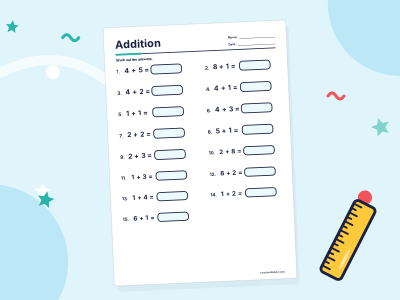
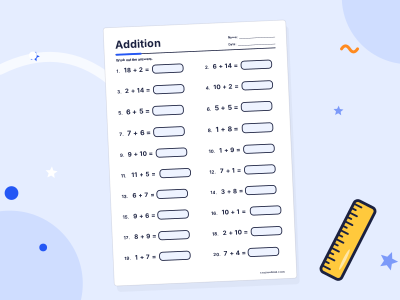
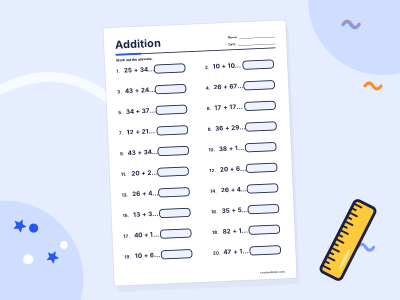
Addition worksheets
For grown-ups
Related topics
Subtraction
Subtraction is taking one amount away from another, or finding the difference between two numbers. The sign is −, so 9 − 4 = 5.
Number bonds
Number bonds are pairs of numbers that add up to a given total, like 3 and 7 making 10. Knowing them by heart makes adding and subtracting much faster.
Place value
Place value means a digit's value depends on its position in a number. In 352, the 3 is worth 300, the 5 is worth 50 and the 2 is worth 2.
Counting
Counting means saying one number for each thing in a group, in order, to find out how many there are. The last number you say is the total.
Money
Money maths means counting coins and notes, adding up prices and working out change. Most currencies split one unit into 100 smaller ones, like 100 pence in a pound.
Multiplication
Multiplication is adding equal groups quickly. 4 × 3 means 4 groups of 3 (or 3 groups of 4), which makes 12. The answer is called the product.