Maths
What is place value?
Quick answer
Place value means a digit's value depends on its position in a number. In 352, the 3 is worth 300, the 5 is worth 50 and the 2 is worth 2.
In one sentence
Place value is the idea that a digit is worth a different amount depending on where it sits in a number.
Explained
We only use ten digits, 0 to 9, yet we can write any number. The trick is position. In 52 the 5 means five tens, but in 520 the same 5 means five hundreds. Each place to the left is worth ten times more than the place to its right.
 blocks
- blocks
- blocks
 pencil
A place value chart makes this visible:
| Thousands | Hundreds | Tens | Ones |
|---|---|---|---|
| 3 | 0 | 8 | 5 |
So 3,085 is 3 thousands, 0 hundreds, 8 tens and 5 ones, or 3000 + 80 + 5. Zero matters: it is a placeholder that tells you the hundreds column is empty. Without it, 3,085 would turn into 385.
Splitting a number like this is called partitioning. It is the reason column methods for addition work, and it is how we compare numbers: 4,219 is bigger than 4,198 because they have the same thousands, but 2 hundreds beats 1 hundred.
Place value carries on to the right of the decimal point too: tenths, hundredths, thousandths. See decimals.
Examples
- 64 = 6 tens + 4 ones = 60 + 4
- 708 = 7 hundreds + 0 tens + 8 ones
- 2,451 = 2000 + 400 + 50 + 1
- 47 can also be partitioned as 30 + 17 (useful for subtraction)
- 38 × 10 = 380 and 380 ÷ 10 = 38 (digits shift one place)
Common mistakes
- Writing numbers as they sound, like "three hundred and four" as 3004. Fix: draw the columns and fill every place, putting 0 where there is nothing.
- Saying "add a zero" to multiply by 10. It works for 25 × 10 but fails for 2.5 × 10 (not 2.50). Say "the digits move one place left".
- Comparing by the first digit only, thinking 912 is bigger than 1,034. Fix: count the digits first. More digits (for whole numbers) means bigger.
Quick quiz
Place value
Check what you know with 4 quick questions.
Question 1 of 4
What is the value of the 7 in 4,723?
Practise it
Try it
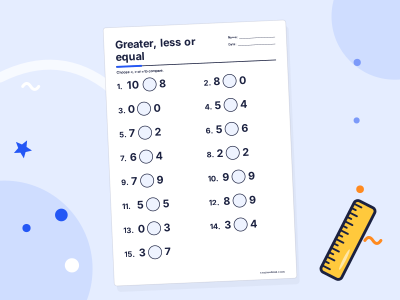
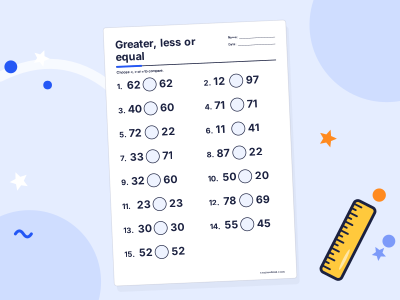
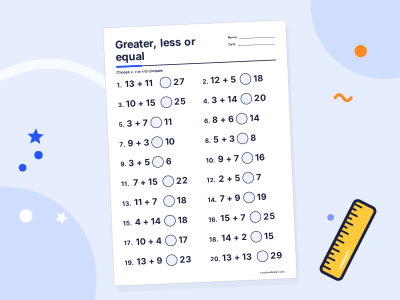
Place value and comparing numbers
For grown-ups
Related topics
Counting
Counting means saying one number for each thing in a group, in order, to find out how many there are. The last number you say is the total.
Decimals
Decimals are numbers with a decimal point. Digits after the point show tenths, hundredths and so on, so 2.5 means two and five tenths.
Rounding
Rounding means replacing a number with a simpler one that is close to it, such as 47 rounded to the nearest ten being 50. It makes numbers easier to work with.
Addition
Addition is putting amounts together to find a total. The sign is +, and the answer is called the sum or total, so 4 + 3 = 7.
Number bonds
Number bonds are pairs of numbers that add up to a given total, like 3 and 7 making 10. Knowing them by heart makes adding and subtracting much faster.
Number line
A number line is a straight line with numbers marked at equal steps, smallest on the left and biggest on the right. It helps you count, compare, add and subtract.