Maths
What is comparing numbers, and how do you use the > and < symbols?
Quick answer
Comparing numbers means deciding which is greater, which is less, or if they are equal, and showing it with >, < or =. For example, 52 > 25 because 5 tens is more than 2 tens.



In one sentence
Comparing numbers means working out which number is bigger, which is smaller, or whether they are the same, and writing it with the signs > (greater than), < (less than) or = (equal to).
Explained
When you compare two piles of sweets, you can just look: the bigger pile has more. With numbers we need a fair way to decide, and a short way to write the answer. That is what the three comparison symbols are for:
- > means "is greater than": 9 > 4 (nine is greater than four).
- < means "is less than": 4 < 9 (four is less than nine).
- = means "is equal to": 5 = 5.
 fish
 apple
 star
Many classrooms use a hungry alligator (or crocodile, or fish) to remember which way the sign points. The open mouth always wants to eat the bigger number, so it opens towards it. Another trick: the small, pointy end always points at the smaller number. Read the sign from left to right: 3 < 7 is "three is less than seven".
Comparing whole numbers. First count the digits. A number with more digits is bigger (for whole numbers without zeros at the front): 1,009 > 999, because a four-digit number has thousands and a three-digit number does not. If the numbers have the same number of digits, compare them place by place from the left, using place value: thousands first, then hundreds, then tens, then ones. The first place where the digits differ decides. In 3,482 and 3,428 the thousands and hundreds match, but 8 tens is more than 2 tens, so 3,482 > 3,428.
Comparing decimals. Line up the decimal points and compare place by place in the same way. It helps to add zeros so both numbers have the same number of decimal places: 0.5 becomes 0.50, so 0.50 > 0.45. A longer decimal is not automatically bigger.
Comparing negative numbers. Picture a number line. Numbers get bigger as you move right and smaller as you move left. −3 is to the right of −8, so −3 > −8, even though 8 looks bigger. Any positive number is greater than any negative number, and 0 sits in between.
Comparing is also the first step in ordering numbers (putting a list from smallest to largest, called ascending order, or largest to smallest, descending order).
Examples
| Numbers | How to decide | Answer |
|---|---|---|
| 8 and 12 | 12 has more digits | 8 < 12 |
| 47 and 74 | 4 tens < 7 tens | 47 < 74 |
| 305 and 350 | hundreds match; 0 tens < 5 tens | 305 < 350 |
| 6,210 and 6,201 | tens: 1 > 0 | 6,210 > 6,201 |
| 2.7 and 2.65 | 2.70 vs 2.65: 7 tenths > 6 tenths | 2.7 > 2.65 |
| 0.4 and 0.40 | same value | 0.4 = 0.40 |
| −5 and −1 | −5 is further left | −5 < −1 |
Worked example: compare 25,107 and 25,170. Both have five digits. Ten thousands: 2 and 2. Thousands: 5 and 5. Hundreds: 1 and 1. Tens: 0 and 7. 0 tens is less than 7 tens, so 25,107 < 25,170.
Common mistakes
- Pointing the sign the wrong way. Fix: the wide, open side faces the bigger number; the point faces the smaller one.
- Thinking a longer decimal is bigger. 0.125 is not greater than 0.5. Fix: add zeros (0.500) and compare place by place.
- Comparing from the right. Looking at the ones first makes 29 look bigger than 31. Fix: always start with the biggest place value on the left.
- Treating negatives like positives. −10 is not greater than −2. Fix: picture the number line; further left is smaller.
Step by step
Step by step
- Check the signsIs one number negative and the other positive? The positive number is greater. If both are negative, the one closer to zero is greater.
- Count the digitsFor whole numbers, more digits means bigger. For decimals, compare the whole-number part first.
- Line them upWrite the numbers one above the other, ones under ones (or decimal point under decimal point). Add zeros to fill gaps after the decimal point.
- Compare from the leftLook at the biggest place first. Move right until two digits differ.
- Write the symbolThe bigger digit belongs to the bigger number. Write >, < or =, with the open side towards the bigger number.
To compare a fraction and a decimal, turn the fraction into a decimal first: 3/4 = 0.75, so 3/4 > 0.7. For two fractions, see comparing fractions.
Practice questions
Write >, < or =
Try each one, then check your answer.
- 7 ? 4
Show answer
7 is more than 4: 7 > 4 - 15 ? 51
Show answer
1 ten < 5 tens: 15 < 51 - 38 ? 83
Show answer
3 tens < 8 tens: 38 < 83 - 120 ? 102
Show answer
Hundreds match; 2 tens > 0 tens: 120 > 102 - 456 ? 465
Show answer
Hundreds match; 5 tens < 6 tens: 456 < 465 - 1,009 ? 999
Show answer
Four digits beat three digits: 1,009 > 999 - 3,482 ? 3,428
Show answer
Tens: 8 > 2, so 3,482 > 3,428 - 25,107 ? 25,170
Show answer
Tens: 0 < 7, so 25,107 < 25,170 - 0.5 ? 0.45
Show answer
0.50 vs 0.45: 5 tenths > 4 tenths, so 0.5 > 0.45 - 2.3 ? 2.30
Show answer
Adding a zero at the end does not change the value: 2.3 = 2.30 - 0.09 ? 0.1
Show answer
0.09 vs 0.10: 0 tenths < 1 tenth, so 0.09 < 0.1 - −3 ? −8
Show answer
−3 is closer to zero (further right): −3 > −8 - −1 ? 0
Show answer
Every negative number is less than 0: −1 < 0 - 3/4 ? 0.7
Show answer
3/4 = 0.75, and 0.75 > 0.70, so 3/4 > 0.7 - Order from smallest to largest: 0.7, 0.07, 0.71, 0.17
Show answer
As hundredths: 0.70, 0.07, 0.71, 0.17. Order: 0.07, 0.17, 0.7, 0.71 - Order from largest to smallest: 2,031; 2,301; 2,013; 2,310
Show answer
Hundreds first, then tens: 2,310; 2,301; 2,031; 2,013
Word problems
Comparing numbers in real life
Try each one, then check your answer.
- Maya has 47 stickers and Leo has 74. Who has more?
Show answer
7 tens > 4 tens, so 74 > 47: Leo has more. - One bike costs $189 and another costs $198. Which is cheaper?
Show answer
Hundreds match; 8 tens < 9 tens, so $189 < $198: the $189 bike. - In a race, Sam runs 100 m in 12.45 seconds and Ana in 12.5 seconds. The lower time wins. Who wins?
Show answer
12.45 vs 12.50: 12.45 < 12.50, so Sam wins. - On Monday it was −4 °C and on Tuesday −9 °C. Which day was colder?
Show answer
−9 is further left on the number line, so −9 < −4: Tuesday was colder. - One bottle holds 1.5 litres and another 1.25 litres. Which holds more?
Show answer
1.50 vs 1.25: 5 tenths > 2 tenths, so the 1.5 litre bottle.
Questions people ask
What does comparing numbers mean in maths?
It means deciding whether one number is greater than, less than or equal to another. You write the answer with >, < or =, for example 52 > 25.
How do you remember which is greater than and which is less than?
The open mouth of the sign always faces the bigger number, like a hungry alligator that wants the bigger meal. The point faces the smaller number. Reading left to right, 3 < 7 says "3 is less than 7".
How do you compare decimals?
Line up the decimal points, add zeros so both have the same number of decimal places, then compare digit by digit from the left. 0.6 = 0.60, which is greater than 0.58.
How do you compare negative numbers?
Use a number line: the number further to the right is greater. So −2 > −7. A quick check: the negative number closer to zero is the greater one.
How do you compare numbers on a number line?
Find both numbers on the line. The one further to the right is greater, and the one further to the left is less.
What is the difference between comparing and ordering numbers?
Comparing looks at two numbers at a time. Ordering puts a whole list in order, smallest to largest (ascending) or largest to smallest (descending), by comparing the numbers in pairs.
How do you teach comparing numbers?
Start with real objects: two piles of blocks or counters. Then move to a number line, then place-value blocks or charts for bigger numbers. Introduce the symbols last, once the idea of "more" and "fewer" is secure.
Quick quiz
Comparing numbers
Check what you know with 5 quick questions.
Question 1 of 5
Which symbol makes this true? 36 ? 63
Practise it
Try it
Practise comparing numbers with unlimited questions
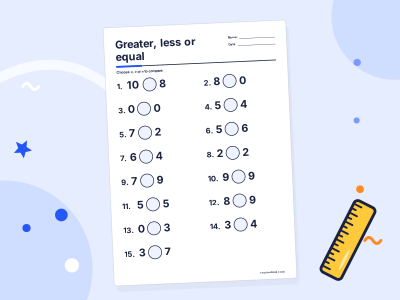
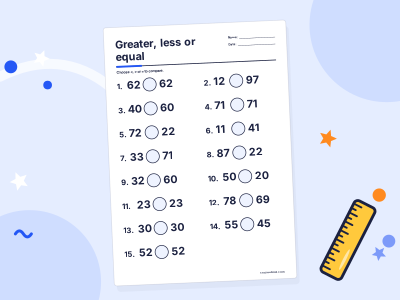
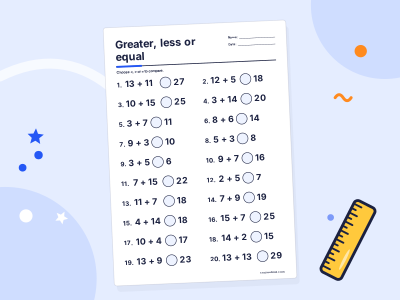
Comparing numbers worksheets
Practise it step by step in a full course: Grade 3 Maths
For grown-ups
Related topics

Place value
Place value means a digit's value depends on its position in a number. In 352, the 3 is worth 300, the 5 is worth 50 and the 2 is worth 2.

Number line
A number line is a straight line with numbers marked at equal steps, smallest on the left and biggest on the right. It helps you count, compare, add and subtract.
Decimals
Decimals are numbers with a decimal point. Digits after the point show tenths, hundredths and so on, so 2.5 means two and five tenths.

Negative numbers
Negative numbers are numbers less than zero, written with a minus sign, like −3. You meet them in cold temperatures, bank overdrafts and floors below ground.

The 24-hour clock
The 24-hour clock counts the hours from 00:00 at midnight to 23:59, so there is no am or pm. For afternoon times, add 12: 3 pm is 15:00.

2D shapes
2D shapes are flat shapes with length and width but no thickness, like circles, triangles, squares and hexagons. You can draw them on paper.