Maths
What is a fraction?
Quick answer
A fraction is part of a whole that has been split into equal parts. In ¾, the bottom number says how many equal parts and the top says how many you have.
In one sentence
A fraction tells you how many equal parts of a whole you have.
Explained
Cut a cake into 4 equal pieces. Each piece is one quarter, written ¼. Take 3 pieces and you have three quarters, ¾.
 cake
cake pizza
pizza orange
Every fraction has two numbers:
- The denominator (bottom) says how many equal parts the whole is split into.
- The numerator (top) says how many of those parts you have.
The word equal matters. If you cut a sandwich into one big bit and one tiny bit, neither piece is a half.
Here is a surprise: the bigger the denominator, the smaller each piece. One third of a pizza is more than one fifth of the same pizza, because sharing between 5 people leaves smaller slices than sharing between 3.
A fraction can also be a part of a group of things. To find ⅓ of 15 marbles, split them into 3 equal groups: 15 ÷ 3 = 5. To find ⅔, take two of those groups: 10. This is why fractions and division are so closely linked. In fact ¾ means 3 ÷ 4.
When the top number is bigger than the bottom, like 7/4, the fraction is more than a whole. It is called an improper fraction, and it can be written as a mixed number: 1¾. Different fractions can also be the same size, like ½ and 2/4. See equivalent fractions.
Examples
| Fraction | Say it | Picture |
|---|---|---|
| ½ | one half | 1 of 2 equal parts |
| ⅓ | one third | 1 of 3 equal parts |
| ¾ | three quarters | 3 of 4 equal parts |
| 5/8 | five eighths | 5 of 8 equal parts |
| 9/4 | nine quarters | 2¼ wholes |
Worked example: ⅖ of 30. One fifth is 30 ÷ 5 = 6, so two fifths is 12.
Common mistakes
- Thinking 1/8 is bigger than 1/4 because 8 is bigger than 4. Fix: draw both on the same-sized bar.
- Unequal parts. Fix: always check the pieces are the same size before naming the fraction.
- Adding tops and bottoms, so ½ + ¼ = 2/6. Fix: make the denominators the same first. ½ = 2/4, so 2/4 + ¼ = ¾.
Quick quiz
Fractions
Check what you know with 5 quick questions.
Question 1 of 5
A pizza is cut into 8 equal slices and you eat 3. What fraction did you eat?
Practise it
Try it
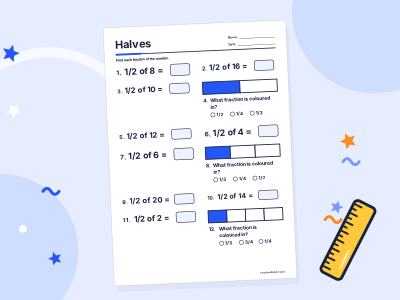
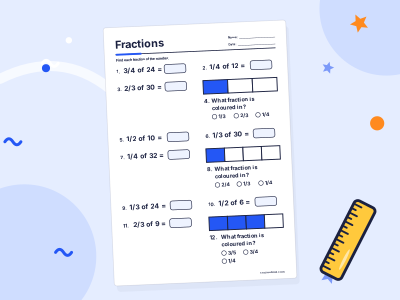
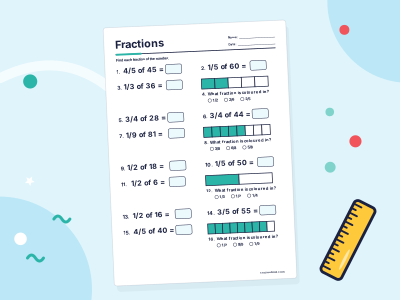
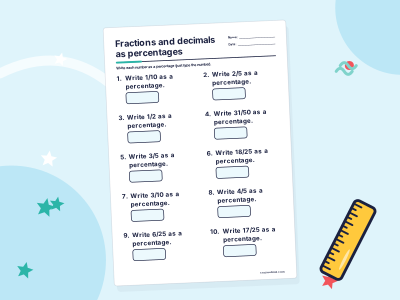
Fraction worksheets
For grown-ups
Related topics
Equivalent fractions
Equivalent fractions look different but are the same size, like 1/2, 2/4 and 4/8. You make them by multiplying or dividing the top and bottom by the same number.
Decimals
Decimals are numbers with a decimal point. Digits after the point show tenths, hundredths and so on, so 2.5 means two and five tenths.
Percentages
A percentage is a number out of 100, written with the sign %. So 25% means 25 out of every 100, which is the same as one quarter.
Division
Division is sharing into equal groups, or finding how many groups fit. The sign is ÷, so 12 ÷ 3 = 4. The answer is called the quotient.
Capacity
Capacity is how much a container can hold, usually measured in millilitres (ml) and litres (l). A large bottle of water often holds 2 litres, which is 2000 ml.
Number line
A number line is a straight line with numbers marked at equal steps, smallest on the left and biggest on the right. It helps you count, compare, add and subtract.