Maths
What is algebra?
Quick answer
Algebra is maths that uses letters, like x or n, to stand for numbers we don't know yet or numbers that can change. For example, if n + 3 = 10, then n = 7.
In one sentence
Algebra is maths where letters stand in for numbers, so you can write rules and solve puzzles about amounts you don't know yet.
Explained
You have been doing algebra for years without the letters. "□ + 3 = 10" is algebra: the box hides a number, and you know it must be 7. Algebra simply replaces the box with a letter: n + 3 = 10, so n = 7.
 box
box key
key
Letters are used in two main ways:
- An unknown: a mystery number to find, as in 2x = 18, so x = 9. (See equations.)
- A variable: a number that can change, as in a rule. If a taxi charges £3 plus £2 per mile, the cost for m miles is 3 + 2m pounds. Put in m = 5 and the cost is 3 + 10 = £13.
There are a few writing habits to learn:
- 3n means 3 × n (we drop the × sign so it isn't confused with the letter x).
- n² means n × n.
- n/2 or n ÷ 2 means half of n.
- 1n is just written n.
An expression is a group of terms, like 4a + 3b − 2. Like terms have exactly the same letters and can be collected: 5x + 2x = 7x, but 5x + 2y stays as it is (you can't add apples and bananas into one number).
Expanding brackets means multiplying every term inside by the number outside: 3(a + 4) = 3a + 12. Going the other way, 6x + 9 = 3(2x + 3), is called factorising. The order of operations still applies: in 2 + 3n with n = 5, multiply first, giving 17.
The word algebra comes from Arabic, al-jabr, from the title of a book written in Baghdad in the 9th century by the mathematician al-Khwarizmi.
Examples
| Expression | When n = 6 |
|---|---|
| n + 9 | 15 |
| 4n | 24 |
| n² | 36 |
| 2n − 5 | 7 |
| 10 − n | 4 |
| (n + 2) ÷ 4 | 2 |
Simplifying: 3a + 5b + 2a − b = 5a + 4b.
Common mistakes
- Reading 3n as "thirty-something". If n = 4, 3n is 12, not 34.
- Combining unlike terms, writing 2a + 3b = 5ab. They stay separate.
- Expanding only the first term: 5(x + 2) is 5x + 10, not 5x + 2.
- Thinking different letters must be different numbers. They can be the same.
Quick quiz
Algebra
Check what you know with 5 quick questions.
Question 1 of 5
If n = 4, what is 3n?
Practise it
Try it
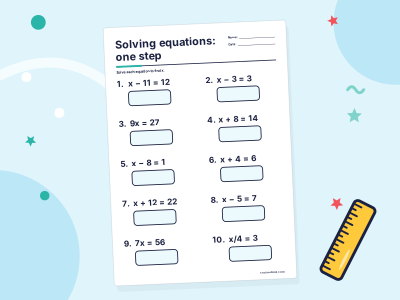
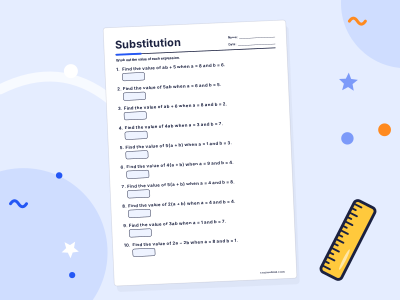
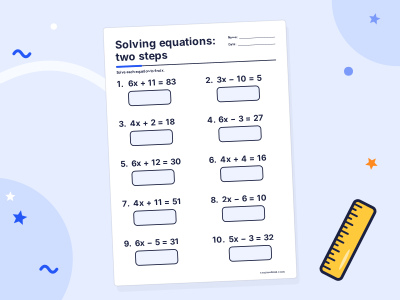
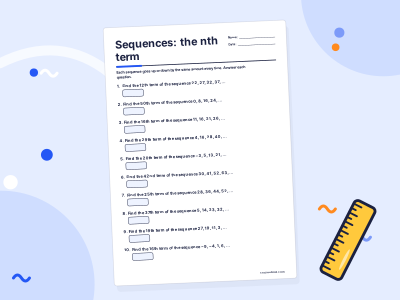
Algebra practice
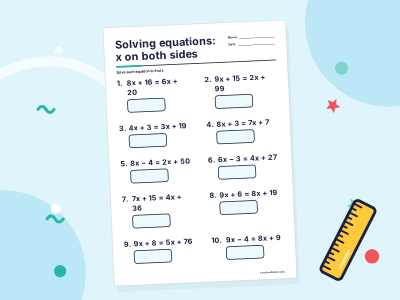
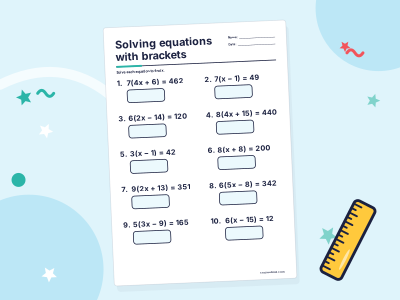
For grown-ups
Related topics
Equations
An equation says two things are equal, using an = sign, like 2x + 1 = 9. Solving it means finding the value of the letter that makes it true, here x = 4.
Sequences
A sequence is a list of numbers or shapes that follows a rule, like 3, 7, 11, 15 (add 4 each time). Each item is called a term.
Order of operations
The order of operations is the agreed order for working out calculations: brackets, then powers, then × and ÷, then + and −. UK pupils learn it as BIDMAS; US pupils as PEMDAS.
Coordinates
Coordinates are a pair of numbers that give an exact position on a grid, like (3, 5). The first number is how far across (x) and the second is how far up (y).
Mean, median and mode
Mean, median and mode are three kinds of average. The mean shares the total out equally, the median is the middle value in order, and the mode is the most common value.
Pi (π)
Pi (π) is the number you get when you divide any circle's circumference by its diameter. It is about 3.14, and its digits go on forever without repeating.