Maths
What is a sequence in maths?
Quick answer
A sequence is a list of numbers or shapes that follows a rule, like 3, 7, 11, 15 (add 4 each time). Each item is called a term.
In one sentence
A sequence is an ordered list of numbers (or patterns) that follows a rule, so you can predict what comes next.
Explained
Look at 2, 4, 6, 8, 10. Each number goes up by 2, so the next one is 12. That is a sequence. Each number in it is a term: 2 is the 1st term, 4 is the 2nd, and so on.
 star
star- star
 flower
- star
- star
- flower
To work out a sequence, find the rule that gets you from one term to the next. This is the term-to-term rule. Common types are:
- Going up or down by the same amount (an arithmetic or linear sequence): 7, 12, 17, 22 (add 5); 30, 26, 22, 18 (subtract 4). The amount is called the common difference.
- Multiplying or dividing by the same number (a geometric sequence): 3, 6, 12, 24 (double); 1000, 100, 10, 1 (divide by 10).
- Special sequences: square numbers (1, 4, 9, 16…), triangular numbers (1, 3, 6, 10…, adding 2, then 3, then 4) and the Fibonacci sequence (1, 1, 2, 3, 5, 8…, where each term is the sum of the two before it). Fibonacci numbers turn up in nature, such as the number of spirals on many pinecones and sunflower heads.
The nth term. In secondary school you find a rule that jumps straight to any term without listing them all. This is the position-to-term rule, written with n for the position. For 5, 8, 11, 14…, the difference is 3, so the rule starts with 3n. The 1st term of 3n would be 3, but the real 1st term is 5, which is 2 more. So the nth term is 3n + 2. Check: when n = 4, 3 × 4 + 2 = 14. ✓ Now the 100th term is easy: 3 × 100 + 2 = 302. This is where sequences meet algebra.
Examples
| Sequence | Rule | Next term |
|---|---|---|
| 1, 3, 5, 7 | add 2 (the odd numbers) | 9 |
| 50, 45, 40, 35 | subtract 5 | 30 |
| 2, 6, 18, 54 | multiply by 3 | 162 |
| 1, 4, 9, 16 | square numbers | 25 |
| 1, 3, 6, 10 | add 2, 3, 4… | 15 |
| −3, −1, 1, 3 | add 2 | 5 |
Common mistakes
- Spotting only the first jump. In 1, 2, 4, 8, it looks like "add 1" at first, but the rule is double. Fix: check the rule on every pair.
- Mixing up the term-to-term rule and the nth term. "Add 3" is not the same as 3n + 2.
- Forgetting to check the nth term on a known term.
Quick quiz
Sequences
Check what you know with 5 quick questions.
Question 1 of 5
What is the next term in 5, 8, 11, 14…?
Practise it
Try it
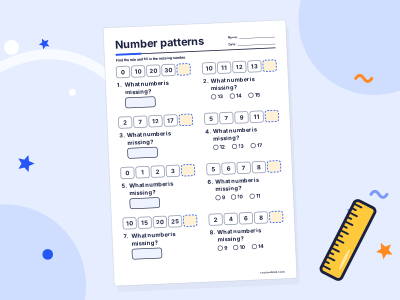
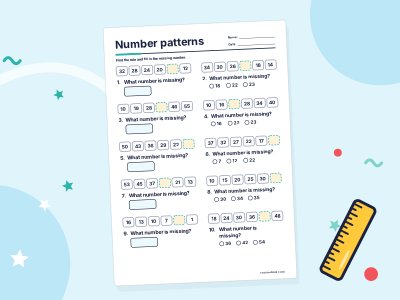
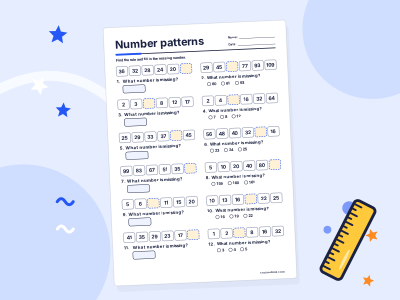
Number pattern and sequence practice
For grown-ups
Related topics
Odd and even numbers
Even numbers can be split into two equal groups or pairs with none left over (2, 4, 6…). Odd numbers always leave one left over (1, 3, 5…).
Algebra
Algebra is maths that uses letters, like x or n, to stand for numbers we don't know yet or numbers that can change. For example, if n + 3 = 10, then n = 7.
Square numbers
A square number is what you get when you multiply a whole number by itself, like 4 × 4 = 16. The first square numbers are 1, 4, 9, 16, 25 and 36.
Times tables
Times tables are lists of the multiplication facts for a number, such as 3 × 1 = 3 up to 3 × 12 = 36. Knowing them by heart speeds up almost all later maths.
Equations
An equation says two things are equal, using an = sign, like 2x + 1 = 9. Solving it means finding the value of the letter that makes it true, here x = 4.
Algorithm
An algorithm is a precise, step-by-step set of instructions for solving a problem or doing a task. Computers follow algorithms written as code.