Maths
What are odd and even numbers?
Quick answer
Even numbers can be split into two equal groups or pairs with none left over (2, 4, 6…). Odd numbers always leave one left over (1, 3, 5…).
In one sentence
An even number can be shared into pairs with nothing left over, and an odd number always has one left over.
Explained
Take 6 socks and pair them up. You get 3 pairs and every sock has a partner, so 6 is even. Try 7 socks: 3 pairs and one sad sock on its own, so 7 is odd.
 sock
sock- sock
- sock
- sock
- sock
- sock
- sock
When you count, the numbers take turns: odd, even, odd, even. 1 is odd, 2 is even, 3 is odd, and so on forever. Even numbers are exactly the numbers in the 2 times table.
For a big number you don't need to count anything. Just look at the last digit (the ones). If it is 0, 2, 4, 6 or 8, the number is even. If it is 1, 3, 5, 7 or 9, it is odd. So 4,718 is even and 90,003 is odd. This works because every ten and every hundred can be split into pairs already, so only the ones decide.
Odd and even numbers follow rules when you add them:
| Add | Result | Example |
|---|---|---|
| even + even | even | 4 + 6 = 10 |
| odd + odd | even | 5 + 3 = 8 |
| even + odd | odd | 4 + 5 = 9 |
For multiplying, the answer is odd only when both numbers are odd: 3 × 5 = 15, but 3 × 4 = 12.
Examples
- Even: 0, 2, 14, 36, 100, 572
- Odd: 1, 9, 23, 45, 101, 999
- 13 people want to play in pairs. 13 is odd, so one person needs a partner from somewhere.
- The house numbers on one side of many streets are odd and on the other side even.
Common mistakes
- Looking at the wrong digit. 58 starts with a 5, so some children call it odd. Fix: only the last digit counts. 58 ends in 8, so it is even.
- Thinking 0 is neither. Zero is even.
- Thinking only small numbers can be odd or even. Every whole number is one or the other, including negative numbers like −4 (even).
Quick quiz
Odd and even numbers
Check what you know with 4 quick questions.
Question 1 of 4
Which number is even?
Practise it
Try it
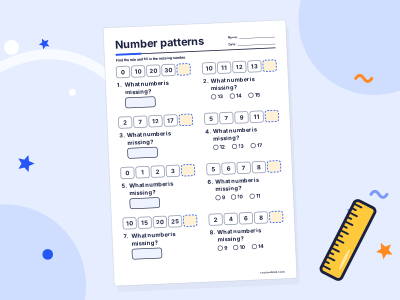
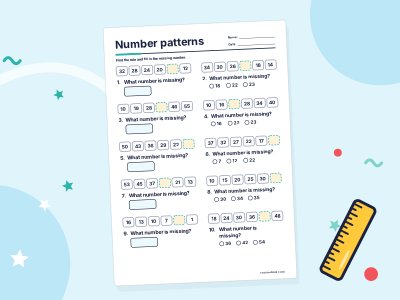
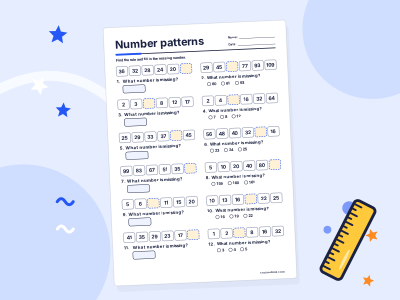
Odd, even and number pattern practice
For grown-ups
Related topics
Counting
Counting means saying one number for each thing in a group, in order, to find out how many there are. The last number you say is the total.
Division
Division is sharing into equal groups, or finding how many groups fit. The sign is ÷, so 12 ÷ 3 = 4. The answer is called the quotient.
Times tables
Times tables are lists of the multiplication facts for a number, such as 3 × 1 = 3 up to 3 × 12 = 36. Knowing them by heart speeds up almost all later maths.
Sequences
A sequence is a list of numbers or shapes that follows a rule, like 3, 7, 11, 15 (add 4 each time). Each item is called a term.
2D shapes
2D shapes are flat shapes with length and width but no thickness, like circles, triangles, squares and hexagons. You can draw them on paper.
3D shapes
3D shapes are solid shapes with length, width and height, like cubes, spheres, cylinders and pyramids. They have faces, edges and vertices.