Maths
What are square numbers?
Quick answer
A square number is what you get when you multiply a whole number by itself, like 4 × 4 = 16. The first square numbers are 1, 4, 9, 16, 25 and 36.
In one sentence
A square number is a number multiplied by itself, and you can always arrange that many dots into a perfect square.
Explained
Lay out tiles in a square: 3 rows of 3 uses 9 tiles. 4 rows of 4 uses 16. Those totals, 9 and 16, are square numbers. Try 10 tiles and you can't make a square without gaps or spares, so 10 is not a square number.
 window
We write squares with a small raised 2: 5² means 5 × 5 = 25. Say it "five squared". The little 2 is called a power or index (see powers and indices).
The square numbers up to 12² are:
| n | 1 | 2 | 3 | 4 | 5 | 6 | 7 | 8 | 9 | 10 | 11 | 12 |
|---|---|---|---|---|---|---|---|---|---|---|---|---|
| n² | 1 | 4 | 9 | 16 | 25 | 36 | 49 | 64 | 81 | 100 | 121 | 144 |
They are hiding in your times tables grid, running diagonally from the top-left corner.
There is a lovely pattern in the gaps between them: 1, 4, 9, 16, 25 go up by 3, 5, 7, 9, the odd numbers in order. Each time you grow the square by one row and one column, you add the next odd number of tiles.
Squares link straight to area: a square garden with sides of 6 m has an area of 6² = 36 m². Going backwards, from 36 to 6, is finding a square root.
Square numbers also have an odd number of factors. The factors of 36 are 1, 2, 3, 4, 6, 9, 12, 18 and 36, which is nine factors, because 6 pairs with itself.
Examples
- 1² = 1 (1 is a square number)
- 9² = 81
- 15² = 225
- 20² = 400 (2² = 4, then add two zeros)
- 0.5² = 0.25
- (−3)² = 9, since a negative times a negative is positive
Common mistakes
- Doubling instead of squaring. 6² is 36, not 12.
- Thinking 1 doesn't count. 1 × 1 = 1, so 1 is the first square number.
- Squaring only part of a number. 30² is 900, not 90. Fix: 30 × 30 = 3 × 3 × 10 × 10.
Quick quiz
Square numbers
Check what you know with 4 quick questions.
Question 1 of 4
What is 7 squared (7²)?
Practise it
Try it
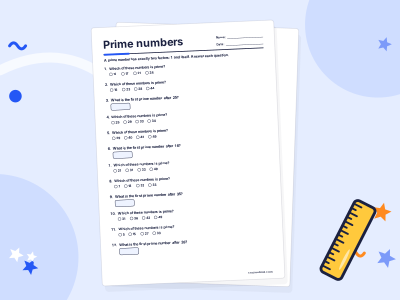
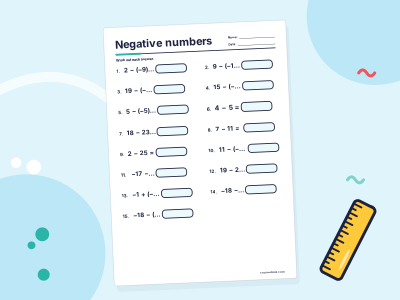
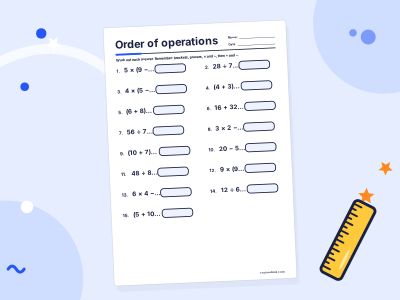
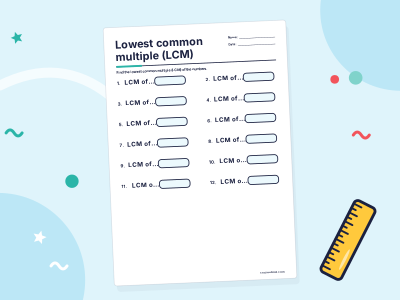
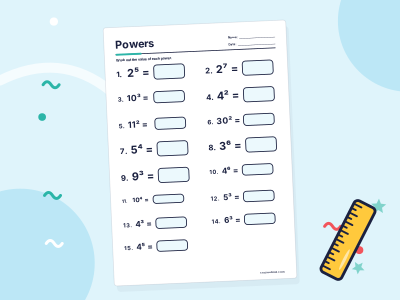
Squares, roots and powers practice

For grown-ups
Related topics
Square roots
The square root of a number is the value that, multiplied by itself, gives that number. The square root of 25 is 5, because 5 × 5 = 25. The sign is √.
Powers and indices
A power (also called an index or exponent) is a small raised number showing how many times to multiply a number by itself. So 2⁴ means 2 × 2 × 2 × 2 = 16.
Times tables
Times tables are lists of the multiplication facts for a number, such as 3 × 1 = 3 up to 3 × 12 = 36. Knowing them by heart speeds up almost all later maths.
Area
Area is the amount of flat space inside a shape, measured in square units like cm² or m². A rectangle 4 cm by 3 cm has an area of 4 × 3 = 12 cm².
Prime numbers
A prime number is a whole number greater than 1 that has exactly two factors, 1 and itself. The first primes are 2, 3, 5, 7, 11 and 13.
Sequences
A sequence is a list of numbers or shapes that follows a rule, like 3, 7, 11, 15 (add 4 each time). Each item is called a term.