Maths
What are powers and indices?
Quick answer
A power (also called an index or exponent) is a small raised number showing how many times to multiply a number by itself. So 2⁴ means 2 × 2 × 2 × 2 = 16.
In one sentence
A power tells you how many copies of a number to multiply together, so 5³ = 5 × 5 × 5 = 125.
Explained
Writing 3 × 3 × 3 × 3 × 3 is tiring. Instead we write 3⁵. The big number, 3, is the base. The small raised number, 5, is the power. In the UK the raised number is also called the index (plural indices); in the US it is usually the exponent. All three words mean the same thing.
- 4² = 4 × 4 = 16 ("four squared", see square numbers)
- 4³ = 4 × 4 × 4 = 64 ("four cubed")
- 4⁴ = 256 ("four to the power of four")
 rocket
 planet
Powers grow incredibly fast. Fold a piece of paper in half and it is 2 layers thick. Fold again: 4. After 10 folds it would be 2¹⁰ = 1,024 layers. That doubling is why computers count in powers of 2 (1 kilobyte was traditionally 2¹⁰ bytes).
Powers of 10 are tied to place value: 10² = 100, 10³ = 1,000, 10⁶ = 1,000,000.
Index laws (for the same base):
| Rule | Example |
|---|---|
| Multiply: add the powers | 2³ × 2⁴ = 2⁷ |
| Divide: subtract the powers | 5⁶ ÷ 5² = 5⁴ |
| Power of a power: multiply | (3²)³ = 3⁶ |
| Power zero | 9⁰ = 1 |
| Negative power: one over | 2⁻³ = 1/2³ = 1/8 |
Why is 9⁰ = 1? Look at the pattern 9³ = 729, 9² = 81, 9¹ = 9. Each step divides by 9. One more step gives 9 ÷ 9 = 1.
Powers come early in the order of operations: in 2 + 3², do the power first, giving 2 + 9 = 11.
Examples
- 6² = 36
- 2³ = 8
- 1⁵⁰ = 1
- (−2)³ = −8
- 3 × 10⁵ = 300,000
- x² × x³ = x⁵
Common mistakes
- Multiplying the base by the power. 3⁴ is 81, not 12.
- Adding powers with different bases. 2³ × 5² cannot be combined into one power.
- Forgetting brackets with negative numbers. −3² means −(3²) = −9, but (−3)² = 9. Brackets matter.
Quick quiz
Powers and indices
Check what you know with 5 quick questions.
Question 1 of 5
What is 2⁵?
Practise it
Try it
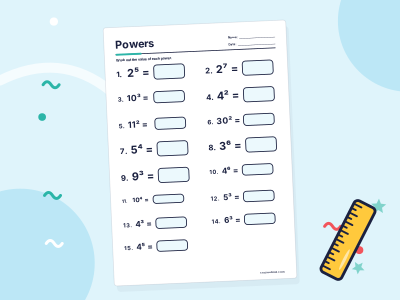
Powers and indices practice

For grown-ups
Related topics
Square numbers
A square number is what you get when you multiply a whole number by itself, like 4 × 4 = 16. The first square numbers are 1, 4, 9, 16, 25 and 36.
Square roots
The square root of a number is the value that, multiplied by itself, gives that number. The square root of 25 is 5, because 5 × 5 = 25. The sign is √.
Order of operations
The order of operations is the agreed order for working out calculations: brackets, then powers, then × and ÷, then + and −. UK pupils learn it as BIDMAS; US pupils as PEMDAS.
Place value
Place value means a digit's value depends on its position in a number. In 352, the 3 is worth 300, the 5 is worth 50 and the 2 is worth 2.
Volume
Volume is the amount of space a 3D object takes up, measured in cubic units like cm³ or m³. A box 4 cm by 3 cm by 2 cm has a volume of 24 cm³.
Factors and multiples
Factors are numbers that divide exactly into a number (the factors of 12 are 1, 2, 3, 4, 6 and 12). Multiples are the numbers in its times table (12, 24, 36…).