Maths
What is a logarithm, and how do logarithms work?
Quick answer
A logarithm answers the question "what power?". log₂ 8 = 3 because 2³ = 8. Logs undo exponents, and their rules turn multiplying into adding.



In one sentence
A logarithm tells you the power: log₂ 8 asks "2 to what power gives 8?", and the answer is 3.
Explained
You already know how to ask "what is 2 to the power 3?" (it is 8). A logarithm asks the same thing backwards: "2 to what power makes 8?". We write that question as log₂ 8, say it as "log base 2 of 8", and its answer is 3. So the definition is:
log_b x = y means exactly the same as b^y = x
The small number b is the base, x is the number you take the log of (it must be positive), and y, the answer, is a power. If you are comfortable with powers and indices, you already know most of what you need: logarithms and exponents are two ways of writing the same fact, and a log "undoes" an exponent the way subtraction undoes addition.
Two bases have their own buttons on a calculator. log (with no base written) means base 10, the common logarithm: log 1000 = 3 because 10³ = 1000. ln means base e, the natural logarithm, where e ≈ 2.718 is a special number that turns up in growth, interest and calculus. ln e = 1 for the same reason log 10 = 1.
 lemon
 wave
 star
Why bother? Because logs shrink huge ranges into small, friendly numbers. log 10 = 1, log 1,000,000 = 6, log 1,000,000,000 = 9. Each step of 1 means "ten times bigger". That is how the pH scale works (pH 3 is ten times more acidic than pH 4), how decibels work (every extra 10 dB is ten times the sound intensity) and why big numbers in scientific notation are easy to compare: the power of 10 is the common log, roughly.
Logs also turn multiplying into adding. In 1614 the Scottish mathematician John Napier published the first tables of logarithms, and Henry Briggs soon made base-10 tables. For more than 300 years scientists and engineers multiplied big numbers by looking up their logs, adding them, and looking the answer back up. Slide rules worked the same way.
Finally, logs are the tool for solving equations where the unknown is in the exponent, like 3^x = 20. You cannot get x down from up there with ordinary algebra, but a logarithm can.
Examples
| Logarithm | Ask: base to what power? | Answer |
|---|---|---|
| log₂ 8 | 2³ = 8 | 3 |
| log₁₀ 1000 | 10³ = 1000 | 3 |
| log₅ 25 | 5² = 25 | 2 |
| log₃ (1/9) | 3⁻² = 1/9 | −2 |
| log₄ 2 | 4^½ = √4 = 2 | ½ |
| log₇ 1 | 7⁰ = 1 | 0 |
The laws of logarithms (for any base b, with M and N positive):
- Product rule: log_b (MN) = log_b M + log_b N
- Quotient rule: log_b (M ÷ N) = log_b M − log_b N
- Power rule: log_b (M^k) = k · log_b M
- Special values: log_b b = 1 and log_b 1 = 0
- Change of base: log_b x = log x ÷ log b (use this for any base on a calculator)
Worked example: solve 3^x = 20. Take logs of both sides: log 3^x = log 20. The power rule gives x · log 3 = log 20, so x = log 20 ÷ log 3 ≈ 1.3010 ÷ 0.4771 ≈ 2.73. Check: 3^2.73 ≈ 20.07, just over 20 (2.73 is rounded).
Common mistakes
- Splitting the log of a sum. log (M + N) is not log M + log N. The product rule is about log (M × N). log 2 + log 3 = log 6, not log 5.
- Treating a fraction of logs as a log of a fraction. log 100 ÷ log 10 = 2 ÷ 1 = 2, but log (100 ÷ 10) = log 10 = 1. The quotient rule is log M − log N.
- Taking the log of 0 or a negative number. No power of a positive base gives 0 or a negative, so log 0 and log (−5) do not exist (in real numbers). Always check your answers to log equations.
- Swapping the base and the number. log₂ 8 = 3, but log₈ 2 = ⅓. Read it as "base 2, what power gives 8?".
Step by step
Step by step
- Turn the log into a power questionFor log_b x, ask "b to what power equals x?". For log₄ 64, ask "4 to what power is 64?".
- Write x as a power of b if you can64 = 4³, so log₄ 64 = 3. Fractions give negative powers and roots give fractional powers.
- Otherwise use the calculatorUse change of base: log_b x = log x ÷ log b. For log₂ 10, type log 10 ÷ log 2 ≈ 3.32.
- To solve b^x = c, take logs of both sidesThe power rule brings x down: x · log b = log c, so x = log c ÷ log b.
- CheckPut your answer back in. For a log equation, throw away any answer that makes you take the log of zero or a negative number.
To simplify a group of logs, first use the power rule to move any number in front of a log up into the exponent, then combine with the product and quotient rules into a single log. For example, 2 log 5 + log 4 = log 25 + log 4 = log 100 = 2.
Practice questions
Logarithms: evaluate, simplify, solve
Try each one, then check your answer.
- Evaluate log₂ 16.
Show answer
2⁴ = 16, so 4 - Evaluate log₁₀ 100,000.
Show answer
10⁵ = 100,000, so 5 - Evaluate log₃ 81.
Show answer
3⁴ = 81, so 4 - Evaluate log₅ 1.
Show answer
5⁰ = 1, so 0 - Evaluate log₂ (1/8).
Show answer
1/8 = 2⁻³, so −3 - Evaluate log₉ 3.
Show answer
9^½ = √9 = 3, so ½ - Write 2⁶ = 64 as a logarithm.
Show answer
log₂ 64 = 6 - Write log₄ 64 = 3 in exponential form.
Show answer
4³ = 64 - Simplify log₆ 4 + log₆ 9.
Show answer
log₆ (4 × 9) = log₆ 36 = 2 (because 6² = 36) - Simplify log₂ 40 − log₂ 5.
Show answer
log₂ (40 ÷ 5) = log₂ 8 = 3 - Evaluate 2 log 5 + log 4 (base 10).
Show answer
log 25 + log 4 = log 100 = 2 - Expand log (x³y) as a sum of logs.
Show answer
log x³ + log y = 3 log x + log y - Solve log₃ x = 4.
Show answer
x = 3⁴ = 81 - Solve 2^x = 50, to 2 decimal places.
Show answer
x = log 50 ÷ log 2 ≈ 1.69897 ÷ 0.30103 ≈ 5.64 - Solve log₂ x + log₂ (x − 2) = 3.
Show answer
log₂ (x(x − 2)) = 3, so x² − 2x = 8, x² − 2x − 8 = 0, (x − 4)(x + 2) = 0. x = −2 would need the log of a negative number, so x = 4
Word problems
Logarithms in real life
Try each one, then check your answer.
- A colony of 100 bacteria doubles every hour. After how many hours are there 6,400?
Show answer
100 · 2^t = 6400, so 2^t = 64 = 2⁶: after 6 hours - You save $1,000 at 5% interest a year, added once a year. When does it first reach $2,000?
Show answer
1.05^t = 2, t = log 2 ÷ log 1.05 ≈ 14.2, so it first passes $2,000 after 15 years ($2,078.93) - A town of 5,000 people grows by 3% a year. Roughly when will it reach 8,000?
Show answer
1.03^t = 1.6, t = log 1.6 ÷ log 1.03 ≈ 15.9 years - Lemon juice has a pH of about 2 and tomato juice about 4. How many times more acidic is the lemon juice?
Show answer
Each pH step is ×10, so 10² = 100 times (in hydrogen-ion concentration) - A street is 70 dB loud and a quiet office is 50 dB. How many times more intense is the street noise?
Show answer
20 dB more is two steps of 10 dB: 10 × 10 = 100 times
Questions people ask
What is a logarithm in simple words?
It is the power you need. log₁₀ 100 = 2 because you need to raise 10 to the power 2 to get 100. A log is an exponent, written the other way round.
What are the rules of logarithms?
The three main laws are the product rule log (MN) = log M + log N, the quotient rule log (M/N) = log M − log N and the power rule log (Mᵏ) = k log M. Add log_b b = 1, log_b 1 = 0 and the change-of-base rule, and you can handle almost any log question in school.
What is the difference between log and ln?
Both are logarithms with a different base. "log" on a calculator is base 10; "ln" is the natural log, base e ≈ 2.718. Any log can be turned into the other: ln x = log x ÷ log e.
How do you do logarithms on a calculator?
For base 10 press log, for base e press ln. For any other base, use change of base: log₂ 50 = log 50 ÷ log 2 ≈ 5.64. Many scientific calculators also have a log key with a box for the base.
How are logarithms related to exponential functions?
They are inverses. y = log_b x undoes y = bˣ, so their graphs are mirror images of each other in the line y = x. That is why logs are used to solve exponential equations.
What is an antilogarithm?
The antilog undoes the log: it is just the power. The antilog of 2 (base 10) is 10² = 100. Old log tables had antilog tables to turn answers back into ordinary numbers.
What are logarithms used for in real life?
Measuring things with huge ranges (pH in chemistry, decibels for sound, star brightness), working out how long growth or decay takes (savings, populations, half-life), and in computing, where log₂ tells you how many times you can halve something.
Quick quiz
Logarithms
Check what you know with 5 quick questions.
Question 1 of 5
What is log₂ 32?
Practise it
Try it
Practise logarithms with unlimited questions
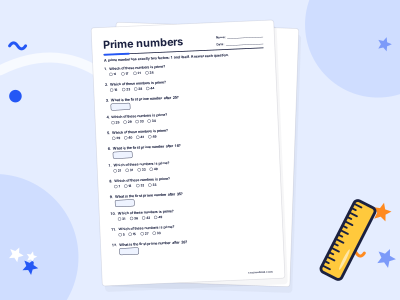
Powers and roots worksheets

Practise it step by step in a full course: Grade 11 Maths
For grown-ups
Related topics

Powers and indices
A power (also called an index or exponent) is a small raised number showing how many times to multiply a number by itself. So 2⁴ means 2 × 2 × 2 × 2 = 16.

Scientific notation
Scientific notation writes very large or very small numbers as a number from 1 to 10 times a power of 10. For example, 3,500,000 is 3.5 × 10⁶. In the UK it is called standard form.

Equations
An equation says two things are equal, using an = sign, like 2x + 1 = 9. Solving it means finding the value of the letter that makes it true, here x = 4.

Algebra
Algebra is maths that uses letters, like x or n, to stand for numbers we don't know yet or numbers that can change. For example, if n + 3 = 10, then n = 7.
Inverse functions
An inverse function f⁻¹ undoes f: if f(3) = 7, then f⁻¹(7) = 3. To find it, write y = f(x), swap x and y, then solve for y.

Cube numbers and cube roots
A cube number is a number multiplied by itself three times, like 4³ = 4 × 4 × 4 = 64. The cube root undoes it, so ∛64 = 4.