Maths
What is an equation and how do you solve one?
Quick answer
An equation says two things are equal, using an = sign, like 2x + 1 = 9. Solving it means finding the value of the letter that makes it true, here x = 4.
In one sentence
An equation is a maths sentence with an equals sign, and solving it means finding the missing number that makes both sides balance.
Explained
The equals sign does not mean "here comes the answer". It means "is the same as". In 3 + 5 = 2 + 6, both sides are worth 8, so the equation is true.
Think of an equation as a set of old-fashioned weighing scales. Whatever is on the left weighs exactly the same as whatever is on the right.
 apple
apple- apple
- apple
 box
box
In algebra, one part of the equation is unknown. Take x + 4 = 11. To find x, take 4 away from both sides so the scales stay balanced: x = 11 − 4 = 7.
The golden rule: whatever you do to one side, do to the other. Each step uses the inverse (opposite) operation to peel away what has been done to the letter:
- undoes −, and − undoes +
- × undoes ÷, and ÷ undoes ×
Two-step equations. Solve 2x + 3 = 13.
- Subtract 3 from both sides: 2x = 10.
- Divide both sides by 2: x = 5.
- Check by putting it back in: 2 × 5 + 3 = 13. ✓
Undo the adding or subtracting first, then the multiplying or dividing. That is the order of operations in reverse.
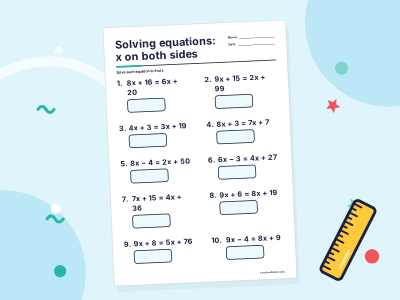
Letters on both sides. For 7x − 4 = 3x + 8, first get the letters together. Subtract 3x from both sides: 4x − 4 = 8. Add 4: 4x = 12. Divide by 4: x = 3.
Real problems become equations too. "I think of a number, multiply it by 5 and subtract 6. The answer is 29." That is 5n − 6 = 29, so 5n = 35 and n = 7.
Examples
| Equation | Steps | Answer |
|---|---|---|
| x − 9 = 4 | add 9 | x = 13 |
| 6m = 54 | ÷ 6 | m = 9 |
| p/3 = 5 | × 3 | p = 15 |
| 4k + 1 = 25 | − 1, then ÷ 4 | k = 6 |
| 2(t + 3) = 18 | ÷ 2, then − 3 | t = 6 |
| 10 − y = 4 | add y, then − 4 | y = 6 |
Common mistakes
- Doing something to one side only. Fix: write the operation on both sides, every line.
- Using the wrong inverse, such as adding 3 to "undo" 3x. Multiplying is undone by dividing.
- Not checking. Substituting the answer back takes ten seconds and catches most errors.
- Getting the sign wrong in equations like 10 − y = 4. Fix: add y to both sides first.
Quick quiz
Equations
Check what you know with 5 quick questions.
Question 1 of 5
Solve x + 7 = 15.
Practise it
Try it
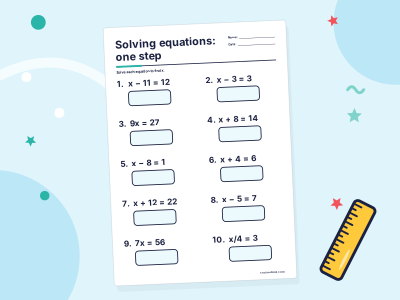
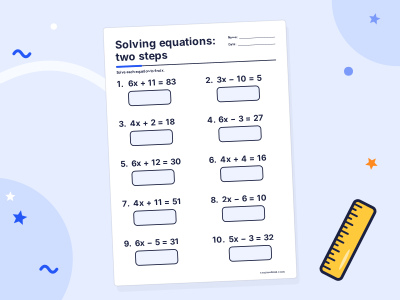
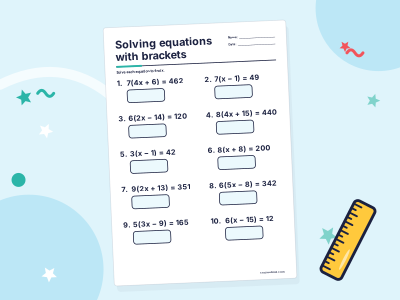
Equation and algebra practice
For grown-ups
Related topics
Algebra
Algebra is maths that uses letters, like x or n, to stand for numbers we don't know yet or numbers that can change. For example, if n + 3 = 10, then n = 7.
Order of operations
The order of operations is the agreed order for working out calculations: brackets, then powers, then × and ÷, then + and −. UK pupils learn it as BIDMAS; US pupils as PEMDAS.
Sequences
A sequence is a list of numbers or shapes that follows a rule, like 3, 7, 11, 15 (add 4 each time). Each item is called a term.
Subtraction
Subtraction is taking one amount away from another, or finding the difference between two numbers. The sign is −, so 9 − 4 = 5.
Mean, median and mode
Mean, median and mode are three kinds of average. The mean shares the total out equally, the median is the middle value in order, and the mode is the most common value.
Pi (π)
Pi (π) is the number you get when you divide any circle's circumference by its diameter. It is about 3.14, and its digits go on forever without repeating.