Maths
What is an inequality in maths, and how do you solve one?
Quick answer
An inequality compares two values with <, >, ≤ or ≥, like x + 2 > 5. Solve it like an equation, but flip the sign if you multiply or divide both sides by a negative number.


In one sentence
An inequality says that one amount is bigger or smaller than another, and solving it tells you all the numbers that make it true.
Explained
An equation says two things are equal. An inequality says they are not, and tells you which side is bigger. You meet inequalities every day: "you must be at least 120 cm tall to ride", "the speed limit is 30 mph", "children under 5 travel free".
 ruler
 car
 clock
There are four main symbols:
| Symbol | Meaning | Example |
|---|---|---|
| < | less than | 3 < 7 |
| > | greater than | 10 > −2 |
| ≤ | less than or equal to | x ≤ 5 |
| ≥ | greater than or equal to | age ≥ 18 |
A memory trick: the open mouth always faces the bigger number, and the line underneath ≤ and ≥ means "or equal to".
An equation like x + 2 = 5 has one answer, x = 3. The inequality x + 2 > 5 has infinitely many: 3.1, 4, 10, a million. So we write the answer as an inequality too: x > 3.
Show solutions on a number line:
- Open (empty) circle for < and >: the number itself is not included.
- Filled (closed) circle for ≤ and ≥: the number is included.
- Then draw an arrow or a thick line in the direction of the solutions.
You can also use interval notation: x > 3 is (3, ∞) and x ≤ 5 is (−∞, 5]. A round bracket means "not included", a square bracket means "included".
Solving works almost exactly like solving an equation: add, subtract, multiply or divide both sides by the same number. There is one big extra rule. When you multiply or divide both sides by a negative number, flip the inequality sign. Here is why: 2 < 5 is true, but multiply both sides by −1 and you get −2 and −5, and on the number line −2 is to the *right* of −5, so −2 > −5. The order reverses, and so must the sign. This is why negative numbers need extra care here.
A double inequality such as −2 < x ≤ 4 means x is between −2 and 4: bigger than −2, and at most 4. On the number line it is a segment with an open circle at −2 and a filled circle at 4.
Examples
| Inequality | Working | Solution |
|---|---|---|
| x + 7 < 12 | subtract 7 | x < 5 |
| 3x ≥ 18 | divide by 3 | x ≥ 6 |
| 2x − 5 > 9 | add 5, then divide by 2 | x > 7 |
| −4x < 20 | divide by −4 and flip | x > −5 |
| 1 ≤ x + 3 < 6 | subtract 3 from all three parts | −2 ≤ x < 3 |
Worked example: a cinema ticket costs $8 and you have $30. How many tickets can you buy? Write 8t ≤ 30, so t ≤ 3.75. You cannot buy part of a ticket, so the answer is at most 3 tickets. Real-life answers often need whole numbers, so always check what the question allows.
Common mistakes
- Forgetting to flip the sign. −2x > 6 gives x < −3, not x > −3. Fix: whenever you multiply or divide by a negative, flip it.
- Flipping when you do not need to. Adding or subtracting a negative number does not flip the sign: x + (−3) > 1 gives x > 4.
- Using the wrong circle. Fix: ≤ and ≥ get a filled circle (the number counts); < and > get an open circle.
- Writing a single number as the answer. x > 3 is the answer, not "3". Check with a number from your solution, like x = 4, to be sure it works.
Step by step
Step by step
- Simplify each sideExpand brackets and collect like terms, just as with an equation.
- Get the x terms on one sideAdd or subtract terms on both sides. This never changes the sign.
- Isolate xDivide (or multiply) both sides by the number in front of x.
- Flip if negativeIf that number was negative, reverse the sign: < becomes >, ≤ becomes ≥.
- Check and showTest one value inside your solution and one outside, then draw it on a number line if asked.
For a double inequality like −3 < 2x + 1 ≤ 9, do the same thing to all three parts at once: subtract 1 to get −4 < 2x ≤ 8, then divide by 2 to get −2 < x ≤ 4.
Practice questions
Solve the inequality
Try each one, then check your answer.
- Write "x is at least 7" as an inequality.
Show answer
"At least" includes 7: x ≥ 7 - Is x = 4 a solution of 3x − 2 > 10?
Show answer
3 × 4 − 2 = 10, and 10 > 10 is false, so no. - Solve x + 5 < 12.
Show answer
Subtract 5: x < 7 - Solve 2x − 3 > 9.
Show answer
2x > 12, so x > 6 - Solve x ÷ 3 ≤ 4.
Show answer
Multiply by 3: x ≤ 12 - Solve −2x < 8.
Show answer
Divide by −2 and flip: x > −4 - Solve 5 − x ≥ 2.
Show answer
−x ≥ −3; multiply by −1 and flip: x ≤ 3 - Solve 3x + 4 ≤ x + 10.
Show answer
2x ≤ 6, so x ≤ 3 - Solve 7 − 3x > 1.
Show answer
−3x > −6; divide by −3 and flip: x < 2 - Solve 2(x − 1) ≥ 3x − 5.
Show answer
2x − 2 ≥ 3x − 5, so −x ≥ −3 and x ≤ 3 - Solve −x ÷ 2 > 3.
Show answer
Multiply by −2 and flip: x < −6 - Solve −3 < 2x + 1 ≤ 9.
Show answer
−4 < 2x ≤ 8, so −2 < x ≤ 4 - List the integers that satisfy −2 < x ≤ 3.
Show answer
−1, 0, 1, 2, 3 (−2 is not included, 3 is) - How do you draw x ≤ 5 on a number line?
Show answer
A filled circle at 5 and an arrow pointing left - What is the smallest whole number n with 3n > 14?
Show answer
n > 14 ÷ 3 ≈ 4.67, so n = 5
Word problems
Inequalities in real life
Try each one, then check your answer.
- You must be at least 120 cm tall to go on a ride. Write an inequality for the height h.
Show answer
h ≥ 120 (in cm) - Cinema tickets cost $9 each and you have $50. How many tickets can you buy?
Show answer
9t ≤ 50, so t ≤ 5.55…: at most 5 tickets - A taxi charges $4 plus $2 per km, and you have $25. How far can you go?
Show answer
4 + 2d ≤ 25, 2d ≤ 21: at most 10.5 km - Sam scored 72 and 85 in two tests. What does she need in the third test for a mean of at least 80?
Show answer
(72 + 85 + x) ÷ 3 ≥ 80, so 157 + x ≥ 240: at least 83 - A lift can carry at most 600 kg. A worker weighing 80 kg loads boxes of 25 kg. How many boxes can go with him?
Show answer
80 + 25b ≤ 600, 25b ≤ 520, b ≤ 20.8: at most 20 boxes - Plan A costs $20 a month plus $0.10 a minute. Plan B costs $35 a month. For how many minutes is plan A cheaper?
Show answer
20 + 0.1m < 35, 0.1m < 15: fewer than 150 minutes
Questions people ask
What is an inequality in maths?
It is a statement that compares two values using <, >, ≤ or ≥ instead of =. For example, x + 1 > 4 says "x plus 1 is greater than 4", which is true for every x greater than 3.
How do you solve inequalities?
Use the same steps as for an equation: add, subtract, multiply or divide both sides by the same number. The one difference: if you multiply or divide by a negative number, flip the inequality sign.
Why do you flip the sign when dividing by a negative?
Multiplying by a negative reverses the order of numbers. 2 < 5, but −2 > −5, because −2 is further right on the number line. Flipping the sign keeps the statement true.
How do you show inequalities on a number line?
Put a circle on the boundary number: open for < or >, filled for ≤ or ≥. Then shade or draw an arrow towards the numbers that work: left for "less than", right for "greater than".
What is interval notation?
It writes the solution as a range. Round brackets leave the end out and square brackets include it: −2 < x ≤ 4 is (−2, 4], and x ≥ 1 is [1, ∞). Infinity always gets a round bracket.
How do you solve inequalities with absolute value?
|x| < 3 means x is less than 3 away from 0, so −3 < x < 3. |x| > 3 means more than 3 away, so x < −3 or x > 3. For |x − 1| < 3, solve −3 < x − 1 < 3 to get −2 < x < 4.
How do you graph an inequality with two variables?
Draw the line (for y > 2x + 1, draw y = 2x + 1): dashed for < or >, solid for ≤ or ≥. Then shade the side that works. Test the point (0, 0): 0 > 1 is false, so shade the side without the origin, above the line.
Quick quiz
Inequalities
Check what you know with 5 quick questions.
Question 1 of 5
Which symbol means "less than or equal to"?
Practise it
Try it
Practise inequalities with unlimited questions
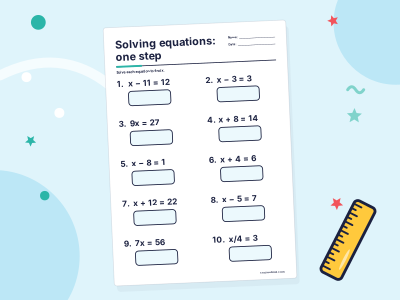
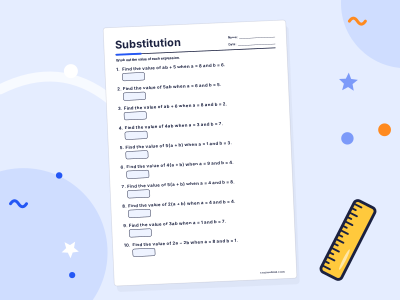
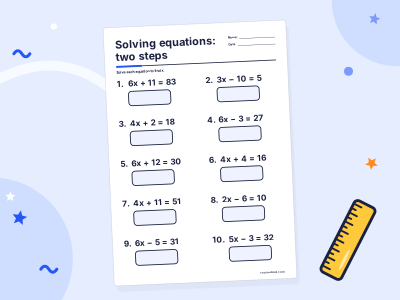
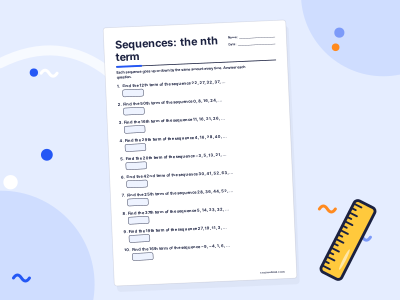
Algebra worksheets
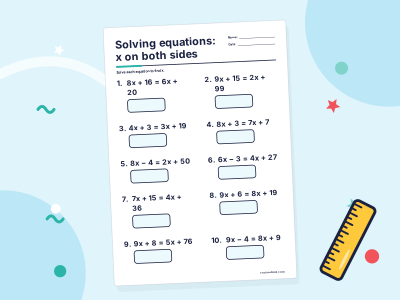
Practise it step by step in a full course: Grade 9 Maths
For grown-ups
Related topics

Equations
An equation says two things are equal, using an = sign, like 2x + 1 = 9. Solving it means finding the value of the letter that makes it true, here x = 4.
Number line
A number line is a straight line with numbers marked at equal steps, smallest on the left and biggest on the right. It helps you count, compare, add and subtract.

Negative numbers
Negative numbers are numbers less than zero, written with a minus sign, like −3. You meet them in cold temperatures, bank overdrafts and floors below ground.

Algebra
Algebra is maths that uses letters, like x or n, to stand for numbers we don't know yet or numbers that can change. For example, if n + 3 = 10, then n = 7.

Completing the square
Completing the square rewrites x² + bx + c as (x + b/2)² − (b/2)² + c. It solves quadratics, finds the vertex (turning point) of a parabola and proves the quadratic formula.

Composite functions
A composite function applies one function and then another. f(g(x)), also written (f ∘ g)(x) or fg(x), means do g first, then put the answer into f.