Maths
What is a square root?
Quick answer
The square root of a number is the value that, multiplied by itself, gives that number. The square root of 25 is 5, because 5 × 5 = 25. The sign is √.
In one sentence
A square root undoes squaring: it asks "what number times itself gives this?"
Explained
You know that 6 × 6 = 36, so 36 is a square number. Going backwards, the square root of 36 is 6. We write it √36 = 6. The tick-like sign is called a radical or root sign.
Picture a square carpet. If you know its area is 49 m², the square root tells you the length of one side: √49 = 7 m. That is where the name comes from: the root is the side of the square.
 mat
mat
For square numbers, the root is a whole number:
| Number | 1 | 4 | 9 | 16 | 25 | 36 | 49 | 64 | 81 | 100 | 144 |
|---|---|---|---|---|---|---|---|---|---|---|---|
| √ | 1 | 2 | 3 | 4 | 5 | 6 | 7 | 8 | 9 | 10 | 12 |
Most numbers are not square numbers, and their roots are long decimals that never end or repeat. √2 = 1.41421…, for example. You can still estimate them using the squares you know. For √30: 5² = 25 and 6² = 36, so √30 is between 5 and 6, a little closer to 5. A calculator says 5.477…
Strictly, every positive number has two square roots, because (−6) × (−6) = 36 as well. The √ sign means the positive one. When solving x² = 36, older students write x = 6 or x = −6 (often shown as ±6).
There are other roots too. The cube root ∛ undoes cubing: ∛64 = 4 because 4 × 4 × 4 = 64.
Square roots are essential for Pythagoras' theorem, where you often finish by finding a root.
Examples
- √9 = 3
- √100 = 10
- √400 = 20 (since 20 × 20 = 400)
- √0.25 = 0.5 (since 0.5 × 0.5 = 0.25)
- √20 is about 4.47 (between 4 and 5)
- ∛125 = 5
Common mistakes
- Halving instead of rooting. √16 is 4, not 8. Fix: check by multiplying your answer by itself.
- Thinking √ of a big number is always a decimal. √10,000 = 100 exactly.
- Adding roots like ordinary numbers. √9 + √16 = 3 + 4 = 7, but √25 = 5. You can't just add under the root sign.
Quick quiz
Square roots
Check what you know with 4 quick questions.
Question 1 of 4
What is √81?
Practise it
Try it
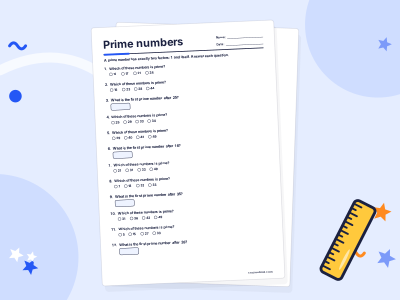
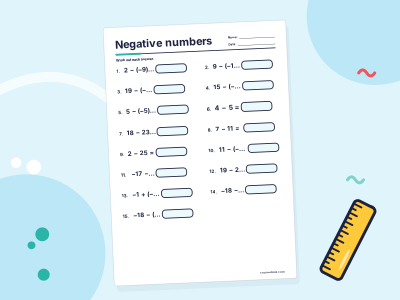
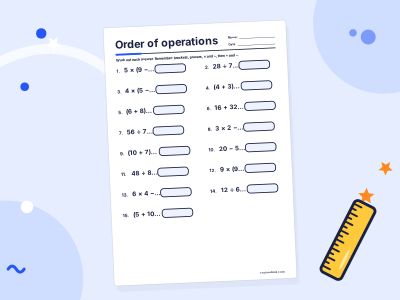
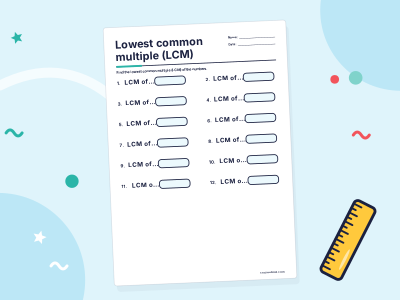
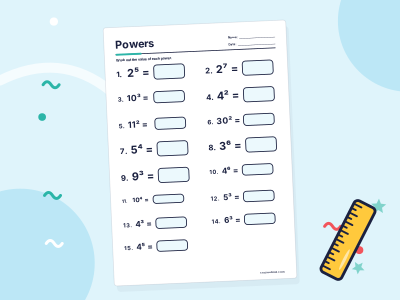
Square roots and powers practice

For grown-ups
Related topics
Square numbers
A square number is what you get when you multiply a whole number by itself, like 4 × 4 = 16. The first square numbers are 1, 4, 9, 16, 25 and 36.
Powers and indices
A power (also called an index or exponent) is a small raised number showing how many times to multiply a number by itself. So 2⁴ means 2 × 2 × 2 × 2 = 16.
Pythagoras' theorem
Pythagoras' theorem says that in a right-angled triangle, a² + b² = c², where c is the longest side (the hypotenuse). For sides 3 and 4, the hypotenuse is 5.
Estimation
Estimating means making a sensible guess at an answer, usually by rounding the numbers first. It tells you roughly what to expect and helps you spot mistakes.
Pi (π)
Pi (π) is the number you get when you divide any circle's circumference by its diameter. It is about 3.14, and its digits go on forever without repeating.
Factors and multiples
Factors are numbers that divide exactly into a number (the factors of 12 are 1, 2, 3, 4, 6 and 12). Multiples are the numbers in its times table (12, 24, 36…).