Maths
What are surds (radicals), and how do you simplify them?
Quick answer
A surd is a root that cannot be written as a whole number or fraction, like √2 or √5. In the US they are called radicals. Simplify them with √(ab) = √a × √b, so √12 = 2√3.



In one sentence
A surd is a square root (or other root) that does not come out exactly, like √2, so we leave it as a root to keep the answer exact.
Explained
Some square roots are whole numbers: √9 = 3 and √25 = 5. Most are not. √2 = 1.41421356… and the digits go on forever without repeating, so √2 is an irrational number. When we write such a root with the root sign, instead of rounding it, we call it a surd. √2, √3, √5, √10 and ∛2 are surds. √9, √(4/9) and ∛8 are not, because they equal 3, ⅔ and 2.
Surds or radicals? "Surd" is the word used in the UK, Ireland, Australia, India and many other countries. In the US the same topic is usually called radicals or simplifying radicals, and "simplest radical form" means the same as "simplified surd form". The √ sign is the radical sign, the number under it is the radicand, and a small number on the sign, like the 3 in ∛, is the index. The rules below are identical whichever word your teacher uses.
 ruler
 pencil
 board
Why not just use a calculator? Because a decimal is only an approximation, and a surd is exact. If a square has sides of 1 m, Pythagoras' theorem says its diagonal is √(1² + 1²) = √2 m. Writing 1.41 m is close; writing √2 m is exactly right, and it stays exact through the rest of a calculation. Surds turn up everywhere in geometry and trigonometry: sin 60° is exactly √3/2.
The key rule is that roots can be split over multiplication and division:
√(ab) = √a × √b and √(a/b) = √a ÷ √b
To simplify a surd, find the largest square number that divides the number under the root, and take its root outside. √50 = √(25 × 2) = √25 × √2 = 5√2. If you cannot spot a square factor, a prime factorisation helps: 72 = 2 × 2 × 2 × 3 × 3, and each pair of equal primes comes out as one number, so √72 = 2 × 3 × √2 = 6√2.
You can add and subtract only like surds, ones with the same number under the root, just as you can add 3x + 5x but not 3x + 5y. So 3√2 + 5√2 = 8√2, but √2 + √3 stays as it is. Often you have to simplify first to see that surds are alike: √18 + √8 = 3√2 + 2√2 = 5√2.
Finally, a surd in the bottom of a fraction is usually removed. This is called rationalising the denominator: multiply the top and bottom by the surd, because √a × √a = a. For 6/√3, multiply by √3/√3 to get 6√3/3 = 2√3.
Surds also connect to indices: a square root is a power of one half, √a = a^½, and a cube root is a^⅓. That is why "surds and indices" are often taught together.
Examples
| Expression | Working | Simplest form |
|---|---|---|
| √12 | √4 × √3 | 2√3 |
| √50 | √25 × √2 | 5√2 |
| √72 | √36 × √2 | 6√2 |
| √2 × √8 | √16 | 4 |
| 3√5 + 2√5 | like surds | 5√5 |
| √18 + √8 | 3√2 + 2√2 | 5√2 |
| 6/√3 | 6√3/3 | 2√3 |
| √(9x²), x ≥ 0 | √9 × √(x²) | 3x |
| √(a³), a ≥ 0 | √(a²) × √a | a√a |
Common mistakes
- Adding under the root. √9 + √16 = 3 + 4 = 7, but √25 = 5. So √a + √b is not √(a + b). Only multiplication and division split.
- Not taking out the largest square. √72 = 2√18 is true but not finished, because √18 = 3√2. Use the largest square factor (36) and you get 6√2 in one step.
- Mixing up the number in front and the number inside. 3√2 means 3 × √2 ≈ 4.24, not √32. To put the 3 back inside you square it: 3√2 = √(9 × 2) = √18.
- Forgetting that √a × √a = a. √7 × √7 = 7, not √49 left as it is or 49. This fact is the whole trick behind rationalising.
Step by step
Step by step
- List the square numbers4, 9, 16, 25, 36, 49, 64, 81, 100, 121, 144. You will look for these as factors.
- Find the largest square factorFor √80, the factors of 80 include 4 and 16; 16 is the largest square, so 80 = 16 × 5.
- Split the root√80 = √16 × √5.
- Take out the root of the square√16 = 4, so √80 = 4√5. Check that the number left inside has no square factor.
- Tidy upCollect like surds, and if a surd is left in a denominator, rationalise it.
For a denominator like 3 − √2, multiply top and bottom by the conjugate 3 + √2. The bottom becomes (3 − √2)(3 + √2) = 9 − 2 = 7, which has no surd left.
Practice questions
Simplify the surds
Try each one, then check your answer.
- Simplify √20.
Show answer
√4 × √5 = 2√5 - Simplify √45.
Show answer
√9 × √5 = 3√5 - Simplify √98.
Show answer
√49 × √2 = 7√2 - Simplify √75.
Show answer
√25 × √3 = 5√3 - Simplify √3 × √5.
Show answer
√15 - Simplify √6 × √6.
Show answer
6 - Simplify 2√3 × 4√2.
Show answer
(2 × 4) × √(3 × 2) = 8√6 - Simplify √50 ÷ √2.
Show answer
√(50 ÷ 2) = √25 = 5 - Simplify 4√7 − √7.
Show answer
3√7 - Simplify √12 + √27.
Show answer
2√3 + 3√3 = 5√3 - Simplify √80 − √20.
Show answer
4√5 − 2√5 = 2√5 - Rationalise 10/√5.
Show answer
10√5/5 = 2√5 - Rationalise 3/√6.
Show answer
3√6/6 = √6/2 - Expand (2 + √3)(2 − √3).
Show answer
4 − 2√3 + 2√3 − 3 = 1 - Expand (1 + √2)².
Show answer
1 + 2√2 + 2 = 3 + 2√2 - Rationalise 4/(3 − √5).
Show answer
Multiply by (3 + √5)/(3 + √5): 4(3 + √5)/(9 − 5) = 3 + √5
Word problems
Surds in real life
Try each one, then check your answer.
- A square tile has sides of 1 m. How long is its diagonal, exactly?
Show answer
√(1² + 1²) = √2 m (about 1.41 m) - A square rug has an area of 50 cm². What is its exact side length?
Show answer
√50 = 5√2 cm (about 7.07 cm) - A right-angled triangle has shorter sides of 2 cm and 4 cm. Find the hypotenuse in surd form.
Show answer
√(4 + 16) = √20 = 2√5 cm (about 4.47 cm) - A rectangle measures √8 cm by √18 cm. Find its area and its perimeter.
Show answer
Area = √144 = 12 cm²; perimeter = 2(2√2 + 3√2) = 10√2 cm - An equilateral triangle has sides of 6 cm. Find its exact height.
Show answer
Half the base is 3 cm, so the height is √(36 − 9) = √27 = 3√3 cm (about 5.20 cm)
Questions people ask
What is a surd in maths?
A surd is a root of a whole number that is irrational, so it cannot be written as a fraction or a terminating or repeating decimal. √2, √3 and √7 are surds; √4 = 2 is not.
Are surds and radicals the same thing?
Nearly. "Radical" means any expression with a root sign, so √9 is a radical even though it equals 3. "Surd" is used for roots that do not simplify to a rational number. In school, "simplifying radicals" (US) and "simplifying surds" (UK) are the same skill.
Why are surds called surds?
The word comes from the Latin surdus, meaning "deaf" or "mute". The usual story is that it began as a translation of an Arabic term: al-Khwarizmi, around 825, called rational numbers "audible" and irrational ones "inaudible".
How do you multiply and divide surds?
Multiply or divide the numbers in front, then multiply or divide the numbers under the roots: 2√3 × 4√2 = 8√6 and √50 ÷ √2 = √25 = 5. Simplify the answer at the end.
How do you add and subtract surds?
Simplify each surd first, then combine only those with the same number under the root: √12 + √27 = 2√3 + 3√3 = 5√3. Unlike surds, like √2 + √3, cannot be combined.
What is the point of surds?
They let you give exact answers. Lengths from Pythagoras, exact trig values and solutions of quadratic equations are often surds, and rounding them early creates errors that grow through a calculation.
What are surds and indices?
They are linked topics: a root can be written as a fractional index, √a = a^½ and ∛a = a^⅓, so the laws of indices also work for surds. For example √a × √a = a^½ × a^½ = a¹ = a.
Quick quiz
Surds (radicals)
Check what you know with 5 quick questions.
Question 1 of 5
Which of these is a surd?
Practise it
Try it
Practise surds with unlimited questions
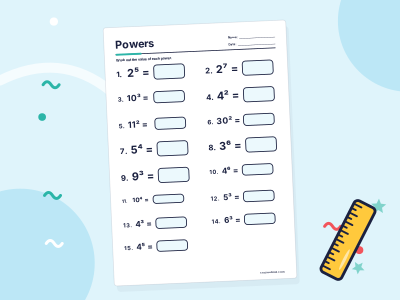
Powers and roots worksheets

Practise it step by step in a full course: Grade 10 Maths
For grown-ups
Related topics

Square roots
The square root of a number is the value that, multiplied by itself, gives that number. The square root of 25 is 5, because 5 × 5 = 25. The sign is √.

Powers and indices
A power (also called an index or exponent) is a small raised number showing how many times to multiply a number by itself. So 2⁴ means 2 × 2 × 2 × 2 = 16.
Prime factorisation
Prime factorisation means writing a number as a product of prime numbers. For example, 60 = 2 × 2 × 3 × 5, which can be written as 2² × 3 × 5.

Pythagoras' theorem
Pythagoras' theorem says that in a right-angled triangle, a² + b² = c², where c is the longest side (the hypotenuse). For sides 3 and 4, the hypotenuse is 5.

Cube numbers and cube roots
A cube number is a number multiplied by itself three times, like 4³ = 4 × 4 × 4 = 64. The cube root undoes it, so ∛64 = 4.
Highest common factor and lowest common multiple
The HCF is the largest number that divides exactly into two numbers. The LCM is the smallest number that both divide into. For 12 and 18, the HCF is 6 and the LCM is 36.