Maths
What is Pythagoras' theorem?
Quick answer
Pythagoras' theorem says that in a right-angled triangle, a² + b² = c², where c is the longest side (the hypotenuse). For sides 3 and 4, the hypotenuse is 5.
In one sentence
Pythagoras' theorem links the three sides of a right-angled triangle: the two shorter sides squared and added together equal the longest side squared.
Explained
Every right-angled triangle has one special side, the hypotenuse. It is the side opposite the right angle and is always the longest. Call the two shorter sides a and b, and the hypotenuse c. Then:
a² + b² = c²
 house
house ruler
ruler
The most famous example is a triangle with sides 3, 4 and 5. Check it: 3² + 4² = 9 + 16 = 25, and 5² = 25. ✓
You can picture it with squares. Draw a square on each side of the triangle. The area of the big square on the hypotenuse equals the two smaller squares' areas added together: 9 + 16 = 25.
Finding the hypotenuse. Square the two short sides, add, then take the square root. A ramp rises 5 m over a ground distance of 12 m. Its length is √(5² + 12²) = √(25 + 144) = √169 = 13 m.
Finding a shorter side. Square the two sides you know, subtract, then take the square root. A 10 m ladder reaches 8 m up a wall. How far is its foot from the wall? √(10² − 8²) = √(100 − 64) = √36 = 6 m.
Checking for a right angle. If a² + b² = c² works for three sides, the triangle has a right angle. Builders have used the 3-4-5 rule with ropes and tape measures to set out square corners.
The theorem is named after Pythagoras, a Greek thinker who lived around 2,500 years ago, but older clay tablets from ancient Babylon show that people knew about these special triangles more than 1,000 years before him.
Examples
| a | b | c (hypotenuse) |
|---|---|---|
| 3 | 4 | 5 |
| 5 | 12 | 13 |
| 8 | 15 | 17 |
| 1 | 1 | √2 ≈ 1.41 |
| 7 | 24 | 25 |
Whole-number sets like 3, 4, 5 are called Pythagorean triples. Multiply one by any number and you get another: 6, 8, 10.
Common mistakes
- Adding when you should subtract. If you know the hypotenuse, subtract to find a short side.
- Forgetting the square root at the end, giving 169 instead of 13.
- Using it on a triangle without a right angle. It only works for right-angled triangles.
- Squaring the sum: (3 + 4)² = 49 is not 3² + 4² = 25.
Quick quiz
Pythagoras' theorem
Check what you know with 4 quick questions.
Question 1 of 4
A right-angled triangle has shorter sides of 6 cm and 8 cm. How long is the hypotenuse?
Practise it
Try it
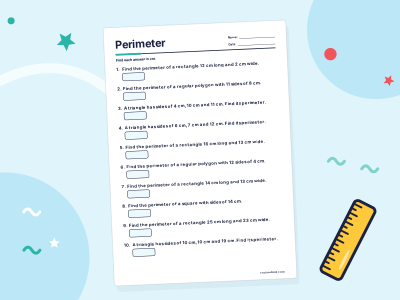
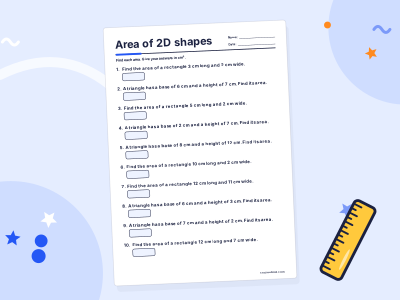
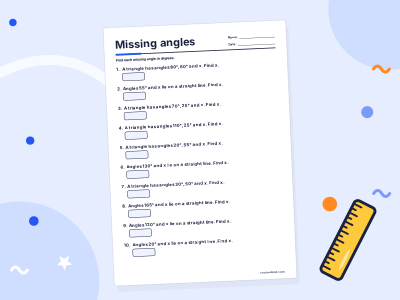
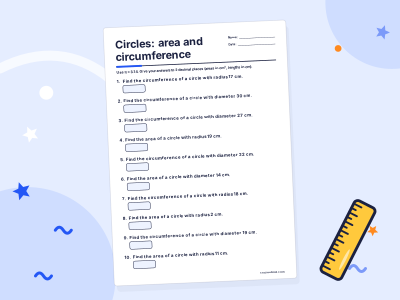
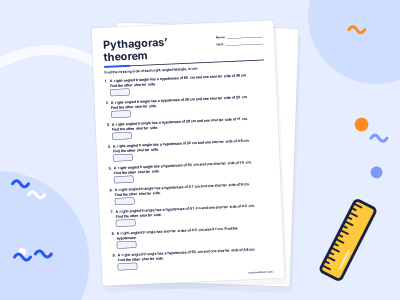
Geometry and Pythagoras practice
For grown-ups
Related topics
Square numbers
A square number is what you get when you multiply a whole number by itself, like 4 × 4 = 16. The first square numbers are 1, 4, 9, 16, 25 and 36.
Square roots
The square root of a number is the value that, multiplied by itself, gives that number. The square root of 25 is 5, because 5 × 5 = 25. The sign is √.
Angles
An angle measures the amount of turn between two lines that meet at a point. Angles are measured in degrees (°); a right angle is 90° and a full turn is 360°.
Area
Area is the amount of flat space inside a shape, measured in square units like cm² or m². A rectangle 4 cm by 3 cm has an area of 4 × 3 = 12 cm².
Pi (π)
Pi (π) is the number you get when you divide any circle's circumference by its diameter. It is about 3.14, and its digits go on forever without repeating.
Coordinates
Coordinates are a pair of numbers that give an exact position on a grid, like (3, 5). The first number is how far across (x) and the second is how far up (y).