Maths
What is area in maths?
Quick answer
Area is the amount of flat space inside a shape, measured in square units like cm² or m². A rectangle 4 cm by 3 cm has an area of 4 × 3 = 12 cm².
In one sentence
Area is how much surface a flat shape covers, counted in squares.
Explained
Suppose you want to cover a floor with square tiles. The number of tiles you need is the area of the floor. That is why area is measured in square units: square centimetres (cm²), square metres (m²) or, in the US, square feet and square inches.
 rug
rug
On squared paper you can simply count the squares inside a shape. For a rectangle there is a shortcut. A rectangle 5 squares long and 3 squares wide has 3 rows of 5 squares, so its area is 5 × 3 = 15 squares. That gives the rule:
Area of a rectangle = length × width
A square is a rectangle with equal sides, so its area is side × side, which is a square number when the side is a whole number.
Other shapes build on this:
- Triangle: cut a rectangle corner to corner and you get two equal triangles. So the area is ½ × base × height.
- Parallelogram: slice a triangle off one end and move it to the other, and it becomes a rectangle. Area = base × height.
- Circle: area = π × radius² (see pi).
The height must be measured straight up (at right angles to the base), not along a sloping side.
For compound shapes like an L-shaped room, split them into rectangles, find each area, then add. Or find the area of the big rectangle and subtract the missing piece.
Area is not the same as perimeter. A 1 m × 16 m strip and a 4 m × 4 m square both cover 16 m², but their perimeters are 34 m and 16 m.
Examples
| Shape | Working | Area |
|---|---|---|
| Rectangle 9 cm × 4 cm | 9 × 4 | 36 cm² |
| Square, side 12 m | 12 × 12 | 144 m² |
| Triangle, base 8 cm, height 5 cm | ½ × 8 × 5 | 20 cm² |
| Parallelogram, base 7 m, height 3 m | 7 × 3 | 21 m² |
Worked example: an L-shaped room. Split it into a 6 m × 4 m part (24 m²) and a 3 m × 2 m part (6 m²). Total: 30 m².
Common mistakes
- Adding the sides instead of multiplying. That gives the perimeter, not the area.
- Writing cm instead of cm². The little 2 shows you counted squares.
- Using the slanted side of a triangle or parallelogram as the height. Fix: the height is the perpendicular distance.
- Converting units wrongly. 1 m² is 100 cm × 100 cm = 10,000 cm², not 100 cm².
Quick quiz
Area
Check what you know with 4 quick questions.
Question 1 of 4
What is the area of a rectangle 7 m long and 3 m wide?
Practise it
Try it
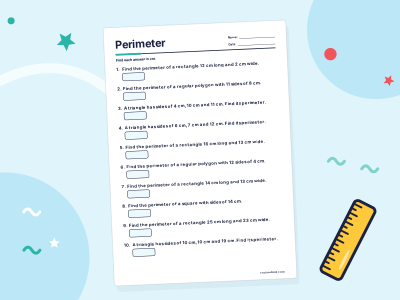
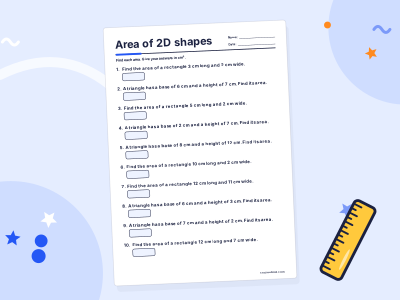
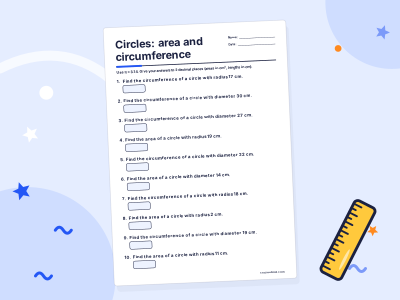
Area and geometry practice
For grown-ups
Related topics
Perimeter
Perimeter is the total distance all the way around the outside of a flat shape. For a rectangle 5 cm long and 3 cm wide, it is 5 + 3 + 5 + 3 = 16 cm.
Volume
Volume is the amount of space a 3D object takes up, measured in cubic units like cm³ or m³. A box 4 cm by 3 cm by 2 cm has a volume of 24 cm³.
Square numbers
A square number is what you get when you multiply a whole number by itself, like 4 × 4 = 16. The first square numbers are 1, 4, 9, 16, 25 and 36.
Multiplication
Multiplication is adding equal groups quickly. 4 × 3 means 4 groups of 3 (or 3 groups of 4), which makes 12. The answer is called the product.
Pi (π)
Pi (π) is the number you get when you divide any circle's circumference by its diameter. It is about 3.14, and its digits go on forever without repeating.
Pythagoras' theorem
Pythagoras' theorem says that in a right-angled triangle, a² + b² = c², where c is the longest side (the hypotenuse). For sides 3 and 4, the hypotenuse is 5.