Maths
What is volume in maths?
Quick answer
Volume is the amount of space a 3D object takes up, measured in cubic units like cm³ or m³. A box 4 cm by 3 cm by 2 cm has a volume of 24 cm³.
In one sentence
Volume is how much space a solid object fills, counted in cubes.
Explained
Area counts the squares that cover a flat shape. Volume goes one step further: it counts the cubes that fill a 3D shape. That's why volume is measured in cubic units, such as cubic centimetres (cm³) and cubic metres (m³). A sugar cube is roughly 1 cm³.
 blocks
- blocks
- blocks
 box
box
Picture a box 4 cm long, 3 cm wide and 2 cm high. The bottom layer fits 4 × 3 = 12 cubes. There are 2 layers, so 12 × 2 = 24 cubes. The volume is 24 cm³. That gives the rule for a cuboid:
Volume = length × width × height
For a cube, all the edges are equal, so volume = side × side × side, written side³ (say "side cubed"). A cube with 5 cm edges has a volume of 5³ = 125 cm³. This is where "cubed" in powers comes from.
The same idea works for any prism (a shape with the same cross-section all the way through): volume = area of the end × length. A cylinder works the same way: area of the circle × height.
Volume and capacity are close cousins. Volume is the space an object takes up; capacity is how much a container can hold. They are linked by a neat fact: 1 cm³ holds exactly 1 ml, and 1,000 cm³ is 1 litre.
Examples
| Shape | Working | Volume |
|---|---|---|
| Cuboid 10 cm × 4 cm × 3 cm | 10 × 4 × 3 | 120 cm³ |
| Cube, edge 2 m | 2 × 2 × 2 | 8 m³ |
| Cube, edge 10 cm | 10 × 10 × 10 | 1,000 cm³ = 1 litre |
| Triangular prism: end area 6 cm², length 10 cm | 6 × 10 | 60 cm³ |
Worked example: a fish tank is 50 cm long, 30 cm wide and 40 cm high. Volume = 50 × 30 × 40 = 60,000 cm³, which holds 60 litres of water when full.
Common mistakes
- Adding the dimensions (4 + 3 + 2 = 9) instead of multiplying.
- Wrong units. Volume is cm³, not cm or cm².
- Mixing units in one calculation, like metres for length and centimetres for height. Fix: convert first.
- Thinking 1 m³ = 100 cm³. It is 100 × 100 × 100 = 1,000,000 cm³.
Quick quiz
Volume
Check what you know with 4 quick questions.
Question 1 of 4
What is the volume of a cuboid 5 cm long, 3 cm wide and 2 cm high?
Practise it
Try it
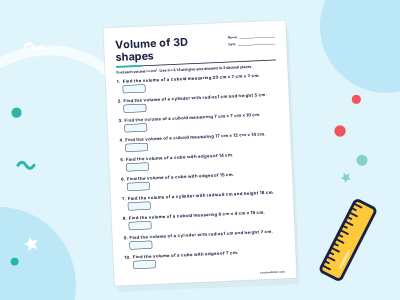
Volume and geometry practice
For grown-ups
Related topics
3D shapes
3D shapes are solid shapes with length, width and height, like cubes, spheres, cylinders and pyramids. They have faces, edges and vertices.
Capacity
Capacity is how much a container can hold, usually measured in millilitres (ml) and litres (l). A large bottle of water often holds 2 litres, which is 2000 ml.
Area
Area is the amount of flat space inside a shape, measured in square units like cm² or m². A rectangle 4 cm by 3 cm has an area of 4 × 3 = 12 cm².
Powers and indices
A power (also called an index or exponent) is a small raised number showing how many times to multiply a number by itself. So 2⁴ means 2 × 2 × 2 × 2 = 16.
Angles
An angle measures the amount of turn between two lines that meet at a point. Angles are measured in degrees (°); a right angle is 90° and a full turn is 360°.
Coordinates
Coordinates are a pair of numbers that give an exact position on a grid, like (3, 5). The first number is how far across (x) and the second is how far up (y).