Maths
How do you find the area of a trapezium (trapezoid)?
Quick answer
Add the two parallel sides, multiply by the height and halve: A = ½(a + b)h. Parallel sides of 4 cm and 6 cm, 3 cm apart, give an area of 15 cm².



In one sentence
To find the area of a trapezium, add the two parallel sides, multiply by the height and divide by 2.
Explained
A trapezium is a four-sided shape (a quadrilateral) with one pair of parallel sides. In the US and Canada the same shape is called a trapezoid. The two parallel sides are often labelled a and b (sometimes called the bases), and the height h is the straight-up distance between them, measured at a right angle.
 bucket
 ruler
 pencil
The formula is
A = ½ × (a + b) × h, also written A = (a + b) ÷ 2 × h
Because a, b and h are lengths, the area is in square units: cm², m², mm² (or square feet in the US).
Where does it come from? Take two identical trapeziums and turn one upside down. Fit them together and they make a parallelogram. Its base is a + b and its height is h, so its area is (a + b) × h. One trapezium is exactly half of that: ½ × (a + b) × h.
Another way to see it: (a + b) ÷ 2 is the average width of the trapezium. Multiply the average width by the height and you get the area, just like length × width for a rectangle. If a and b are equal, the trapezium is really a parallelogram and the formula becomes a × h. If one of them shrinks to zero, it becomes a triangle and the formula becomes ½ × b × h, the area of a triangle.
There are some special trapeziums:
- Right trapezium (right trapezoid): one side is at right angles to the parallel sides, so that side is the height.
- Isosceles trapezium: the two slanted sides are equal, and the shape is symmetrical. If you know the slanted sides but not the height, you can find the height with Pythagoras.
- Scalene trapezium: the slanted sides are different lengths. The formula is exactly the same.
For more about measuring flat space, see area.
Examples
| Parallel side a | Parallel side b | Height h | (a + b) ÷ 2 | Area |
|---|---|---|---|---|
| 4 cm | 6 cm | 3 cm | 5 cm | 5 × 3 = 15 cm² |
| 5 m | 9 m | 4 m | 7 m | 7 × 4 = 28 m² |
| 3 cm | 8 cm | 5 cm | 5.5 cm | 5.5 × 5 = 27.5 cm² |
| 10 mm | 14 mm | 7 mm | 12 mm | 12 × 7 = 84 mm² |
| 2.5 m | 4.5 m | 2 m | 3.5 m | 3.5 × 2 = 7 m² |
Worked example without the height: an isosceles trapezium has parallel sides 4 cm and 10 cm and slanted sides of 5 cm. The longer side sticks out (10 − 4) ÷ 2 = 3 cm on each end. Each end is a right-angled triangle with hypotenuse 5 cm and base 3 cm, so h = √(5² − 3²) = √16 = 4 cm. Area = ½ × (4 + 10) × 4 = 28 cm².
Common mistakes
- Using a slanted side as the height. The height must be perpendicular (at 90°) to the parallel sides. Fix: look for the dotted line with a little square for the right angle.
- Forgetting to halve. (a + b) × h is the area of two trapeziums. Fix: always finish with ÷ 2.
- Adding the wrong sides. Only the two parallel sides go in the bracket, never the slanted ones.
- Mixing units. If a and b are in metres and h is in centimetres, convert first. Then write square units: cm², not cm.
Step by step
Step by step
- Find the parallel sidesLabel them a and b. It does not matter which is which.
- Find the heightThe perpendicular distance between a and b. If it is missing, use a right side (right trapezium) or Pythagoras (isosceles trapezium).
- Add the parallel sidesWork out a + b.
- Multiply by the height and halve½ × (a + b) × h. You can halve first if that is easier: halve (a + b) or halve h.
- Write square unitsCm², m² or mm². Check: the area should be between (shorter side × h) and (longer side × h).
Working backwards: if you know the area, rearrange the formula. h = 2A ÷ (a + b), and a missing parallel side is b = 2A ÷ h − a.
Practice questions
Find the area of the trapezium
Try each one, then check your answer.
- Parallel sides 3 cm and 5 cm, height 4 cm.
Show answer
½ × (3 + 5) × 4 = ½ × 8 × 4 = 16 cm² - Parallel sides 6 cm and 8 cm, height 5 cm.
Show answer
½ × 14 × 5 = 35 cm² - Parallel sides 10 m and 4 m, height 6 m.
Show answer
½ × 14 × 6 = 42 m² - Parallel sides 7 cm and 12 cm, height 8 cm.
Show answer
½ × 19 × 8 = 76 cm² - Parallel sides 2.5 cm and 5.5 cm, height 3 cm.
Show answer
½ × 8 × 3 = 12 cm² - Parallel sides 9 cm and 6 cm, height 7 cm.
Show answer
½ × 15 × 7 = 52.5 cm² - A right trapezium has parallel sides 5 cm and 9 cm, and the side at right angles to them is 6 cm. Find the area.
Show answer
That side is the height: ½ × 14 × 6 = 42 cm² - Parallel sides 1.2 m and 1.8 m, height 50 cm. Give the area in m².
Show answer
h = 0.5 m; ½ × 3 × 0.5 = 0.75 m² - A trapezium has area 60 cm² and parallel sides 7 cm and 13 cm. Find the height.
Show answer
60 = ½ × 20 × h = 10h, so h = 6 cm - A trapezium has area 45 m², height 5 m and a longer parallel side of 10 m. Find the shorter parallel side.
Show answer
45 = ½ × (10 + b) × 5, so 10 + b = 18 and b = 8 m - A trapezium has area 24 cm² and height 4 cm. What do the parallel sides add up to?
Show answer
a + b = 2 × 24 ÷ 4 = 12 cm - An isosceles trapezium has parallel sides 6 cm and 12 cm and slanted sides 5 cm. Find its area.
Show answer
Overhang (12 − 6) ÷ 2 = 3 cm; h = √(25 − 9) = 4 cm; area = ½ × 18 × 4 = 36 cm² - An isosceles trapezium has parallel sides 10 cm and 26 cm and slanted sides 17 cm. Find its area.
Show answer
Overhang 8 cm; h = √(289 − 64) = √225 = 15 cm; area = ½ × 36 × 15 = 270 cm² - A right trapezium has parallel sides 4 cm and 7 cm and a height of 4 cm. Find its perimeter and its area.
Show answer
Slanted side = √(3² + 4²) = 5 cm; perimeter = 4 + 7 + 4 + 5 = 20 cm; area = ½ × 11 × 4 = 22 cm² - Show that the formula gives a × h when both parallel sides are equal to a.
Show answer
½ × (a + a) × h = ½ × 2a × h = a × h, the area of a parallelogram
Word problems
Trapeziums in real life
Try each one, then check your answer.
- A garden bed is a trapezium with parallel sides 3 m and 5 m, which are 2 m apart. One bag of compost covers 2 m². How many bags are needed?
Show answer
Area = ½ × 8 × 2 = 8 m²; 8 ÷ 2 = 4 bags - One side of a roof is a trapezium with parallel edges 8 m and 12 m and a height of 3 m. What is its area?
Show answer
½ × 20 × 3 = 30 m² - A field is a trapezium with parallel sides 120 m and 80 m, 50 m apart. What is its area?
Show answer
½ × 200 × 50 = 5,000 m² (half a hectare) - The cross-section of a ditch is a trapezium 3 m wide at the top, 1.4 m wide at the bottom and 1.2 m deep. What is the area of the cross-section?
Show answer
½ × 4.4 × 1.2 = 2.64 m² - A trough is a prism 100 cm long. Its end is a trapezium with parallel sides 20 cm and 30 cm and height 10 cm. How much water does it hold?
Show answer
End area = ½ × 50 × 10 = 250 cm²; volume = 250 × 100 = 25,000 cm³ = 25 litres - A wall is a trapezium 4 m wide at the bottom, 6 m wide at the top and 2.5 m high. One litre of paint covers 10 m². How much paint is needed?
Show answer
Area = ½ × 10 × 2.5 = 12.5 m²; 12.5 ÷ 10 = 1.25 litres
Questions people ask
What is the formula for the area of a trapezium?
A = ½(a + b)h: add the two parallel sides, multiply by the perpendicular height and divide by 2.
Is a trapezium the same as a trapezoid?
Yes, for school maths. "Trapezium" is the British, Irish, Australian and Indian word; "trapezoid" is the American and Canadian word. Both mean a quadrilateral with a pair of parallel sides, and the area formula is the same.
Why do you halve in the trapezium formula?
Two identical trapeziums, one turned upside down, fit together into a parallelogram with base a + b and height h. One trapezium is half of it, so you halve.
How do you find the area of a trapezium without the height?
You need to work the height out first. In an isosceles trapezium, use Pythagoras on the triangle at one end: h = √(slanted side² − overhang²). In a general trapezium where all four sides are known, split it into a rectangle and triangles and find the height from those; this is harder and usually comes later.
What is the difference between the area of a trapezium and a parallelogram?
A parallelogram has two pairs of parallel sides and an area of base × height. A trapezium has one pair, so you use the average of the two parallel sides: ½(a + b) × h.
How do you find the volume of a trapezoidal prism?
Find the area of the trapezium at one end, then multiply by the length of the prism. Its surface area is different: add up the areas of all the faces, the two trapezium ends and the rectangles around the sides.
What units is the area of a trapezium in?
Square units. If the lengths are in feet, the area is in square feet (ft²); in centimetres, square centimetres (cm²).
Quick quiz
Area of a trapezium (trapezoid)
Check what you know with 5 quick questions.
Question 1 of 5
Which formula gives the area of a trapezium with parallel sides a and b and height h?
Practise it
Try it
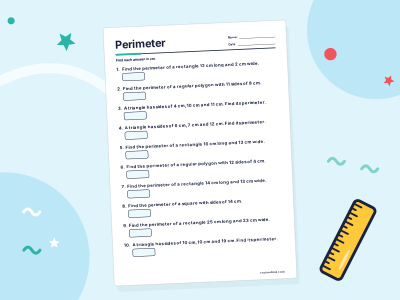
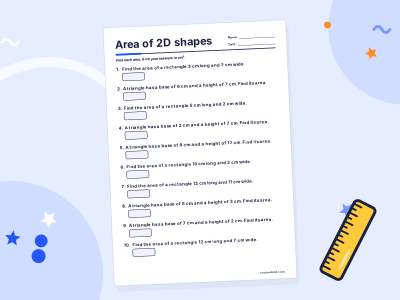
Practise areas of triangles, parallelograms and trapezoids
Geometry worksheets
Practise it step by step in a full course: Grade 7 Maths
For grown-ups
Related topics

Area
Area is the amount of flat space inside a shape, measured in square units like cm² or m². A rectangle 4 cm by 3 cm has an area of 4 × 3 = 12 cm².
Quadrilaterals
A quadrilateral is any flat shape with four straight sides. Squares, rectangles, rhombuses, parallelograms, trapezia and kites are all quadrilaterals, and their angles add up to 360 degrees.
Area of a triangle
The area of a triangle is half of its base times its perpendicular height: A = ½ × b × h. A triangle with base 8 cm and height 5 cm has an area of 20 square centimetres.

Perimeter
Perimeter is the total distance all the way around the outside of a flat shape. For a rectangle 5 cm long and 3 cm wide, it is 5 + 3 + 5 + 3 = 16 cm.

Angles in parallel lines
When a line crosses two parallel lines, corresponding (F) and alternate (Z) angles are equal and co-interior (C) angles add to 180°. Vertically opposite angles are always equal.

Area of a circle
The area of a circle is pi times the radius squared: A = πr². A circle with radius 5 cm has an area of about 78.5 square centimetres.