Maths
What are the different types of quadrilaterals?
Quick answer
A quadrilateral is any flat shape with four straight sides. Squares, rectangles, rhombuses, parallelograms, trapezia and kites are all quadrilaterals, and their angles add up to 360 degrees.



In one sentence
A quadrilateral is a closed flat shape with four straight sides and four corners, and its angles always add up to 360 degrees.
Explained
Quadrilaterals are everywhere: windows, doors, books, tiles and kites. They come in several named families, depending on their sides and angles.
 ruler
 blocks
 pencil
- Square: four equal sides and four right angles.
- Rectangle: opposite sides equal and four right angles.
- Rhombus: four equal sides, but the angles need not be right angles. It looks like a squashed square.
- Parallelogram: two pairs of parallel sides. Opposite sides and opposite angles are equal.
- Trapezium: exactly one pair of parallel sides. (In the US this shape is called a trapezoid.)
- Kite: two pairs of equal sides that sit next to each other. One diagonal cuts the shape into two matching triangles.
Shapes can belong to more than one family. A square is a special rectangle, and also a special rhombus, and also a special parallelogram. A rectangle is a parallelogram with right angles. A rhombus is a parallelogram with four equal sides.
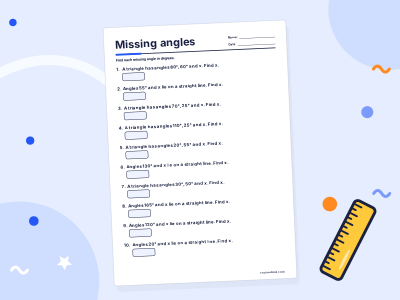
The angles of every quadrilateral add up to 360 degrees. You can see why by drawing one diagonal: it splits the shape into two triangles, and each has angles that add to 180 degrees. See types of triangles. A quadrilateral with no special pattern of sides or angles is called irregular.
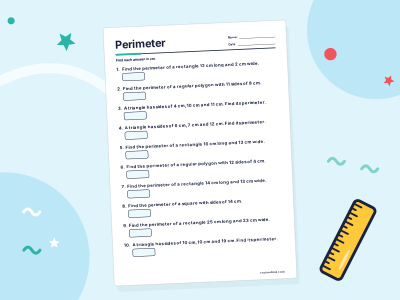
To find the distance around a quadrilateral, you add up its sides: see perimeter. Quadrilaterals are one group of 2D shapes.
Examples
| Shape | Equal sides | Parallel sides | Right angles |
|---|---|---|---|
| Square | all 4 | 2 pairs | 4 |
| Rectangle | opposite pairs | 2 pairs | 4 |
| Rhombus | all 4 | 2 pairs | none needed |
| Parallelogram | opposite pairs | 2 pairs | none needed |
| Trapezium | not needed | 1 pair | not needed |
| Kite | 2 pairs next to each other | none needed | not needed |
Common mistakes
- "A square is not a rectangle." It is a rectangle with equal sides.
- Calling a tilted square a diamond. It is still a square, turned round.
- Mixing up rhombus and parallelogram. A rhombus has four equal sides; a general parallelogram only has opposite sides equal.
Quick quiz
Quadrilaterals
Check what you know with 4 quick questions.
Question 1 of 4
How many sides does a quadrilateral have?
Practise it
Try it
Geometry practice
Practise it step by step in a full course: Grade 5 Maths
For grown-ups
Related topics

2D shapes
2D shapes are flat shapes with length and width but no thickness, like circles, triangles, squares and hexagons. You can draw them on paper.
Types of triangles
Triangles are named by their sides (equilateral, isosceles, scalene) or by their angles (acute, right-angled, obtuse). The three angles of any triangle add up to 180 degrees.

Perimeter
Perimeter is the total distance all the way around the outside of a flat shape. For a rectangle 5 cm long and 3 cm wide, it is 5 + 3 + 5 + 3 = 16 cm.
Polygons
A polygon is a flat shape made only of straight sides that close up completely. Triangles, squares, pentagons and hexagons are polygons; a circle is not.

Angles
An angle measures the amount of turn between two lines that meet at a point. Angles are measured in degrees (°); a right angle is 90° and a full turn is 360°.

Area
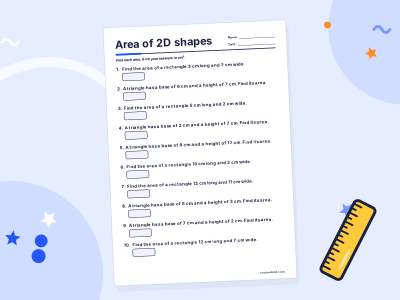
Area is the amount of flat space inside a shape, measured in square units like cm² or m². A rectangle 4 cm by 3 cm has an area of 4 × 3 = 12 cm².