Maths
What is an angle?
Quick answer
An angle measures the amount of turn between two lines that meet at a point. Angles are measured in degrees (°); a right angle is 90° and a full turn is 360°.
In one sentence
An angle is the amount of turn between two lines that meet at a corner.
Explained
Open a pair of scissors a little and the blades make a small angle. Open them wide and the angle gets bigger. The length of the blades doesn't matter; only how far they have turned apart. The point where the two lines meet is the vertex.
 scissors
 clock
clock pizza
pizza
Angles are measured in degrees, written with a small circle: 90°. A full turn, all the way round, is 360°. That gives us some landmarks:
| Turn | Degrees | Name |
|---|---|---|
| quarter turn | 90° | right angle (marked with a little square) |
| half turn | 180° | straight line |
| three-quarter turn | 270° | |
| full turn | 360° |
Angles are also sorted by size:
- Acute: less than 90° (think "a cute little angle").
- Right: exactly 90°, like the corner of a book.
- Obtuse: between 90° and 180°.
- Reflex: between 180° and 360°.
You measure angles with a protractor. Line its centre cross up with the vertex and its zero line along one arm, then read where the other arm crosses the scale. Use the scale that starts at 0 on your arm; estimating first ("is it acute or obtuse?") stops you reading the wrong one.
Three facts let you work out missing angles without measuring:
- Angles on a straight line add up to 180°.
- Angles around a point add up to 360°.
- The angles inside any triangle add up to 180°. (Inside any quadrilateral, 360°.)
Examples
- A slice that is ⅛ of a round pizza has an angle of 360 ÷ 8 = 45°.
- On a straight line, if one angle is 115°, the other is 180 − 115 = 65°.
- A triangle with angles 90° and 35° has a third angle of 55°.
- A quadrilateral with angles 80°, 100° and 95° has a fourth of 360 − 275 = 85°.
- An equilateral triangle has three 60° angles.
Common mistakes
- Reading the wrong scale on a protractor, giving 120° for a 60° angle. Fix: decide first whether it is acute or obtuse.
- Thinking longer lines make a bigger angle. The angle is the turn, not the length.
- Forgetting reflex angles. Around a point, the "outside" angle is 360° minus the inside one.
Quick quiz
Angles
Check what you know with 5 quick questions.
Question 1 of 5
How many degrees are in a right angle?
Practise it
Try it
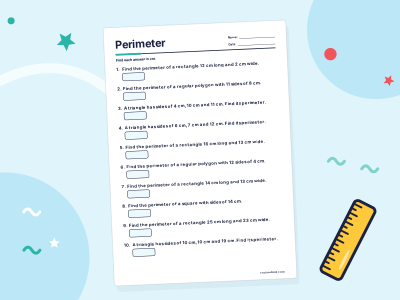
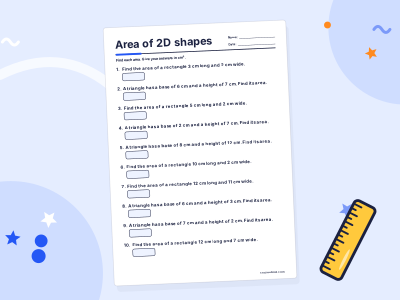
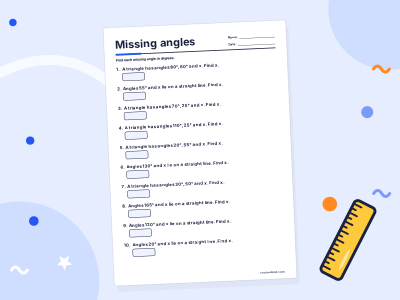
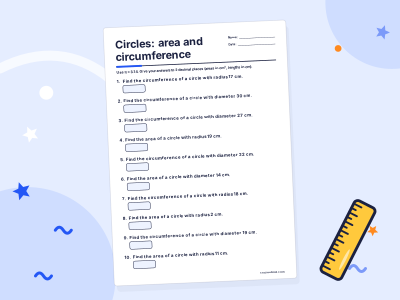
Angle and geometry practice
For grown-ups
Related topics
2D shapes
2D shapes are flat shapes with length and width but no thickness, like circles, triangles, squares and hexagons. You can draw them on paper.
3D shapes
3D shapes are solid shapes with length, width and height, like cubes, spheres, cylinders and pyramids. They have faces, edges and vertices.
Pythagoras' theorem
Pythagoras' theorem says that in a right-angled triangle, a² + b² = c², where c is the longest side (the hypotenuse). For sides 3 and 4, the hypotenuse is 5.
Symmetry
A shape has symmetry when one half is a mirror image of the other (line symmetry), or when it looks the same after being turned (rotational symmetry).
Telling the time
To tell the time on a clock, read the short hand for the hour and the long hand for the minutes. When the long hand points to 6, it is half past the hour.
Area
Area is the amount of flat space inside a shape, measured in square units like cm² or m². A rectangle 4 cm by 3 cm has an area of 4 × 3 = 12 cm².