Maths
What is perimeter?
Quick answer
Perimeter is the total distance all the way around the outside of a flat shape. For a rectangle 5 cm long and 3 cm wide, it is 5 + 3 + 5 + 3 = 16 cm.
In one sentence
The perimeter is the distance around the edge of a shape, like the length of fence you'd need to go round a garden.
Explained
Imagine walking all the way around the edge of a playground and measuring how far you went. That distance is the perimeter. The word comes from Greek: peri means "around" and metron means "measure".
 flower
- flower
- flower
- flower
- flower
To find the perimeter of a shape with straight sides, add up the lengths of all its sides. Perimeter is a length, so it is measured in units like centimetres (cm), metres (m) or inches.
For some shapes there are shortcuts:
- Square: 4 equal sides, so perimeter = 4 × side.
- Rectangle: two lengths and two widths, so perimeter = 2 × (length + width).
- Regular polygon: number of sides × side length. A regular hexagon with 5 cm sides has a perimeter of 6 × 5 = 30 cm.
For L-shapes and other awkward shapes, the trick is to work out any missing sides first. On an L-shaped room, the two short horizontal edges together equal the long bottom edge.
The perimeter of a circle has its own name, the circumference. You find it using pi: circumference = π × diameter.
Perimeter and area are different things. Perimeter is the edge; area is the space inside. Two shapes can have the same perimeter but different areas. A 6 by 4 rectangle and a 5 by 5 square both have a perimeter of 20 cm, but areas of 24 cm² and 25 cm².
Examples
| Shape | Working | Perimeter |
|---|---|---|
| Square, side 9 cm | 4 × 9 | 36 cm |
| Rectangle, 12 m by 5 m | 2 × (12 + 5) | 34 m |
| Equilateral triangle, side 4 cm | 3 × 4 | 12 cm |
| Regular octagon, side 3 cm | 8 × 3 | 24 cm |
Worked example: an L-shape made from a 10 m × 6 m rectangle with a 4 m × 2 m corner cut out. Cutting the corner out pushes two edges inwards, but their lengths still add up to the same total. So the perimeter is the same as the full rectangle: 2 × (10 + 6) = 32 m.
Common mistakes
- Forgetting sides that aren't labelled. On a rectangle, only two sides may be marked. Fix: write the missing lengths on before adding.
- Mixing up perimeter and area. Perimeter is in cm; area is in cm².
- Mixing units, such as adding 1 m and 50 cm to get 51. Fix: change everything to the same unit first (100 cm + 50 cm = 150 cm).
Quick quiz
Perimeter
Check what you know with 4 quick questions.
Question 1 of 4
What is the perimeter of a square with sides of 6 cm?
Practise it
Try it
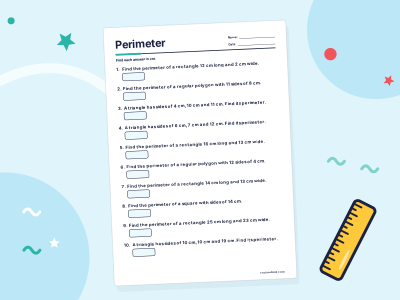
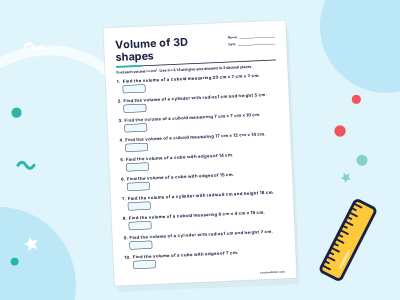
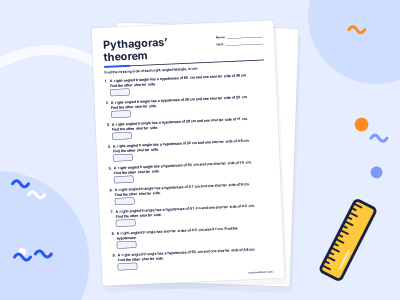
Perimeter and geometry practice
For grown-ups
Related topics
Area
Area is the amount of flat space inside a shape, measured in square units like cm² or m². A rectangle 4 cm by 3 cm has an area of 4 × 3 = 12 cm².
Length and measuring
Length is how long, tall or far something is. It is measured with a ruler or tape in units such as millimetres, centimetres, metres and kilometres (or inches, feet and miles).
2D shapes
2D shapes are flat shapes with length and width but no thickness, like circles, triangles, squares and hexagons. You can draw them on paper.
Pi (π)
Pi (π) is the number you get when you divide any circle's circumference by its diameter. It is about 3.14, and its digits go on forever without repeating.
Angles
An angle measures the amount of turn between two lines that meet at a point. Angles are measured in degrees (°); a right angle is 90° and a full turn is 360°.
Coordinates
Coordinates are a pair of numbers that give an exact position on a grid, like (3, 5). The first number is how far across (x) and the second is how far up (y).