Maths
What is pi (π)?
Quick answer
Pi (π) is the number you get when you divide any circle's circumference by its diameter. It is about 3.14, and its digits go on forever without repeating.
In one sentence
Pi, written π, is the number of times a circle's diameter fits around its edge, which is a little over 3.
Explained
Take any round object, a plate, a tin lid, a bicycle wheel. Measure the distance across the middle (the diameter) and the distance all the way round (the circumference). Now divide the circumference by the diameter. Whatever the size of the circle, you will get about 3.14. That number is π, the Greek letter "pi", said like "pie".
 pizza
pizza clock
clock
π is not exactly 3.14. It starts 3.14159265… and the digits carry on forever without falling into a repeating pattern. Numbers like this are called irrational. Computers have now worked out trillions of digits, but for most maths 3.14, the π button on a calculator, or the fraction 22/7 is plenty. For everyday work, rounding to 3.14 is fine; see decimals.
The parts of a circle you need:
- Radius (r): from the centre to the edge.
- Diameter (d): right across through the centre. d = 2r.
- Circumference (C): the perimeter of the circle.
And the two key formulas:
- Circumference = π × diameter, written C = πd (or C = 2πr).
- Area = π × radius², written A = πr². (See area.)
Why the radius squared? Imagine a square drawn on the radius. A circle covers a bit more than three of those squares: exactly π of them.
People have been estimating π for thousands of years. Archimedes, in ancient Greece, showed that it lies between 3 10/71 and 3 1/7 by fitting many-sided shapes inside and outside a circle.
Fans celebrate Pi Day on 14 March, because in the US date style that's written 3/14. In the UK the same date is written 14/3, so some people prefer 22 July (22/7).
Examples
| Circle | Working | Answer |
|---|---|---|
| Circumference, d = 7 cm | 22/7 × 7 | 22 cm |
| Circumference, r = 10 m | 2 × 3.14 × 10 | 62.8 m |
| Area, r = 3 cm | 3.14 × 3² = 3.14 × 9 | 28.26 cm² |
| Area, d = 20 cm (so r = 10 cm) | 3.14 × 100 | 314 cm² |
Worked example: a bicycle wheel has a diameter of 70 cm. In one turn it travels about 3.14 × 70 = 219.8 cm, roughly 2.2 m.
Common mistakes
- Using the diameter in the area formula. A = πr² uses the radius. Halve the diameter first.
- Squaring after multiplying by π. In πr², square the radius first, then multiply by π.
- Thinking π = 3.14 exactly. It is only a rounded value.
Quick quiz
Pi (π)
Check what you know with 5 quick questions.
Question 1 of 5
What is π to two decimal places?
Practise it
Try it
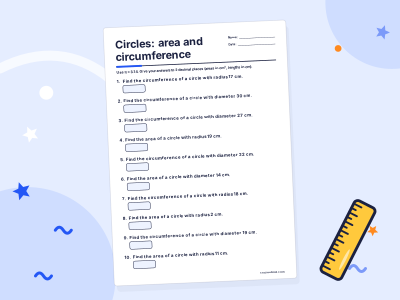
Circles and geometry practice


For grown-ups
Related topics
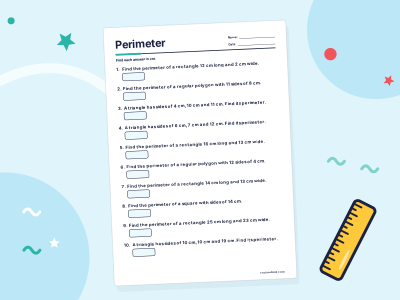
Perimeter
Perimeter is the total distance all the way around the outside of a flat shape. For a rectangle 5 cm long and 3 cm wide, it is 5 + 3 + 5 + 3 = 16 cm.
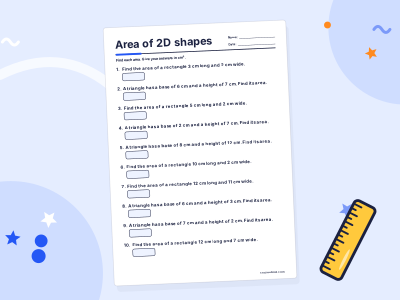
Area
Area is the amount of flat space inside a shape, measured in square units like cm² or m². A rectangle 4 cm by 3 cm has an area of 4 × 3 = 12 cm².
Decimals
Decimals are numbers with a decimal point. Digits after the point show tenths, hundredths and so on, so 2.5 means two and five tenths.
Square roots
The square root of a number is the value that, multiplied by itself, gives that number. The square root of 25 is 5, because 5 × 5 = 25. The sign is √.
Pythagoras' theorem
Pythagoras' theorem says that in a right-angled triangle, a² + b² = c², where c is the longest side (the hypotenuse). For sides 3 and 4, the hypotenuse is 5.
Angles
An angle measures the amount of turn between two lines that meet at a point. Angles are measured in degrees (°); a right angle is 90° and a full turn is 360°.