Maths
What is a prime number?
Quick answer
A prime number is a whole number greater than 1 that has exactly two factors, 1 and itself. The first primes are 2, 3, 5, 7, 11 and 13.
In one sentence
A prime number can only be divided exactly by 1 and by itself.
Explained
Take 12 building blocks and try to arrange them in a rectangle. You can make 1 row of 12, 2 rows of 6 or 3 rows of 4. Lots of options. Now try 7 blocks. The only rectangle is 1 row of 7. Numbers like 7, which can only make a single line, are prime.
 blocks
- blocks
- blocks
- blocks
- blocks
- blocks
- blocks
In maths language, a prime has exactly two factors: 1 and the number itself. A whole number bigger than 1 that is not prime, like 12, is called composite.
Two numbers cause arguments:
- 1 is not prime. It has only one factor, so it doesn't meet the rule.
- 2 is prime, and it is the only even prime. Every other even number divides by 2.
The primes up to 50 are: 2, 3, 5, 7, 11, 13, 17, 19, 23, 29, 31, 37, 41, 43 and 47. That is 15 of them.
To test whether a number is prime, try dividing it by the primes 2, 3, 5, 7… in turn. You can stop once the prime you are trying, multiplied by itself, is bigger than your number. For 91: 2 no, 3 no, 5 no, 7 yes (7 × 13). So 91 is not prime, although it looks like one.
Primes are the building blocks of all whole numbers. Every composite number can be split into primes multiplied together, in only one way (apart from order). For 84: 84 = 2 × 42 = 2 × 2 × 21 = 2 × 2 × 3 × 7. A factor tree is a neat way to draw this.
Over 2,000 years ago, the Greek mathematician Euclid proved that the primes never run out. There is no biggest prime.
Examples
| Number | Factors | Prime? |
|---|---|---|
| 13 | 1, 13 | yes |
| 21 | 1, 3, 7, 21 | no |
| 29 | 1, 29 | yes |
| 51 | 1, 3, 17, 51 | no |
| 97 | 1, 97 | yes |
Common mistakes
- Saying all odd numbers are prime. 9, 15, 25 and 27 are odd but not prime.
- Calling 1 prime. It isn't.
- Missing hidden factors in numbers like 57 (3 × 19) and 91 (7 × 13). Fix: test with 3 by adding the digits (5 + 7 = 12, which divides by 3).
Quick quiz
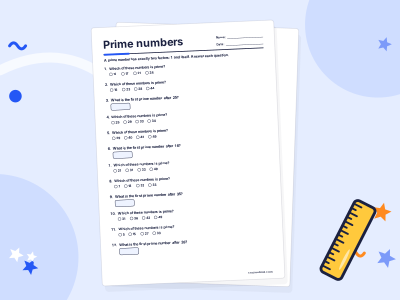
Prime numbers
Check what you know with 4 quick questions.
Question 1 of 4
Which of these is a prime number?
Practise it
Try it
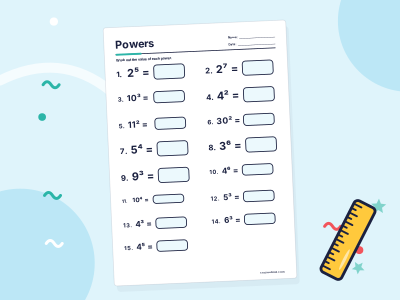
Prime, power and root practice

For grown-ups
Related topics
Factors and multiples
Factors are numbers that divide exactly into a number (the factors of 12 are 1, 2, 3, 4, 6 and 12). Multiples are the numbers in its times table (12, 24, 36…).
Multiplication
Multiplication is adding equal groups quickly. 4 × 3 means 4 groups of 3 (or 3 groups of 4), which makes 12. The answer is called the product.
Square numbers
A square number is what you get when you multiply a whole number by itself, like 4 × 4 = 16. The first square numbers are 1, 4, 9, 16, 25 and 36.
Division
Division is sharing into equal groups, or finding how many groups fit. The sign is ÷, so 12 ÷ 3 = 4. The answer is called the quotient.
Powers and indices
A power (also called an index or exponent) is a small raised number showing how many times to multiply a number by itself. So 2⁴ means 2 × 2 × 2 × 2 = 16.
Square roots
The square root of a number is the value that, multiplied by itself, gives that number. The square root of 25 is 5, because 5 × 5 = 25. The sign is √.