Maths
What is compound interest, and how is it different from simple interest?
Quick answer
Simple interest is paid only on the starting amount: I = P × r × t. Compound interest is also paid on earlier interest: A = P(1 + r)ⁿ. $1,000 at 10% for 2 years: $1,200 simple, $1,210 compound.


In one sentence
With simple interest you earn the same amount every year; with compound interest you also earn interest on your interest, so the amount grows faster and faster.
Explained
When you put money in a savings account, the bank pays you interest: a percentage of your money, usually every year. When you borrow money, you pay interest instead. There are two ways to work it out.
Simple interest is always worked out on the starting amount, called the principal (P). If the rate is r per year (as a decimal) for t years:
Simple interest: I = P × r × t and the total is A = P + I
Save $1,000 at 5% simple interest: you get $50 every year. After 3 years you have earned $150, so you have $1,150.
Compound interest is added to the account, and next year's interest is worked out on the new, bigger total. So each year you earn interest on your interest as well. Each year the amount is multiplied by the same number, the multiplier 1 + r. For 5% that is 1.05:
Compound interest: A = P × (1 + r)ⁿ where n is the number of years. The interest earned is A − P.
 clock
 tree
 bag
$1,000 at 5% compound interest: after one year 1,000 × 1.05 = $1,050; after two years 1,050 × 1.05 = $1,102.50; after three years $1,157.63. That is $7.63 more than simple interest. The gap looks small at first but keeps widening, because the power in (1 + r)ⁿ makes the growth faster each year (it is a geometric sequence). After 10 years simple interest gives $1,500, but compound interest gives $1,628.89.
The same idea works for things that lose value, called depreciation. A phone that loses 25% of its value each year keeps 75% of it, so its value is multiplied by 0.75 every year: V = P × (1 − r)ⁿ.
Sometimes interest is added more often than once a year, for example every month. Then you divide the yearly rate by the number of times it is added (k) and multiply the number of years by k: A = P(1 + r/k)ᵏⁿ. Real accounts and loans also have their own rules and fees, but the maths underneath is exactly this.
Examples
$1,000 saved at 5% per year:
| After | Simple interest | Compound interest |
|---|---|---|
| 1 year | $1,050 | $1,050.00 |
| 2 years | $1,100 | $1,102.50 |
| 3 years | $1,150 | $1,157.63 |
| 4 years | $1,200 | $1,215.51 |
| 5 years | $1,250 | $1,276.28 |
| 10 years | $1,500 | $1,628.89 |
Worked example: $2,000 at 3% compound interest for 5 years. The multiplier is 1.03, so A = 2,000 × 1.03⁵ = 2,000 × 1.159274… = $2,318.55. The interest earned is 2,318.55 − 2,000 = $318.55.
Common mistakes
- Using the percentage instead of the multiplier. Fix: 5% growth is × 1.05, not × 0.05 and not × 1.5.
- Multiplying instead of using a power. Fix: 1,000 × 1.05 × 3 is wrong; you need 1,000 × 1.05³.
- Giving the total when the question asks for the interest (or the other way round). Fix: interest = final amount − principal.
- Taking 20% off twice from the original. Fix: with compound change, each year's percentage is taken from the new amount, so 20% off twice is × 0.8² = × 0.64, not − 40%.
Step by step
Step by step
- Simple or compound?Simple: the same interest every year. Compound: interest on interest.
- Write the rate as a decimal5% = 0.05; 2.5% = 0.025.
- Simple interestI = P × r × t, then add I to P if you need the total.
- Compound interestFind the multiplier (1 + r, or 1 − r for a decrease) and work out A = P × (multiplier)ⁿ.
- Round at the endRound money to 2 decimal places only after the last step, and say whether your answer is the total or the interest.
Practice questions
Simple and compound interest
Try each one, then check your answer.
- Find the simple interest on $500 at 4% per year for 3 years.
Show answer
500 × 0.04 × 3 = $60 - $1,200 is saved at 3% simple interest for 5 years. Find the interest and the total.
Show answer
1,200 × 0.03 × 5 = $180, so the total is $1,380 - Find the total after $800 is saved at 2.5% simple interest for 4 years.
Show answer
800 × 0.025 × 4 = $80, so $880 - $600 earns $90 simple interest in 5 years. What is the rate?
Show answer
90 = 600 × r × 5, so r = 90 ÷ 3,000 = 0.03 = 3% - $1,000 is saved at 10% compound interest for 3 years. Find the total and the interest.
Show answer
1,000 × 1.1³ = $1,331, interest $331 - $500 is saved at 4% compound interest for 2 years. Find the total.
Show answer
500 × 1.04² = 500 × 1.0816 = $540.80 - $2,000 is saved at 3% compound interest for 5 years. Find the total.
Show answer
2,000 × 1.03⁵ ≈ $2,318.55 - Write the multiplier for a 6% increase and for a 15% decrease.
Show answer
1.06 and 0.85 - $5,000 is saved at 2% compound interest for 10 years. Find the total.
Show answer
5,000 × 1.02¹⁰ ≈ $6,094.97 - A car bought for $15,000 depreciates by 10% a year. What is it worth after 3 years?
Show answer
15,000 × 0.9³ = 15,000 × 0.729 = $10,935 - $1,000 is saved at 5% for 3 years. How much more does compound interest give than simple interest?
Show answer
1,157.63 − 1,150 = $7.63 - $1,000 is saved at 6% a year, with 3% added every 6 months. Find the total after 1 year.
Show answer
1,000 × 1.03² = $1,060.90 (yearly compounding would give $1,060) - $1,000 is saved at 10% compound interest. After how many whole years is it worth more than $1,500?
Show answer
After 4 years $1,464.10; after 5 years $1,610.51, so 5 years - After 2 years at 5% compound interest, an account holds $882. How much was put in?
Show answer
882 ÷ 1.05² = 882 ÷ 1.1025 = $800 - $400 grows to $484 in 2 years with compound interest. What is the yearly rate?
Show answer
484 ÷ 400 = 1.21 = 1.1², so 10%
Word problems
Interest in real life
Try each one, then check your answer.
- Maya saves $250 at 2% compound interest per year. How much does she have after 3 years?
Show answer
250 × 1.02³ = 250 × 1.061208 ≈ $265.30 - A $2,000 loan charges 5% simple interest per year for 2 years. How much is paid back in total?
Show answer
2,000 × 0.05 × 2 = $200, so $2,200 - A colony of 500 bacteria grows by 20% every hour. How many are there after 3 hours?
Show answer
500 × 1.2³ = 500 × 1.728 = 864 bacteria - A new phone costs $800 and loses 25% of its value each year. What is it worth after 2 years?
Show answer
800 × 0.75² = 800 × 0.5625 = $450 - Account A pays 4% simple interest; account B pays 3.5% compound interest. Which gives more on $1,000 after 5 years?
Show answer
A: 1,000 + 1,000 × 0.04 × 5 = $1,200. B: 1,000 × 1.035⁵ ≈ $1,187.69. Account A gives more. - $1,000 is saved at 8% compound interest. After how many whole years has it more than doubled?
Show answer
After 9 years ≈ $1,999.00 (just short); after 10 years ≈ $2,158.92, so 10 years
Questions people ask
What is compound interest in simple words?
It is interest on interest. Each year the interest is added to your money, and next year you earn interest on the bigger total, so the amount grows faster over time.
What is the compound interest formula?
A = P(1 + r)ⁿ, where P is the starting amount, r the yearly rate as a decimal and n the number of years. The interest is A − P. If interest is added k times a year, use A = P(1 + r/k)ᵏⁿ.
What is the simple interest formula?
I = P × r × t: principal times rate (as a decimal) times time in years. $500 at 4% for 3 years earns 500 × 0.04 × 3 = $60.
What is the difference between simple and compound interest?
Simple interest is always worked out on the original amount, so it adds the same amount each year. Compound interest is worked out on the growing total, so it adds a bit more each year. For the same rate and more than one year, compound interest always gives more.
How do you calculate compound interest monthly?
Divide the yearly rate by 12 and use months as the power: A = P(1 + r/12)¹²ⁿ. At 6% a year, each month multiplies the amount by 1.005.
How do you work out compound interest on a calculator?
Type the principal, multiply by the multiplier, then use the power key (xʸ or ^) for the number of years. For $2,000 at 3% for 5 years: 2000 × 1.03 ^ 5 = 2318.55.
How long does it take money to double?
A quick estimate is the "rule of 72": divide 72 by the percentage rate. At 8% it is about 72 ÷ 8 = 9 years. The exact answer is a little longer: $1,000 is worth $1,999 after 9 years.
Quick quiz
Compound interest and simple interest
Check what you know with 4 quick questions.
Question 1 of 4
How much simple interest does $200 earn at 5% per year for 3 years?
Practise it
Try it
Practise compound interest and depreciation
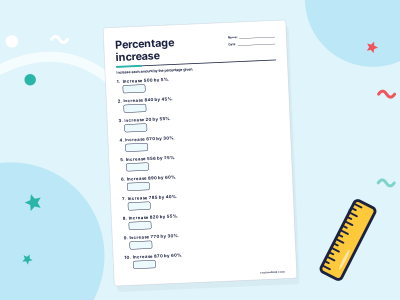
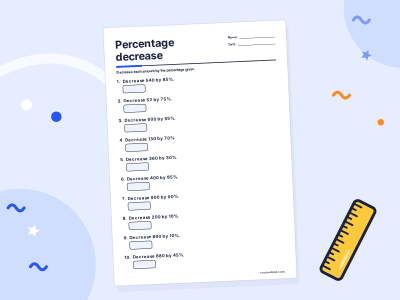
Percentages worksheets
Practise it step by step in a full course: Grade 10 Maths
For grown-ups
Related topics

Percentages
A percentage is a number out of 100, written with the sign %. So 25% means 25 out of every 100, which is the same as one quarter.

Powers and indices
A power (also called an index or exponent) is a small raised number showing how many times to multiply a number by itself. So 2⁴ means 2 × 2 × 2 × 2 = 16.
Money
Money maths means counting coins and notes, adding up prices and working out change. Most currencies split one unit into 100 smaller ones, like 100 pence in a pound.

Sequences
A sequence is a list of numbers or shapes that follows a rule, like 3, 7, 11, 15 (add 4 each time). Each item is called a term.

Direct proportion
Two quantities are in direct proportion when one is always the same multiple of the other, so doubling one doubles the other. The rule is y = kx, where k is the constant of proportionality.
Profit and loss
Profit = selling price − cost price; loss = cost price − selling price. Profit percentage = profit ÷ cost price × 100. Buy at $20, sell at $25: profit $5, which is 25%.