Maths
How do you calculate profit, loss and profit percentage?
Quick answer
Profit = selling price − cost price; loss = cost price − selling price. Profit percentage = profit ÷ cost price × 100. Buy at $20, sell at $25: profit $5, which is 25%.


In one sentence
If you sell something for more than it cost you, the difference is a profit; if you sell it for less, the difference is a loss.
Explained
Every profit-and-loss question has two prices. The cost price (CP) is what you paid for something, or what it cost to make. The selling price (SP) is what you sell it for. Compare them:
- If SP is bigger than CP, you made a profit: Profit = SP − CP.
- If SP is smaller than CP, you made a loss: Loss = CP − SP.
- If they are equal, you broke even: no profit and no loss.
 shop
 bag
 juice
A profit of $5 means something different on a $10 item and on a $1,000 item. That is why we often give profit as a percentage of the cost price:
Profit % = profit ÷ cost price × 100 and Loss % = loss ÷ cost price × 100
Buy a T-shirt for $8 and sell it for $10: the profit is $2, and 2 ÷ 8 × 100 = 25%. Notice that we divide by the cost price, the amount you started with. "Gain" is another word for profit, so gain percentage is the same thing.
You can also go the other way. To sell at a 25% profit, the selling price must be 125% of the cost, so you multiply by 1.25. To sell at a 25% loss, you get 75% of the cost, so you multiply by 0.75. These numbers are called multipliers:
SP = CP × (1 + profit % ÷ 100) and SP = CP × (1 − loss % ÷ 100)
Working backwards is a "reverse percentage": if a coat sold for $90 at a 20% profit, then $90 is 120% of the cost, so the cost was 90 ÷ 1.2 = $75. Do not just take 20% off $90!
Businesses also talk about profit margin, which is profit as a percentage of the selling price. Buy at $60, sell at $80: the profit is $20, the profit percentage (markup) is 20 ÷ 60 ≈ 33.3%, but the margin is 20 ÷ 80 = 25%. Always check which one a question wants. (A "profit and loss statement" is a company report that lists all its income and costs for a period to show the overall profit or loss. It uses the same subtraction, just with many more numbers.)
Examples
| Cost price | Selling price | Profit or loss | Percentage |
|---|---|---|---|
| $40 | $50 | profit $10 | 10 ÷ 40 = 25% profit |
| $120 | $150 | profit $30 | 30 ÷ 120 = 25% profit |
| $80 | $60 | loss $20 | 20 ÷ 80 = 25% loss |
| $250 | $270 | profit $20 | 20 ÷ 250 = 8% profit |
| $200 | $170 | loss $30 | 30 ÷ 200 = 15% loss |
Worked example: a class lemonade stall spends $12 on lemons, sugar and cups and sells 30 cups at $0.75 each. Money taken = 30 × 0.75 = $22.50. Profit = 22.50 − 12 = $10.50. Profit % = 10.50 ÷ 12 × 100 = 87.5%.
Common mistakes
- Dividing by the selling price. Fix: profit % uses the cost price (the starting amount) unless the question says "margin".
- Taking the percentage off the wrong number when working backwards. Fix: if $60 includes a 20% profit, divide by 1.2 to get $50; do not subtract 20% of $60.
- Forgetting all the costs. Fix: add every cost (ingredients, cups, transport) before you subtract.
- Mixing up profit and selling price. Fix: re-read the question. "Find the profit" is the difference; "find the selling price" is the new price.
Step by step
Step by step
- Find the cost priceAdd up everything that was spent.
- Find the selling priceAdd up all the money taken from sales.
- SubtractSP − CP. A positive answer is a profit; a negative answer means a loss of that size.
- Turn it into a percentageDivide the profit (or loss) by the cost price and multiply by 100.
- Check it makes senseA 100% profit means you doubled your money; a loss can never be more than 100%.
Practice questions
Profit and loss
Try each one, then check your answer.
- CP $30, SP $45. Find the profit.
Show answer
45 − 30 = $15 profit - CP $75, SP $60. Find the profit or loss.
Show answer
75 − 60 = $15 loss - CP $40, SP $50. Find the profit percentage.
Show answer
10 ÷ 40 × 100 = 25% - CP $200, SP $230. Find the profit percentage.
Show answer
30 ÷ 200 × 100 = 15% - CP $80, SP $68. Find the loss percentage.
Show answer
Loss = 12; 12 ÷ 80 × 100 = 15% loss - CP $25, SP $36. Find the profit percentage.
Show answer
11 ÷ 25 × 100 = 44% - An item costs $60. Find the selling price for a 20% profit.
Show answer
60 × 1.2 = $72 - An item costs $150 and is sold at a 30% loss. Find the selling price.
Show answer
150 × 0.7 = $105 - An item costs $45. Find the selling price for a 40% profit.
Show answer
45 × 1.4 = $63 - An item sold for $84 made a 20% profit. Find the cost price.
Show answer
84 ÷ 1.2 = $70 - An item sold for $72 made a 10% loss. Find the cost price.
Show answer
72 ÷ 0.9 = $80 - CP $60, SP $80. Find the profit percentage and the profit margin.
Show answer
Profit 20: 20 ÷ 60 ≈ 33.3% profit, 20 ÷ 80 = 25% margin - You buy 12 pens for $9 in total and sell each for $1. Find the profit percentage.
Show answer
SP = $12, profit = $3; 3 ÷ 9 × 100 ≈ 33.3% - A shop buys apples at 3 for $2 and sells them at 2 for $3. Find the profit percentage.
Show answer
For 6 apples: CP = $4, SP = $9, profit = $5; 5 ÷ 4 × 100 = 125% - Two phones are each sold for $60. One makes a 20% profit, the other a 20% loss. Is there an overall profit or loss?
Show answer
Costs: 60 ÷ 1.2 = $50 and 60 ÷ 0.8 = $75, total $125. Sales $120, so a loss of $5 (4%).
Word problems
Profit and loss in real life
Try each one, then check your answer.
- A bake sale spends $18 on ingredients and sells 24 cupcakes at $1.50 each. Find the profit and the profit percentage.
Show answer
24 × 1.50 = $36; profit = $18, which is 18 ÷ 18 = 100% - Sam buys a bike for $120 and sells it a year later for $90. Find the loss percentage.
Show answer
Loss = $30; 30 ÷ 120 × 100 = 25% loss - A shop buys T-shirts for $8 and sells them for $14. Find the profit percentage, and the profit on 50 shirts.
Show answer
6 ÷ 8 = 75%; 50 × $6 = $300 - Mia paid $40 for a second-hand game and wants a 15% profit. What should she sell it for?
Show answer
40 × 1.15 = $46 - A phone case is sold for $27 at a 35% profit. What did it cost the shop?
Show answer
27 ÷ 1.35 = $20 - A stall buys 50 mangoes for $25. Ten go bad, and the rest are sold for $0.80 each. Find the profit percentage.
Show answer
40 × 0.80 = $32; profit $7; 7 ÷ 25 × 100 = 28%
Questions people ask
How do you calculate profit and loss?
Subtract the cost price from the selling price. If the answer is positive it is a profit; if the selling price is smaller, the difference (CP − SP) is a loss.
What is the profit percentage formula?
Profit % = (selling price − cost price) ÷ cost price × 100. Buy at $40 and sell at $50: 10 ÷ 40 × 100 = 25%.
What is the loss percentage formula?
Loss % = (cost price − selling price) ÷ cost price × 100. Buy at $80 and sell at $60: 20 ÷ 80 × 100 = 25% loss.
What is the difference between profit percentage and profit margin?
Profit percentage (also called markup) divides the profit by the cost price; profit margin divides it by the selling price. For CP $60 and SP $80, the profit percentage is about 33.3% but the margin is 25%.
How do you find the cost price from the selling price?
Turn the percentage into a multiplier and divide. After a 25% profit, SP is 125% of CP, so CP = SP ÷ 1.25. After a 10% loss, CP = SP ÷ 0.9.
What is a profit and loss statement?
It is a report from a business (also called an income statement or P&L) listing its income and its costs over a period, such as a year. The bottom line shows whether there was a profit or a loss overall.
What is gain percentage?
It is another name for profit percentage: the gain divided by the cost price, times 100.
Quick quiz
Profit and loss
Check what you know with 5 quick questions.
Question 1 of 5
You buy a game for $20 and sell it for $25. What is the profit percentage?
Practise it
Try it
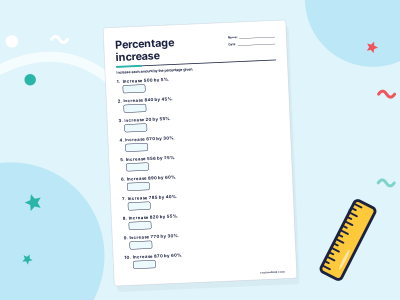
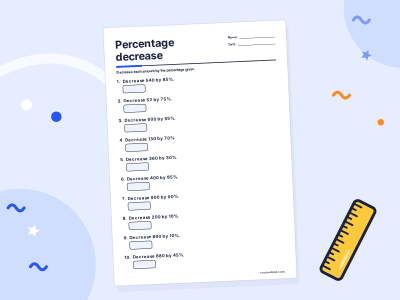
Practise percentage increase and decrease
Percentages worksheets
Practise it step by step in a full course: Grade 8 Maths
For grown-ups
Related topics
Percentages
A percentage is a number out of 100, written with the sign %. So 25% means 25 out of every 100, which is the same as one quarter.
Money
Money maths means counting coins and notes, adding up prices and working out change. Most currencies split one unit into 100 smaller ones, like 100 pence in a pound.

Decimals
Decimals are numbers with a decimal point. Digits after the point show tenths, hundredths and so on, so 2.5 means two and five tenths.
Ratio
A ratio compares two or more amounts, written with a colon. A ratio of 2:3 means for every 2 of one thing there are 3 of the other.

Compound interest and simple interest
Simple interest is paid only on the starting amount: I = P × r × t. Compound interest is also paid on earlier interest: A = P(1 + r)ⁿ. $1,000 at 10% for 2 years: $1,200 simple, $1,210 compound.

Direct proportion
Two quantities are in direct proportion when one is always the same multiple of the other, so doubling one doubles the other. The rule is y = kx, where k is the constant of proportionality.