Maths
What is a ratio?
Quick answer
A ratio compares two or more amounts, written with a colon. A ratio of 2:3 means for every 2 of one thing there are 3 of the other.
In one sentence
A ratio tells you how much of one thing there is compared with another.
Explained
Picture a jug of lemonade made from 1 cup of lemon juice and 4 cups of water. The ratio of juice to water is 1 to 4, written 1:4. Make a bigger jug with 2 cups of juice and 8 cups of water, and it tastes exactly the same, because the ratio 2:8 is the same as 1:4.
 lemon
lemon juice
juice cup
cup- cup
- cup
- cup
Order matters. "Juice to water is 1:4" is not the same as "water to juice is 1:4". Always check which amount comes first.
You simplify a ratio just like a fraction: divide every part by the same number. 10:15 becomes 2:3 (divide by 5). 18:24:30 becomes 3:4:5 (divide by 6). Scaling up works the same way with multiplication.
Ratios and fractions are related but not identical. If cats and dogs at a shelter are in the ratio 3:2, there are 3 + 2 = 5 parts altogether. So ⅗ of the animals are cats and ⅖ are dogs. The fraction compares a part with the whole; the ratio compares a part with another part.
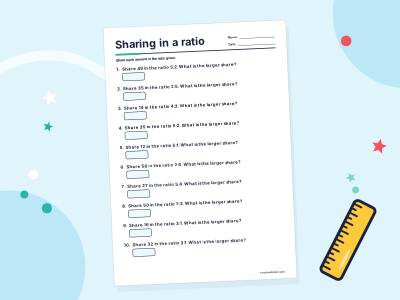
Sharing in a ratio is a classic problem. To share 40 sweets between Kemi and Tom in the ratio 3:5, add the parts (3 + 5 = 8), find one part (40 ÷ 8 = 5), then multiply: Kemi gets 3 × 5 = 15 and Tom gets 5 × 5 = 25. Check: 15 + 25 = 40.
Examples
| Situation | Ratio |
|---|---|
| 6 apples to 9 oranges | 6:9 = 2:3 |
| Map scale, 1 cm to 1 km | 1:100 000 |
| Recipe: 200 g flour to 100 g butter | 2:1 |
| Share 60 in 1:2:3 | 10, 20 and 30 |
Worked example: a recipe for 4 people uses 300 g of rice. For 6 people, scale by 6 ÷ 4 = 1.5, so use 450 g.
Common mistakes
- Swapping the order, writing boys:girls when asked for girls:boys. Fix: write the labels above the numbers.
- Dividing by the wrong total. Sharing in 3:5 means dividing by 8, not by 3 or 5.
- Adding instead of multiplying to scale: 2:3 is not the same as 4:5. Fix: multiply both parts by the same number, giving 4:6.
Quick quiz
Ratio
Check what you know with 4 quick questions.
Question 1 of 4
A class has 12 girls and 15 boys. What is the ratio of girls to boys in its simplest form?
Practise it
Try it
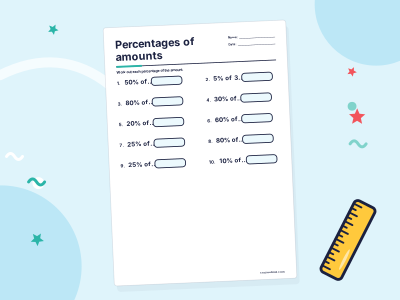
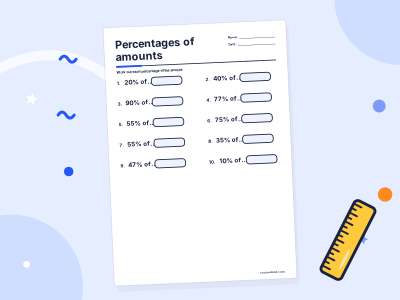
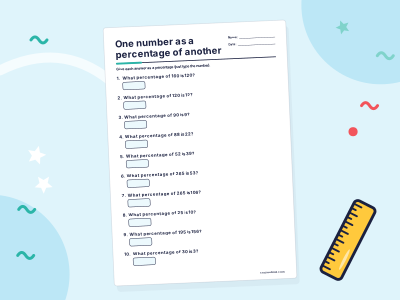
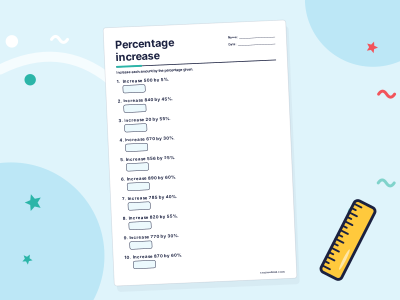
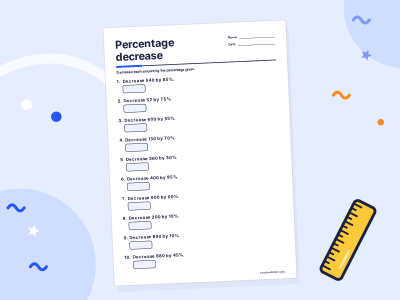
Ratio and percentage practice
For grown-ups
Related topics
Fractions
A fraction is part of a whole that has been split into equal parts. In ¾, the bottom number says how many equal parts and the top says how many you have.
Percentages
A percentage is a number out of 100, written with the sign %. So 25% means 25 out of every 100, which is the same as one quarter.
Multiplication
Multiplication is adding equal groups quickly. 4 × 3 means 4 groups of 3 (or 3 groups of 4), which makes 12. The answer is called the product.
Division
Division is sharing into equal groups, or finding how many groups fit. The sign is ÷, so 12 ÷ 3 = 4. The answer is called the quotient.
Algebra
Algebra is maths that uses letters, like x or n, to stand for numbers we don't know yet or numbers that can change. For example, if n + 3 = 10, then n = 7.
Equations
An equation says two things are equal, using an = sign, like 2x + 1 = 9. Solving it means finding the value of the letter that makes it true, here x = 4.