Crayonbird
Menu

Maths · Ages 5–6 · 40 minutes

Telling the time to o'clock and half past

Children read and show o'clock and half past times on an analogue clock and explain what each hand tells them.

Success criteria

  • I can find the hour hand and the minute hand
  • I can read o'clock times
  • I can read half past times

Key vocabulary

  • clock
  • hour hand
  • minute hand
  • o'clock
  • half past
  • hour
  • minute

You will need

  • a large demonstration clock with geared hands
  • one small cardboard clock per child or pair
  • a paper plate and split pin for each child (optional)
  • Year 1· England
  • Kindergarten· United States
  • Primary 1· Nigeria
  • Class 1· India

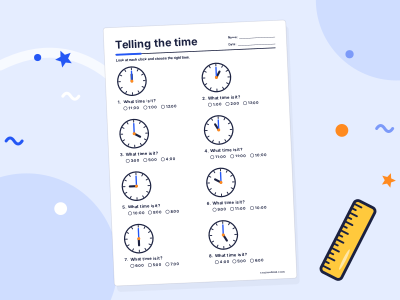
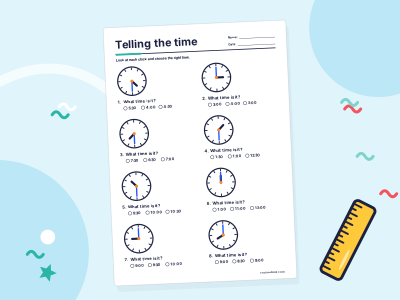
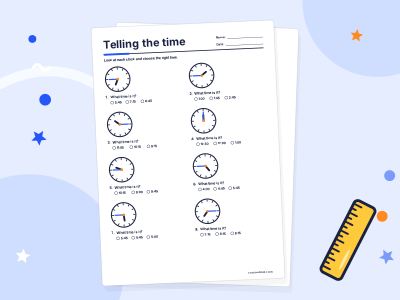
Practice sheets

Generated fresh each time you press a button, and marked instantly on screen.

The lesson at a glance

40 minutes in all. Timings are a guide: follow your class.

  1. Step 1: Starter

    Talk about the school day.
    6 minutes
  2. Step 2: Teach

    Use the large clock. "A clock has two hands.
    12 minutes
  3. Step 3: Guided practice

    Each child has a small clock.
    8 minutes
  4. Step 4: Independent practice

    Use the practice buttons above.
    10 minutes
  5. Step 5: Plenary

    Set the big clock to half past 6 but with the hour hand pointing straight at 6.
    4 minutes
  6. Step 6: Assessment for learning

    Look for children who: tell the hour hand from the minute hand without hesitation; check the long hand first; read the hour correctly at half past (the number just passed).
  7. Step 7: Differentiation

    Children who are not yet secure should only work with o'clock times today and use a clock with a coloured hour hand.
  8. Step 8: Common misconceptions

    Mixing up the two hands.
  9. Step 9: Home link

    Each evening, look at a clock together at an o'clock or half past time and ask your child to read it.

1.Starter

6 minutes

Talk about the school day. "What time do we have lunch? What time do you go to bed?" Show the class clock. "How do we know what time it is? The clock tells us, if we can read it."

Count round the clock face together from 1 to 12, pointing to each number. "What comes after 12?" (1 again: the clock goes round and round.)

2.Teach

12 minutes

Use the large clock. "A clock has two hands. The short hand is the hour hand. The long hand is the minute hand."

Set the clock to 3 o'clock. "The long hand points straight up to 12. When it points to 12, it's o'clock. Now I look at the short hand. It points to 3. So it's 3 o'clock."

Step by step

  1. Look at the long hand firstIs it pointing to 12 (o'clock) or to 6 (half past)?
  2. Look at the short handWhich number is it on, or which number has it just gone past?
  3. Say the time"7 o'clock" or "half past 7".

Now move the minute hand slowly from 12 all the way round to 6, so children see the hour hand creep too. "The long hand has gone half way round. Half past. Where's the short hand? It's half way between 3 and 4. It's half past 3."

"At half past, the short hand is never right on the number. It's moved half way to the next one. We use the number it has just passed."

  • clock
  • sun
  • moon
Morning and night times are easy to talk about with o'clock times.

The rest of the plan

Guided and independent practice, the plenary, assessment for learning, differentiation, common misconceptions and the home link are free with a Crayonbird account.

  1. Guided practice8 minutes
  2. Independent practice10 minutes
  3. Plenary4 minutes
  4. Assessment for learning
  5. Differentiation
  6. Common misconceptions
  7. Home link

Learning Wiki

Telling the time

To tell the time on a clock, read the short hand for the hour and the long hand for the minutes. When the long hand points to 6, it is half past the hour.

Counting

Counting means saying one number for each thing in a group, in order, to find out how many there are. The last number you say is the total.

Number bonds

Number bonds are pairs of numbers that add up to a given total, like 3 and 7 making 10. Knowing them by heart makes adding and subtracting much faster.

  • Maths · Ages 5–6 · 45 min

    2D shapes and their properties

    Children name common 2D shapes and describe them by counting their sides and corners, whatever their size, colour or which way round they are.

  • Maths · Ages 5–6 · 45 min

    Number bonds to 10

    Children find and recall the pairs of whole numbers that make 10 and use a ten frame to explain how they know.

  • Maths · Ages 6–7 · 50 min

    The 2, 5 and 10 times tables

    Children count in steps of 2, 5 and 10, connect skip counting to multiplication facts, and spot the patterns that help them check an answer.