Maths
How do you tell the time on a clock?
Quick answer
To tell the time on a clock, read the short hand for the hour and the long hand for the minutes. When the long hand points to 6, it is half past the hour.
In one sentence
To tell the time on a clock, the short hand shows the hour and the long hand shows the minutes past that hour.
Explained
A clock face has the numbers 1 to 12 around it and two hands. The short hand (hour hand) moves slowly and tells you the hour. The long hand (minute hand) goes all the way round once every hour.
 clock
clock sun
sun moon
moon
Start with the easy times:
- O'clock: the long hand points straight up to 12. If the short hand points to 9, it is 9 o'clock.
- Half past: the long hand points down to 6. It has gone half way round, so 30 minutes have passed.
- Quarter past: the long hand points to 3, a quarter of the way round (15 minutes).
- Quarter to: the long hand points to 9. There are 15 minutes left until the next hour.
Each number is worth 5 minutes for the long hand, so you can count in fives from the 12: the 1 means 5 minutes, the 2 means 10, the 4 means 20, and so on. That is why the 5 times table is so handy here.
A tricky detail: at half past 9, the short hand is halfway between 9 and 10, not on the 9. Read the number it has just passed.
Digital clocks show the time in numbers. 8:20 means 20 minutes past 8. Some use the 24-hour clock, which counts the hours from 00 at midnight to 23. After midday, add 12: 2:30 pm is 14:30. On a 12-hour clock, am means morning (before midday) and pm means afternoon and evening.
Examples
| Analogue | Words | Digital | 24-hour |
|---|---|---|---|
| short hand on 7, long on 12 | 7 o'clock (evening) | 7:00 pm | 19:00 |
| short hand past 2, long on 6 | half past 2 | 2:30 | 02:30 or 14:30 |
| short hand near 11, long on 9 | quarter to 11 | 10:45 | 10:45 or 22:45 |
| short hand past 4, long on 4 | twenty past 4 | 4:20 | 04:20 or 16:20 |
Time is not decimal: there are 60 minutes in an hour, so 1:50 plus 20 minutes is 2:10, not 1:70.
Common mistakes
- Mixing up the hands. Fix: the long hand has the long job of going all the way round every hour; the short hand only creeps from one number to the next.
- Saying "quarter to 10" as 10:45. Quarter to 10 is 9:45.
- Adding time like ordinary numbers. Fix: count up to the next o'clock first, then add the rest.
Quick quiz
Telling the time
Check what you know with 5 quick questions.
Question 1 of 5
The short hand points to 4 and the long hand points to 12. What time is it?
Practise it
Try it
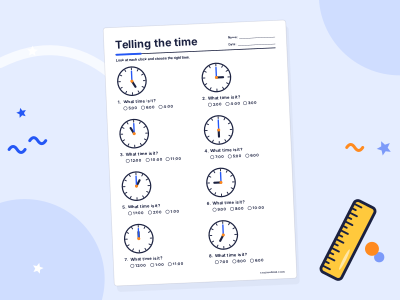
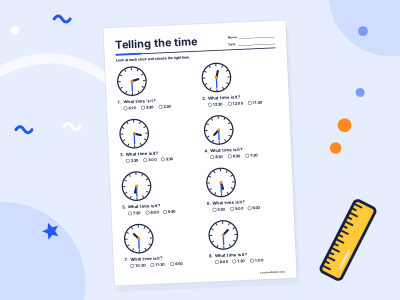
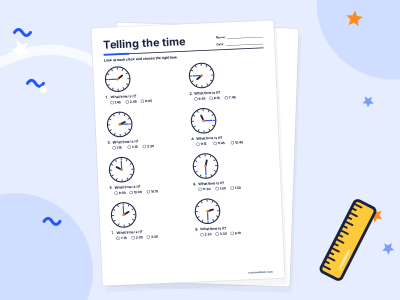
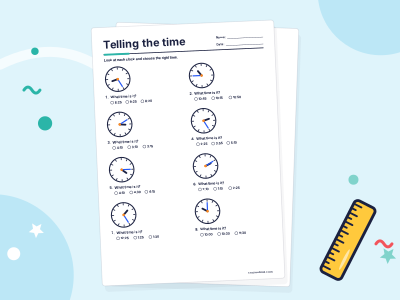
Telling the time worksheets
For grown-ups
Related topics
Counting
Counting means saying one number for each thing in a group, in order, to find out how many there are. The last number you say is the total.
Times tables
Times tables are lists of the multiplication facts for a number, such as 3 × 1 = 3 up to 3 × 12 = 36. Knowing them by heart speeds up almost all later maths.
Fractions
A fraction is part of a whole that has been split into equal parts. In ¾, the bottom number says how many equal parts and the top says how many you have.
Angles
An angle measures the amount of turn between two lines that meet at a point. Angles are measured in degrees (°); a right angle is 90° and a full turn is 360°.
2D shapes
2D shapes are flat shapes with length and width but no thickness, like circles, triangles, squares and hexagons. You can draw them on paper.
3D shapes
3D shapes are solid shapes with length, width and height, like cubes, spheres, cylinders and pyramids. They have faces, edges and vertices.