Crayonbird
Menu

Maths · Ages 5–6 · 45 minutes

2D shapes and their properties

Children name common 2D shapes and describe them by counting their sides and corners, whatever their size, colour or which way round they are.

Success criteria

  • I can name circles squares triangles and rectangles
  • I can count sides and corners
  • I can spot a shape even when it is turned

Key vocabulary

  • shape
  • side
  • corner
  • straight
  • curved
  • circle
  • triangle
  • square
  • rectangle
  • pentagon
  • hexagon

You will need

  • a feely bag
  • plastic or card 2D shapes in different sizes and colours
  • lolly sticks and playdough
  • mini whiteboards
  • Year 1· England
  • Kindergarten· United States
  • Primary 1· Nigeria
  • Class 1· India

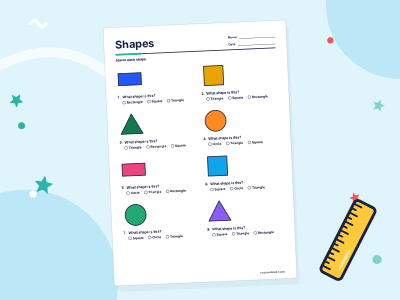
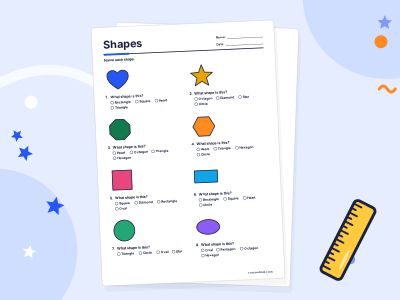
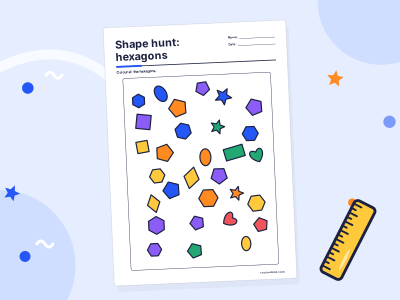
Practice sheets

Generated fresh each time you press a button, and marked instantly on screen.

The lesson at a glance

45 minutes in all. Timings are a guide: follow your class.

  1. Step 1: Starter

    Feely bag. One child puts a hand in and describes a shape without looking: "It's got straight sides...
    7 minutes
  2. Step 2: Teach

    Hold up a large triangle.
    12 minutes
  3. Step 3: Guided practice

    Pairs make shapes with lolly sticks and playdough corners.
    10 minutes
  4. Step 4: Independent practice

    Use the practice buttons above.
    12 minutes
  5. Step 5: Plenary

    Hold up a shape behind a book and reveal it slowly, one side at a time.
    4 minutes
  6. Step 6: Assessment for learning

    Look for children who: name a shape correctly when it's turned or a different size; count sides and corners systematically without missing or repeating; use the words side and corner when describing.
  7. Step 7: Differentiation

    Children who need support should handle and trace real shapes, with a dot on the first corner to count from.
  8. Step 8: Common misconceptions

    A turned square is a "diamond" and no longer a square.
  9. Step 9: Home link

    Go on a shape hunt at home and count the sides and corners of things you find, like a door, a plate or a book.

1.Starter

7 minutes

Feely bag. One child puts a hand in and describes a shape without looking: "It's got straight sides... it's got pointy corners... three of them." The class guesses. Do three shapes. Ask: "What helped you guess?" Write the words "side" and "corner" on the board.

2.Teach

12 minutes

Hold up a large triangle. "Let's count its sides. A side is a straight edge." Run your finger along each side: 1, 2, 3. "Now its corners. A corner is where two sides meet." Touch each: 1, 2, 3. "Three sides, three corners. Tri means three."

Do the same for a square (4 equal sides, 4 corners), a rectangle (4 sides, 4 corners, two long and two short) and a circle ("one curved side and no corners").

Then turn the square on its point. "Is it still a square?" Children often say "it's a diamond now". "Count its sides. Are they still equal? Still four corners? Turning a shape doesn't change what it is."

Step by step

  1. Count the sidesRun your finger along each straight edge.
  2. Count the cornersTouch each point where two sides meet.
  3. Name it3 sides is a triangle, 4 sides could be a square or rectangle, 5 is a pentagon, 6 is a hexagon.

Show a long, thin triangle and an upside-down one. "Still triangles? How do you know?" (Three sides, three corners.)

The rest of the plan

Guided and independent practice, the plenary, assessment for learning, differentiation, common misconceptions and the home link are free with a Crayonbird account.

  1. Guided practice10 minutes
  2. Independent practice12 minutes
  3. Plenary4 minutes
  4. Assessment for learning
  5. Differentiation
  6. Common misconceptions
  7. Home link

Learning Wiki

2D shapes

2D shapes are flat shapes with length and width but no thickness, like circles, triangles, squares and hexagons. You can draw them on paper.

3D shapes

3D shapes are solid shapes with length, width and height, like cubes, spheres, cylinders and pyramids. They have faces, edges and vertices.

Symmetry

A shape has symmetry when one half is a mirror image of the other (line symmetry), or when it looks the same after being turned (rotational symmetry).

  • Maths · Ages 5–6 · 45 min

    Number bonds to 10

    Children find and recall the pairs of whole numbers that make 10 and use a ten frame to explain how they know.

  • Maths · Ages 6–7 · 50 min

    The 2, 5 and 10 times tables

    Children count in steps of 2, 5 and 10, connect skip counting to multiplication facts, and spot the patterns that help them check an answer.