Crayonbird
Menu

Maths · Ages 6–7 · 50 minutes

The 2, 5 and 10 times tables

Children count in steps of 2, 5 and 10, connect skip counting to multiplication facts, and spot the patterns that help them check an answer.

Success criteria

  • I can count in 2s 5s and 10s
  • I can write a times fact from equal groups
  • I can use a pattern to check my answer

Key vocabulary

  • multiply
  • times
  • lots of
  • groups of
  • multiple
  • skip count
  • pattern

You will need

  • a 100 square
  • pairs of socks or shoes for the 2s
  • hands for the 5s
  • ten frames for the 10s
  • mini whiteboards
  • Year 2· England
  • Grade 1· United States
  • Primary 2· Nigeria
  • Class 2· India

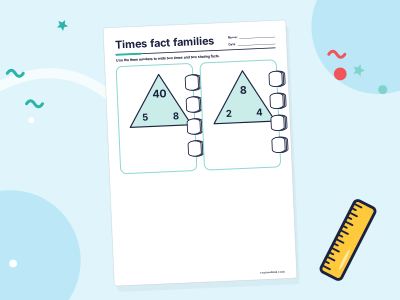
Practice sheets

Generated fresh each time you press a button, and marked instantly on screen.

The lesson at a glance

50 minutes in all. Timings are a guide: follow your class.

  1. Step 1: Starter

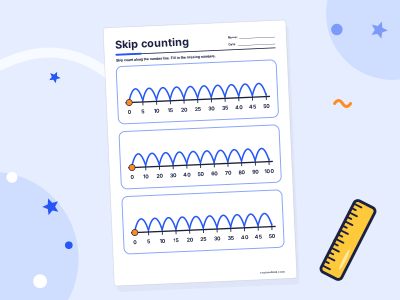
    Count in 10s to 100 and back, clapping on each number.
    8 minutes
  2. Step 2: Teach

    Show 4 pairs of socks.
    12 minutes
  3. Step 3: Guided practice

    On whiteboards. Show a picture of equal groups (or real objects); children write the times fact.
    10 minutes
  4. Step 4: Independent practice

    Use the practice buttons above.
    15 minutes
  5. Step 5: Plenary

    "True or false?" Children show thumbs: 6 × 10 = 60 7 × 5 = 34 9 × 2 = 18 45 is in the 2 times table For each false one, ask how the pattern gives it away.
    5 minutes
  6. Step 6: Assessment for learning

    Look for children who: skip count accurately and keep track of the number of steps on fingers; recall some facts instantly (usually the 10s first); use a pattern to check, not just to answer.
  7. Step 7: Differentiation

    Children who lose count can use a number line or a 100 square with the multiples already coloured.
  8. Step 8: Common misconceptions

    Losing track of how many steps have been counted.
  9. Step 9: Home link

    Count in 2s with pairs of shoes by the door, in 5s with fingers on hands, and in 10s with coins, and say the times fact together.

1.Starter

8 minutes

Count in 10s to 100 and back, clapping on each number. Then count in 5s to 50 while children hold up one hand at a time, standing in a line so the class can see the hands grow. Finish with 2s to 20 using pairs of shoes.

Ask: "Six children each held up one hand. How many fingers?" Children count in 5s along the line: 5, 10, 15, 20, 25, 30.

2.Teach

12 minutes

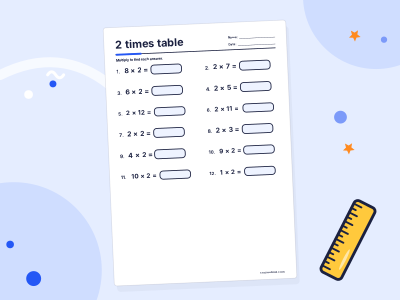
Show 4 pairs of socks. "How many socks? I could count every sock, but they come in 2s. 2, 4, 6, 8. Four lots of 2 is 8. We write that as 4 × 2 = 8."

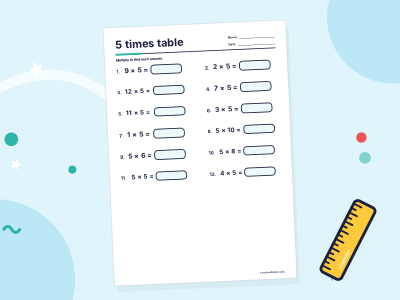
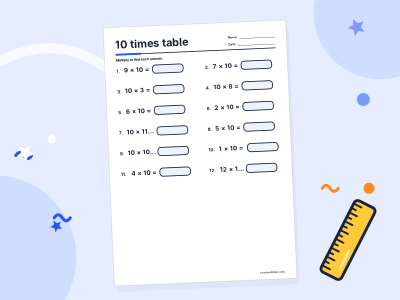
Do the same with 3 hands (3 × 5 = 15) and 6 ten frames (6 × 10 = 60).

Then shade the multiples on a 100 square: 2s in one colour, 5s in another, 10s circled.

"Look at the patterns. The 10s all end in 0. The 5s end in 5 or 0. The 2s end in 0, 2, 4, 6 or 8; those are the even numbers."

Step by step

  1. Spot the equal groupsWhat size is each group: 2, 5 or 10?
  2. Skip countCount in that step, one step per group, with a finger for each group.
  3. Write the fact and check the pattern7 × 5 = 35 ends in 5, so it could be right. 7 × 5 = 36 can't be.

"Here's a useful shortcut: 3 × 5 and 5 × 3 give the same answer. Three hands or five pairs of three. Times facts work both ways round."

  • hand
  • sock
  • shoe
Hands, socks and shoes are ready-made groups of 5 and 2.

The rest of the plan

Guided and independent practice, the plenary, assessment for learning, differentiation, common misconceptions and the home link are free with a Crayonbird account.

  1. Guided practice10 minutes
  2. Independent practice15 minutes
  3. Plenary5 minutes
  4. Assessment for learning
  5. Differentiation
  6. Common misconceptions
  7. Home link

Learning Wiki

Times tables

Times tables are lists of the multiplication facts for a number, such as 3 × 1 = 3 up to 3 × 12 = 36. Knowing them by heart speeds up almost all later maths.

Number bonds

Number bonds are pairs of numbers that add up to a given total, like 3 and 7 making 10. Knowing them by heart makes adding and subtracting much faster.

Odd and even numbers

Even numbers can be split into two equal groups or pairs with none left over (2, 4, 6…). Odd numbers always leave one left over (1, 3, 5…).

  • Maths · Ages 6–7 · 50 min

    Adding within 20 on a number line

    Children add two numbers within 20 by counting on along a number line, starting from the larger number.

  • Maths · Ages 6–7 · 45 min

    Halves and quarters

    Children find halves and quarters of shapes and small amounts and explain that the parts must be equal.