Crayonbird
Menu

Maths · Ages 6–7 · 45 minutes

Halves and quarters

Children find halves and quarters of shapes and small amounts and explain that the parts must be equal.

Success criteria

  • I can split a shape into 2 or 4 equal parts
  • I can find half and a quarter of an amount
  • I can explain why the parts must be equal

Key vocabulary

  • half
  • halves
  • quarter
  • quarters
  • equal
  • whole
  • share
  • fraction

You will need

  • paper squares and circles for folding
  • counters
  • paper plates
  • a slice of bread or a paper "pizza"
  • mini whiteboards
  • Year 2· England
  • Grade 1· United States
  • Primary 2· Nigeria
  • Class 2· India

Practice sheets

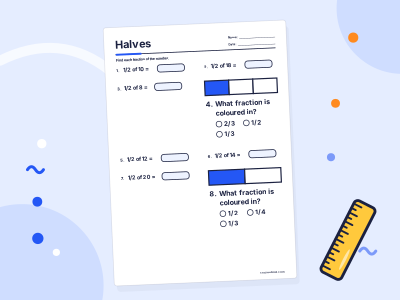
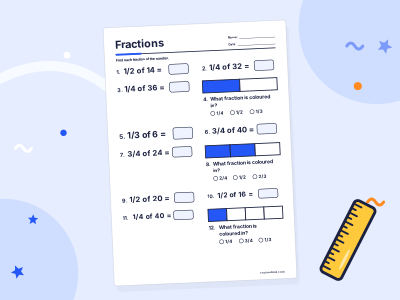
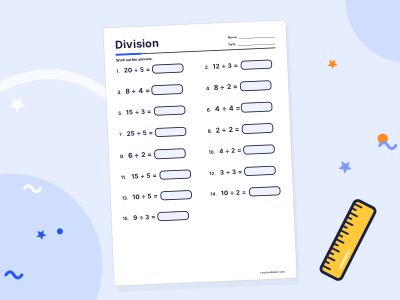
Generated fresh each time you press a button, and marked instantly on screen.

The lesson at a glance

45 minutes in all. Timings are a guide: follow your class.

  1. Step 1: Starter

    Hold up a paper "pizza" cut into two pieces: one big, one small.
    7 minutes
  2. Step 2: Teach

    "A half is one of two equal parts.
    12 minutes
  3. Step 3: Guided practice

    Pairs with counters and plates.
    10 minutes
  4. Step 4: Independent practice

    Use the practice buttons above.
    12 minutes
  5. Step 5: Plenary

    "Is it true? Half of 10 is 5.
    4 minutes
  6. Step 6: Assessment for learning

    Look for children who: check that parts are equal before calling them halves or quarters; share counters one at a time rather than guessing; use "half of a half" to find a quarter.
  7. Step 7: Differentiation

    Children who need support should fold and cut real shapes and use counters for every amount question.
  8. Step 8: Common misconceptions

    Thinking any split into two parts is a half.
  9. Step 9: Home link

    Cut toast, a sandwich or a fruit into halves and quarters together and ask "Are the parts equal?

1.Starter

7 minutes

Hold up a paper "pizza" cut into two pieces: one big, one small. "I'll have this half and you have that half. Fair?" Children will protest. "Why isn't it fair?" Draw out the key word: the pieces aren't equal.

Quick fold: every child folds a paper square in half. Compare: some fold edge to edge, some corner to corner. "Are these both halves?" (Yes, as long as the two parts match.)

2.Teach

12 minutes

"A half is one of two equal parts. A quarter is one of four equal parts." Write 1/2 and 1/4. "The bottom number tells us how many equal parts the whole is split into. The top number tells us how many parts we're talking about."

Fold the square in half, then in half again. Open it up: four equal parts. "Each part is one quarter. Two quarters cover the same as one half."

Now amounts. Put 8 counters on the board. "Half of 8: share them between 2 plates." Deal them: 4 each. "Half of 8 is 4." Then share 8 between 4 plates: 2 each. "A quarter of 8 is 2."

Step by step

  1. Count the partsHalves mean 2 equal parts, quarters mean 4.
  2. Share equallyDeal counters one at a time onto 2 or 4 plates.
  3. Count one partThat's your half or your quarter.

"Here's a trick. A quarter is half of a half. Half of 8 is 4; half of 4 is 2. So a quarter of 8 is 2."

  • pizza
  • bread
  • orange
Food is the easiest way to argue about whether halves are fair.

The rest of the plan

Guided and independent practice, the plenary, assessment for learning, differentiation, common misconceptions and the home link are free with a Crayonbird account.

  1. Guided practice10 minutes
  2. Independent practice12 minutes
  3. Plenary4 minutes
  4. Assessment for learning
  5. Differentiation
  6. Common misconceptions
  7. Home link

Learning Wiki

Fractions

A fraction is part of a whole that has been split into equal parts. In ¾, the bottom number says how many equal parts and the top says how many you have.

Equivalent fractions

Equivalent fractions look different but are the same size, like 1/2, 2/4 and 4/8. You make them by multiplying or dividing the top and bottom by the same number.

Number bonds

Number bonds are pairs of numbers that add up to a given total, like 3 and 7 making 10. Knowing them by heart makes adding and subtracting much faster.

  • Maths · Ages 6–7 · 50 min

    The 2, 5 and 10 times tables

    Children count in steps of 2, 5 and 10, connect skip counting to multiplication facts, and spot the patterns that help them check an answer.

  • Maths · Ages 6–7 · 50 min

    Adding within 20 on a number line

    Children add two numbers within 20 by counting on along a number line, starting from the larger number.