Crayonbird
Menu

Maths · Ages 6–7 · 45 minutes

Comparing numbers with <, > and =

Children compare two-digit numbers using tens first and write the comparison with <, > or =.

Success criteria

  • I can compare the tens first
  • I can look at the ones when the tens match
  • I can use < > and = correctly

Key vocabulary

  • greater than
  • less than
  • equal to
  • compare
  • more
  • fewer
  • symbol

You will need

  • base-ten blocks or straw bundles
  • a number line 0–100
  • symbol cards < > =
  • mini whiteboards
  • Year 2· England
  • Grade 1· United States
  • Primary 2· Nigeria
  • Class 2· India

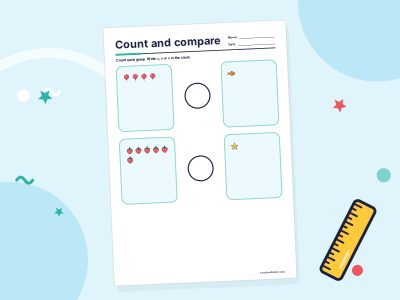
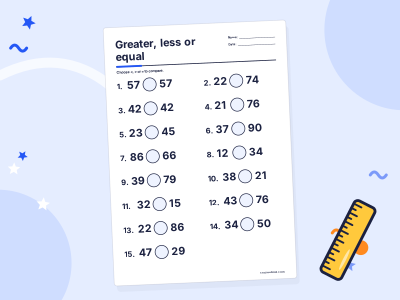
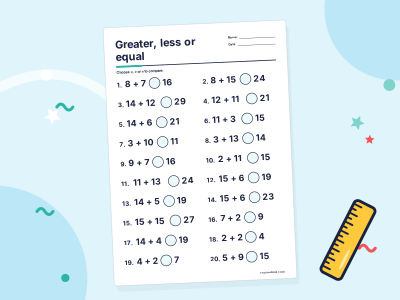
Practice sheets

Generated fresh each time you press a button, and marked instantly on screen.

The lesson at a glance

45 minutes in all. Timings are a guide: follow your class.

  1. Step 1: Starter

    Show two groups of cubes: 6 and 9.
    7 minutes
  2. Step 2: Teach

    Write 47 and 52 on the board.
    12 minutes
  3. Step 3: Guided practice

    Hand out symbol cards.
    10 minutes
  4. Step 4: Independent practice

    Use the practice buttons above.
    12 minutes
  5. Step 5: Plenary

    Write three statements.
    4 minutes
  6. Step 6: Assessment for learning

    Look for children who: compare tens before ones, rather than looking at the last digit; read the symbols as words correctly from left to right; use = when the numbers are the same, instead of leaving the gap empty.
  7. Step 7: Differentiation

    Children who need support should build both numbers with blocks before choosing a symbol.
  8. Step 8: Common misconceptions

    Looking at the ones first (thinking 39 > 41 because 9 > 1).
  9. Step 9: Home link

    Compare two prices, house numbers or bus numbers when you're out and ask "Which is greater?

1.Starter

7 minutes

Show two groups of cubes: 6 and 9. "Which group has more? How do you know?" Then two towers: 14 and 41. Children decide without counting each cube. Someone will say "the one with 4 tens", which is exactly where the lesson goes.

Quick whiteboard round: "Write a number bigger than 30 but smaller than 40."

2.Teach

12 minutes

Write 47 and 52 on the board. Build each with tens and ones.

"To compare, I look at the tens first because tens are worth more. 47 has 4 tens; 52 has 5 tens. Five tens is more, so 52 is greater. I don't need to look at the ones."

Write 47 < 52. "The symbol is like an arrow. The pointy end points at the smaller number, and the open side faces the bigger one. Read it from left to right: 47 is less than 52."

Step by step

  1. Compare the tensThe number with more tens is greater.
  2. If the tens match, compare the ones63 and 68 both have 6 tens, so look at the ones.
  3. Choose the symbolThe open side faces the greater number. If they're the same, use =.

Then try 63 and 68 together: tens match, 3 ones is less than 8 ones, so 63 < 68. Finally, show 29 and 92. "Same digits. Which is greater? Why?" Place a dot for each on the number line to check.


The rest of the plan

Guided and independent practice, the plenary, assessment for learning, differentiation, common misconceptions and the home link are free with a Crayonbird account.

  1. Guided practice10 minutes
  2. Independent practice12 minutes
  3. Plenary4 minutes
  4. Assessment for learning
  5. Differentiation
  6. Common misconceptions
  7. Home link

Learning Wiki

Place value

Place value means a digit's value depends on its position in a number. In 352, the 3 is worth 300, the 5 is worth 50 and the 2 is worth 2.

Number line

A number line is a straight line with numbers marked at equal steps, smallest on the left and biggest on the right. It helps you count, compare, add and subtract.

Number bonds

Number bonds are pairs of numbers that add up to a given total, like 3 and 7 making 10. Knowing them by heart makes adding and subtracting much faster.

  • Maths · Ages 6–7 · 50 min

    Place value with tens and ones

    Children show two-digit numbers with tens and ones and explain what each digit is worth.

  • Maths · Ages 6–7 · 50 min

    The 2, 5 and 10 times tables

    Children count in steps of 2, 5 and 10, connect skip counting to multiplication facts, and spot the patterns that help them check an answer.

  • Maths · Ages 6–7 · 50 min

    Adding within 20 on a number line

    Children add two numbers within 20 by counting on along a number line, starting from the larger number.