Crayonbird
Menu

Maths · Ages 6–7 · 50 minutes

Adding within 20 on a number line

Children add two numbers within 20 by counting on along a number line, starting from the larger number.

Success criteria

  • I can start at the bigger number
  • I can count on in jumps
  • I can check with a number line

Key vocabulary

  • add
  • total
  • count on
  • number line
  • jump
  • start
  • land

You will need

  • number lines 0–20 (one per child)
  • a floor number line or masking tape and chalk
  • mini whiteboards
  • counters
  • Year 2· England
  • Grade 1· United States
  • Primary 2· Nigeria
  • Class 2· India

Practice sheets

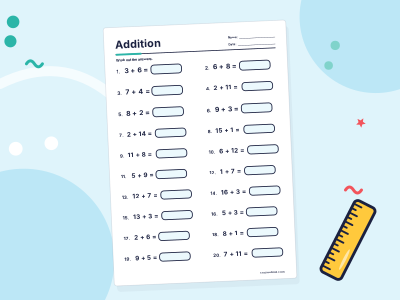
Generated fresh each time you press a button, and marked instantly on screen.

The lesson at a glance

50 minutes in all. Timings are a guide: follow your class.

  1. Step 1: Starter

    Count forwards from different start numbers.
    8 minutes
  2. Step 2: Teach

    Use the floor number line.
    12 minutes
  3. Step 3: Guided practice

    Each child has a number line and a whiteboard.
    10 minutes
  4. Step 4: Independent practice

    Use the practice buttons above.
    15 minutes
  5. Step 5: Plenary

    Show a mistake on the board: 8 + 4 drawn as hops starting on 8 and counting "8, 9, 10, 11", giving 11.
    5 minutes
  6. Step 6: Assessment for learning

    Look for children who: start at the larger number without a reminder; count the start number as a hop (the most common slip, see below); bridge through 10 using bonds instead of single hops.
  7. Step 7: Differentiation

    Children who are not yet secure can use counters on top of the number line, sliding one along for each hop.
  8. Step 8: Common misconceptions

    Counting the start number as the first hop (8 + 4 = 11).
  9. Step 9: Home link

    On a walk or up the stairs, start on a number step and ask your child to "count on 4": where do they land?

1.Starter

8 minutes

Count forwards from different start numbers. "Start at 7 and count on four." Children whisper 8, 9, 10, 11 and hold up a finger for each number. Repeat from 12 and from 15.

Then ask: "Is 3 + 9 easier if I start at 3 or at 9?" Take votes and leave the question open. The lesson will answer it.

2.Teach

12 minutes

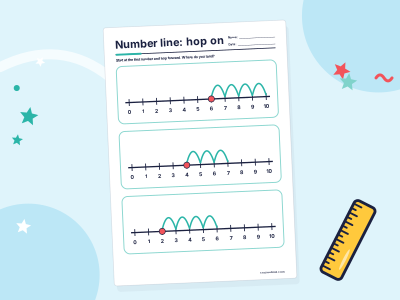
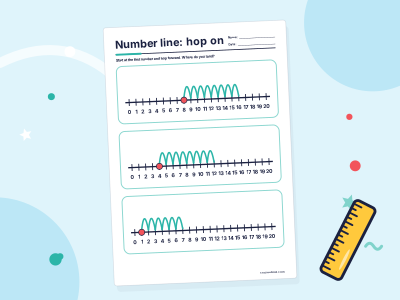
Use the floor number line. Ask a child to be the frog.

"Our frog starts at 8. We want to add 5. The frog doesn't jump from zero; it starts on 8 and hops forward one at a time." Count each hop together as the child moves: 9, 10, 11, 12, 13. "Where did the frog land? 13. So 8 + 5 = 13."

Model on a drawn number line with curved hops above it. Point out: "I don't count the number I start on. The first hop takes me to 9."

Step by step

  1. Find the bigger numberPut your finger on it. That's your start.
  2. Count on the smaller numberOne hop for each, saying the number you land on.
  3. Read where you landThat's the total. Write the number sentence.

Now go back to the starter question. Model 3 + 9 both ways: nine hops from 3, then three hops from 9. "Same answer. Which was quicker? Starting from the bigger number means fewer hops, and fewer hops means fewer chances to slip."

  • frog
  • ruler
  • pencil
A hopping frog is a handy picture for counting on.

The rest of the plan

Guided and independent practice, the plenary, assessment for learning, differentiation, common misconceptions and the home link are free with a Crayonbird account.

  1. Guided practice10 minutes
  2. Independent practice15 minutes
  3. Plenary5 minutes
  4. Assessment for learning
  5. Differentiation
  6. Common misconceptions
  7. Home link

Learning Wiki

Number bonds

Number bonds are pairs of numbers that add up to a given total, like 3 and 7 making 10. Knowing them by heart makes adding and subtracting much faster.

Addition

Addition is putting amounts together to find a total. The sign is +, and the answer is called the sum or total, so 4 + 3 = 7.

Odd and even numbers

Even numbers can be split into two equal groups or pairs with none left over (2, 4, 6…). Odd numbers always leave one left over (1, 3, 5…).

  • Maths · Ages 7–8 · 50 min

    Column addition with exchanging

    Children add two-digit numbers using the column method, lining up digits by place value and exchanging ten ones for one ten.

  • Maths · Ages 5–6 · 45 min

    Number bonds to 10

    Children find and recall the pairs of whole numbers that make 10 and use a ten frame to explain how they know.

  • Maths · Ages 6–7 · 50 min

    The 2, 5 and 10 times tables

    Children count in steps of 2, 5 and 10, connect skip counting to multiplication facts, and spot the patterns that help them check an answer.