Crayonbird
Menu

Maths · Ages 6–7 · 50 minutes

Place value with tens and ones

Children show two-digit numbers with tens and ones and explain what each digit is worth.

Success criteria

  • I can make a number with tens and ones
  • I can say what each digit is worth
  • I can read a number from a picture of tens and ones

Key vocabulary

  • tens
  • ones
  • digit
  • place value
  • worth
  • partition
  • exchange

You will need

  • bundles of 10 straws and loose straws (or base-ten blocks)
  • place-value mats
  • digit cards 0–9
  • mini whiteboards
  • Year 2· England
  • Grade 1· United States
  • Primary 2· Nigeria
  • Class 2· India

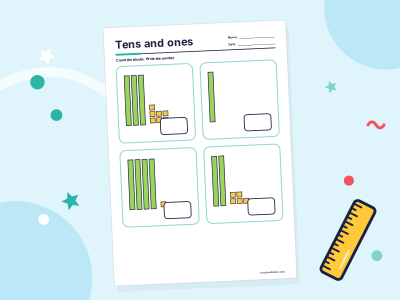
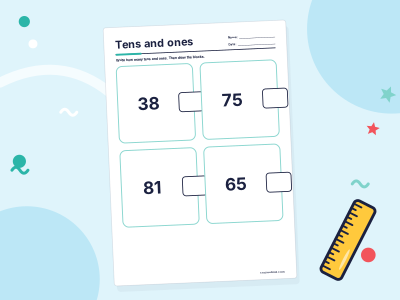
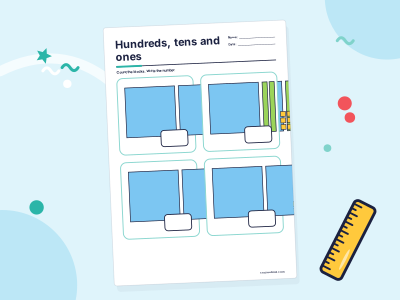
Practice sheets

Generated fresh each time you press a button, and marked instantly on screen.

The lesson at a glance

50 minutes in all. Timings are a guide: follow your class.

  1. Step 1: Starter

    Count in tens from 0 to 100 together, then back.
    8 minutes
  2. Step 2: Teach

    Tip out 34 loose straws.
    12 minutes
  3. Step 3: Guided practice

    In pairs with straws or blocks.
    10 minutes
  4. Step 4: Independent practice

    Use the practice buttons above.
    15 minutes
  5. Step 5: Plenary

    Write 7 and 70 on the board.
    5 minutes
  6. Step 6: Assessment for learning

    Look for children who: read the tens digit as a number of tens ("the 5 means fifty"); put zero in the ones place without prompting; can exchange ten ones for one ten.
  7. Step 7: Differentiation

    Children who are not yet secure should build every number with straws before writing it.
  8. Step 8: Common misconceptions

    Thinking the 3 in 34 is worth 3.
  9. Step 9: Home link

    Group 10 coins, pasta pieces or crayons in bundles of ten and ask your child how many there are altogether.

1.Starter

8 minutes

Count in tens from 0 to 100 together, then back. Then count in tens from 4: 4, 14, 24, 34. "What stays the same? What changes?" Children should notice that the ones digit stays the same.

Quick fire on whiteboards: "Write the number that is ten more than 23." Repeat with 41 and 70.

2.Teach

12 minutes

Tip out 34 loose straws. "How many? Counting one by one would take ages. Let's make bundles of ten." Bundle three tens with elastic bands while children count. Four are left over.

"Three bundles of ten and four ones. That's 30 and 4, which makes 34."

Put them on a place-value mat: tens on the left, ones on the right. Write 34 above. Point to the 3: "This 3 isn't worth three. It's worth three tens: thirty." Point to the 4: "This one is worth four ones."

Step by step

  1. Make tensGroup in tens wherever you can.
  2. Count the tens, then the ones"three tens, four ones".
  3. Say what each digit is worth"the 3 is worth 30, the 4 is worth 4, and 30 + 4 = 34".

Now swap the digits: 43. "Same digits. Is it the same number?" Build it: four bundles and three loose straws. "Place changes value. That's why it's called place value."

Show one tricky case: 40. "Four tens and no ones. The zero holds the ones place, so we don't mix 40 up with 4."


The rest of the plan

Guided and independent practice, the plenary, assessment for learning, differentiation, common misconceptions and the home link are free with a Crayonbird account.

  1. Guided practice10 minutes
  2. Independent practice15 minutes
  3. Plenary5 minutes
  4. Assessment for learning
  5. Differentiation
  6. Common misconceptions
  7. Home link

Learning Wiki

Place value

Place value means a digit's value depends on its position in a number. In 352, the 3 is worth 300, the 5 is worth 50 and the 2 is worth 2.

Number line

A number line is a straight line with numbers marked at equal steps, smallest on the left and biggest on the right. It helps you count, compare, add and subtract.

Number bonds

Number bonds are pairs of numbers that add up to a given total, like 3 and 7 making 10. Knowing them by heart makes adding and subtracting much faster.

  • Maths · Ages 6–7 · 50 min

    The 2, 5 and 10 times tables

    Children count in steps of 2, 5 and 10, connect skip counting to multiplication facts, and spot the patterns that help them check an answer.

  • Maths · Ages 6–7 · 50 min

    Adding within 20 on a number line

    Children add two numbers within 20 by counting on along a number line, starting from the larger number.