Crayonbird
Menu

Maths · Ages 4–5 · 30 minutes

Counting objects to 10

Children count up to 10 objects accurately by touching or moving each one once and know that the last number they say tells them how many there are.

Success criteria

  • I can touch each thing once
  • I can say one number for each thing
  • I know the last number is how many

Key vocabulary

  • count
  • how many
  • one more
  • total
  • same

You will need

  • counters or small toys
  • egg boxes or ten frames
  • a soft toy puppet
  • number cards 1–10
  • Reception· England
  • Pre-K· United States

Practice sheets

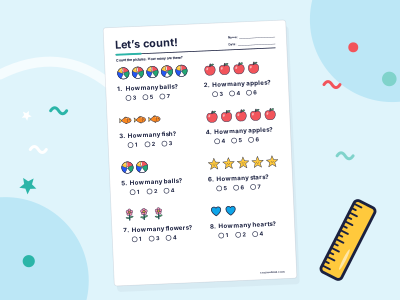
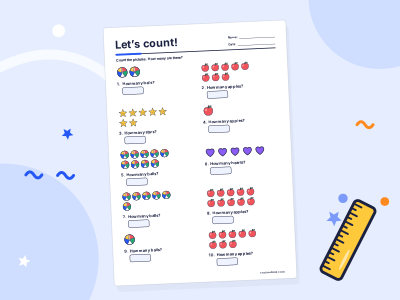
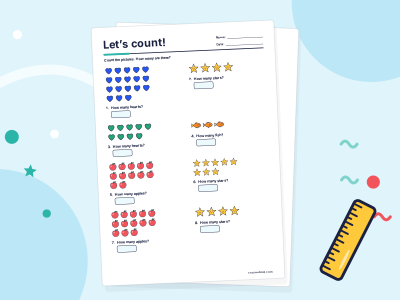
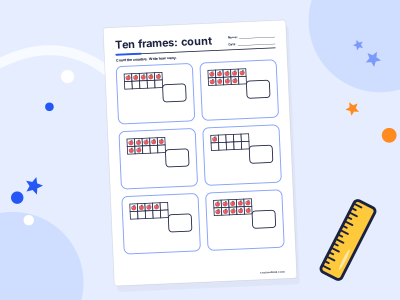
Generated fresh each time you press a button, and marked instantly on screen.

The lesson at a glance

30 minutes in all. Timings are a guide: follow your class.

  1. Step 1: Starter

    Sit in a circle with a puppet.
    5 minutes
  2. Step 2: Teach

    Put eight counters in a messy pile on a tray where everyone can see.
    10 minutes
  3. Step 3: Guided practice

    Children work in pairs with an egg box (or a ten frame) and a pot of counters.
    5 minutes
  4. Step 4: Independent practice

    Use the practice buttons above.
    7 minutes
  5. Step 5: Plenary

    Show a ten frame with 9 dots.
    3 minutes
  6. Step 6: Assessment for learning

    Look for children who: touch and say at the same speed (one-to-one correspondence); answer "how many?" with one number without recounting (cardinality); keep track of where they started in a scattered group.
  7. Step 7: Differentiation

    Keep groups for less confident counters to 5 and use objects they can pick up and drop into a tin ("clink" for each one).
  8. Step 8: Common misconceptions

    Saying numbers faster than touching.
  9. Step 9: Home link

    Count things you put away together at home, like spoons into a drawer or socks into a basket, and ask "So how many?" at the end.

1.Starter

5 minutes

Sit in a circle with a puppet. The puppet counts six blocks out loud but says "one, two, three, five, six, seven". Stop and look puzzled. "Hmm. Did Puppet count properly? What went wrong?" Let children explain, then count the blocks together, touching each one.

Finish with a quick clap-and-count: clap 4 times, children hold up 4 fingers. Repeat with 7 and 9.

2.Teach

10 minutes

Put eight counters in a messy pile on a tray where everyone can see.

"When I count, I need a plan. I take one counter and move it to this side. I say one number for each counter I move. Watch my hand and my mouth go together."

Step by step

  1. Move itSlide each object across a line as you count it, so nothing gets counted twice.
  2. One number, one objectSay the number as your finger lands, not before.
  3. Stop and tellThe last number you say is how many. "Eight. There are eight counters."

Now count the same eight counters in a line. "Do I have more now? Let's check." Count again: still eight. "Moving them didn't change how many."

Do one more with objects children can't move, like apples printed on a page: "When I can't move them, I touch each one and cross it off in my head, starting at the top."

  • apple
  • star
  • ball
  • fish
Counting pictures like these are on the practice sheets.

The rest of the plan

Guided and independent practice, the plenary, assessment for learning, differentiation, common misconceptions and the home link are free with a Crayonbird account.

  1. Guided practice5 minutes
  2. Independent practice7 minutes
  3. Plenary3 minutes
  4. Assessment for learning
  5. Differentiation
  6. Common misconceptions
  7. Home link

Learning Wiki

Counting

Counting means saying one number for each thing in a group, in order, to find out how many there are. The last number you say is the total.

Number bonds

Number bonds are pairs of numbers that add up to a given total, like 3 and 7 making 10. Knowing them by heart makes adding and subtracting much faster.

Odd and even numbers

Even numbers can be split into two equal groups or pairs with none left over (2, 4, 6…). Odd numbers always leave one left over (1, 3, 5…).

  • Maths · Ages 5–6 · 45 min

    2D shapes and their properties

    Children name common 2D shapes and describe them by counting their sides and corners, whatever their size, colour or which way round they are.

  • Maths · Ages 5–6 · 45 min

    Number bonds to 10

    Children find and recall the pairs of whole numbers that make 10 and use a ten frame to explain how they know.